
 AI Summary:
This recap covers all ten OxyCon 2026 sessions, from AI-guided dataset building and a browser-free approach to scraping dynamic content, to lessons on using AI in production, investigative debugging methods, and agentic workflow design. It also touches on the two panel discussions, one on the agentic web, one on the future of open data access, closing with a reflection on the themes that tied the day together.
It's wild how something you wait months for can somehow still catch you off guard when it finally happens. And then vanish just as fast! One minute we're counting down, the next we're waving goodbye to a room full of experts and thousands more tuning in from screens around the world. Numbers-wise and topic-wise, this was the biggest OxyCon yet: more speakers, more perspectives, and honestly, more moments that made the room go quiet in the best way.
If the day flew by for you too and you're already trying to piece it all back together, you're in the right place. Here's a recap to keep the memory fresh a little longer.
Welcome Word & Industry Overview
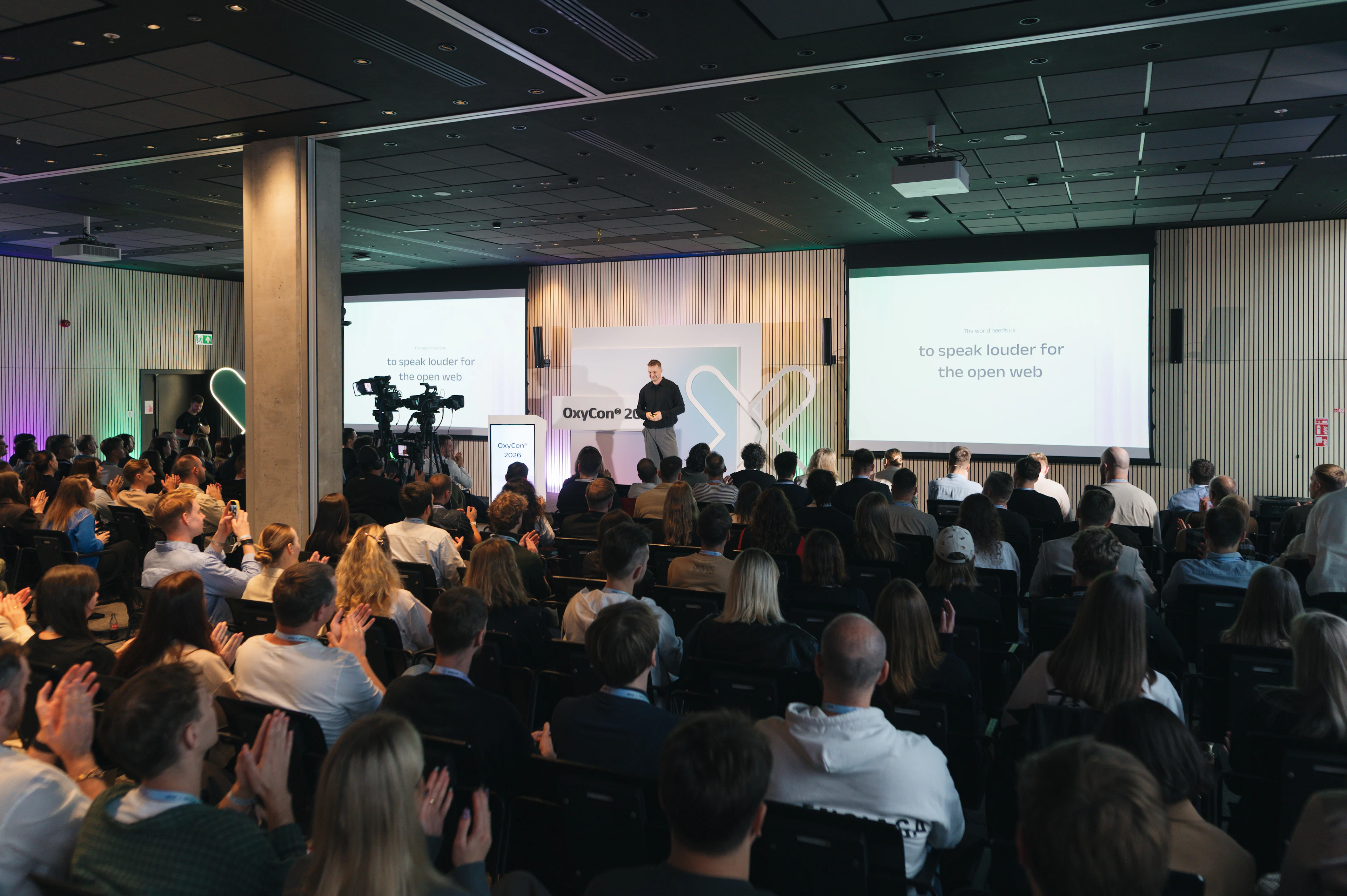
Vytautas Savickas, Group CEO @ Oxylabs
The day opened the way you'd hope it would – warm, direct, and with a clear sense of why everyone had actually shown up. Vytautas made the case for why the day's topics matter right now, backed by fresh numbers from a June 2026 global survey of 500 senior business decision-makers, conducted by Censuswide: 68% expect their web data needs to grow over the next year.
"The world needs us to speak louder for the open web."
— Vytautas Savickas
Your Next Dataset Starts with a Prompt
Andrius Kūkšta, Tech Lead @ Oxylabs
A strong, practical opener. Andrius walked through the all-too-familiar spiral of a "small" dataset request turning into a multi-day slog of site analysis, selector-hunting, and infrastructure headaches, and asked whether an LLM can really shortcut all that. His answer: only if you already know enough scraping to guide it. That's the gap Oxylabs' new AI-Guided Datasets solution closes, baking pagination logic, hidden API calls discovery, and selector-writing know-how directly into the model. Live on stage, we saw how an unfamiliar site can go from empty project to finished dataset in about half an hour.
"It's not the LLM helping you, it's you helping it."
— Andrius Kūkšta
Web Hydration: Loading Dynamic Content Without a Browser
Etienne Ellie, Lead Developer @ Scraping Bee
Etienne argued that the most expensive line in a scraping stack is often the one that launches a browser – not because it's slow, but because that cost repeats across every single page, at scale. He laid out a "cost ladder" for handling dynamic content: extract straight from the HTML when you can, replay the underlying API call when you can't, hydrate the page yourself with a lightweight DOM when there's no clean endpoint, and only reach for a full browser when you genuinely need a rendering engine.
"Reach for the browser last, not first."
— Etienne Ellie

Where AI Actually Helps in Production Scraping
Giedrius Šteimantas, Director of Scraping Engineering @ Oxylabs
Giedrius took on the "just use AI" reflex head-on. At Oxylabs, AI doesn't touch extraction itself, but works around the pipeline: keeping access reliable, helping parsers adapt as sites change, and clearing repetitive work off engineers' plates. He was candid that AI adoption can go two ways: real gains or a flood of "slop" – and that the fix starts with choosing the right metrics and listening to engineers rather than chasing raw output.
"Good AI makes engineers happy, who in turn build great things."
— Giedrius Šteimantas
The Cost of Solving the Wrong Problem: Data-Driven Decisions for Web Access
Kieron William Spearing & Juan Manuel Perez, Engineers @ Centric Software
Running thousands of crawlers means every hour of engineering time has to earn its place. Kieron and Juan shared their investigative mindset – a repeatable, almost forensic process for isolating exactly where and why a spider gets restricted, tested down to individual cURL requests, and used Akamai and DataDome as case studies for deciding where R&D effort actually moves the needle across a whole crawler fleet.
"Don't trust the tools to be 100% correct natively; invest in tools to check your tools."
— Kieron William Spearing
Agentic Workflows: Patterns Behind Successful AI Automation
Yenny Cheung, Vice President of Engineering @ Bluefish AI
Building for Fortune 500 clients leaves little room to experiment carelessly, so Yenny shared the framework Bluefish uses to bring AI into its dev lifecycle deliberately: automate the genuinely monotonous, keep humans in the loop where judgment matters, and keep people fully in charge where creativity and accountability count most. Her broader point – AI can't buy you taste, and as coding becomes commodity, planning becomes the step that determines quality.
"We can't throw away quality just to make way for speed."
— Yenny Cheung
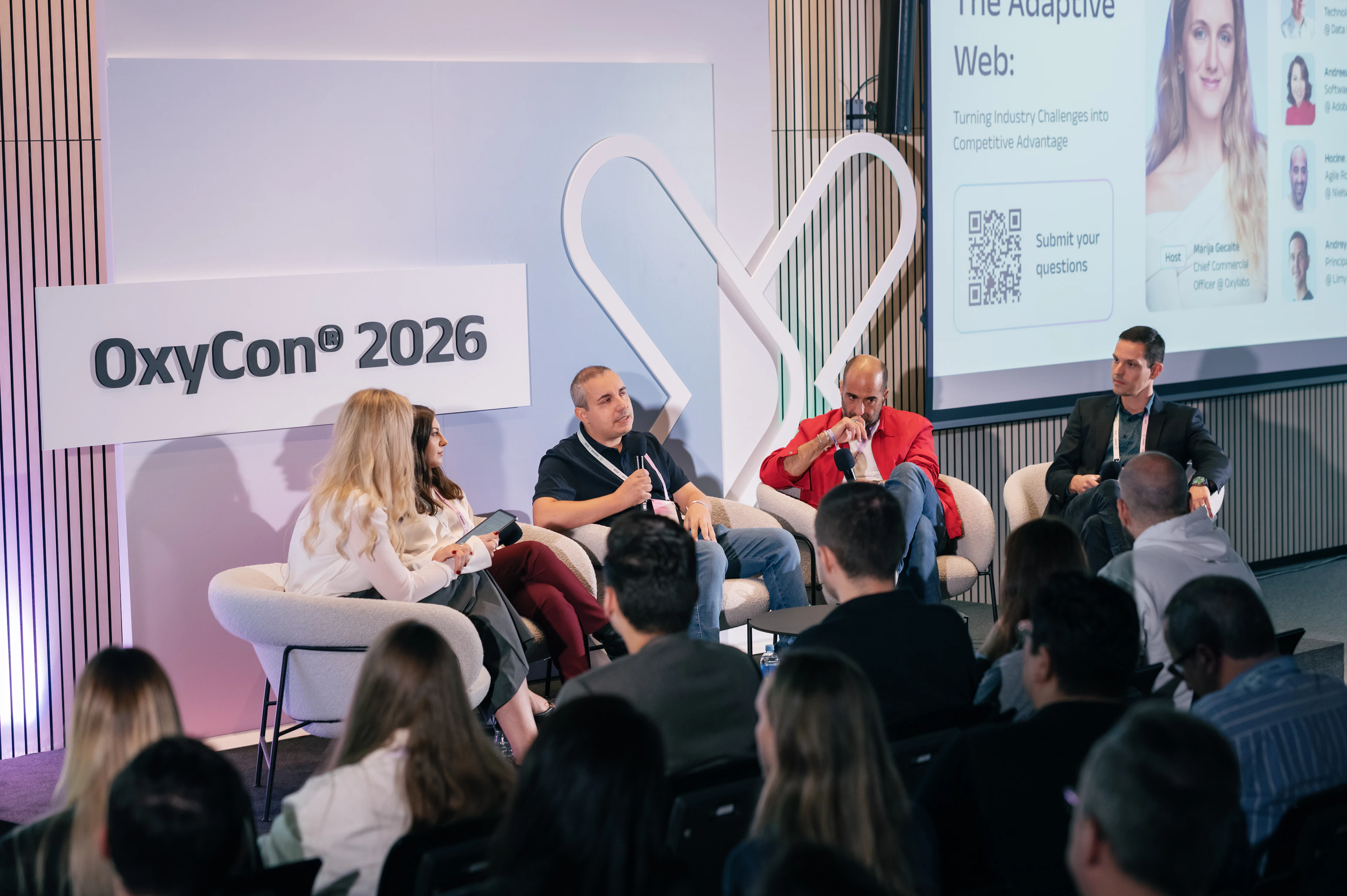
The Adaptive Web: Turning Industry Challenges into Competitive Advantage
Panel: Pierluigi Vinciguerra, Andreea Stroe, Hocine Amrane, Andrey Gourine; hosted by Marija Gecaitė
A panel that came in ready to spar but landed on a surprising amount of agreement. Host Marija pushed the group on provocative framing, including whether "the agentic web" is more buzzword than reality, and the discussion settled into common ground more often than conflict, with a shared, cautiously optimistic read that plenty of "AI problems" can be solved with better automation and prompting alone.
"Whatever you do, at the end of the day, there's a human who will step in."
— Hocine Amrane
We Made Our Web Search Worse on Purpose
Emilis Strimaitis, Head of Innovation @ Hostinger
Hostinger's five million customers mostly aren't engineers – they just want a working website and some competitor insight. Emilis explained how the team's launch instinct to feed their agent more (more search results, another tool, or additional agents) actually backfired: a model's context window is a fixed desk, and stuffing it with unrequested information just crowds out what the customer actually needs. Cutting the many agents down, as well as cutting search results down, both made the product simpler and more effective.
"The customer doesn't experience our architecture. They experience whether the conversation helped them get something done."
— Emilis Strimaitis
Is the Web Closing? What It Could Mean for Businesses, Journalists, and Researchers
Panel: Carl Miller, Paul Bradshaw, Krishna Sood; hosted by Denas Grybauskas
One of the most anticipated sessions of the day, given how many audiences it touches and how much uncertainty surrounds it, yet the panel came in confident and largely aligned. Krishna pointed to a growing asymmetry in data access across both policy and technology; Carl described a research field watching access shrink just as its analytical tools finally caught up; Paul reframed the debate entirely, arguing it's less about whether the web is closing and more about which parts need to stay open.
"The data picture is becoming bleaker and bleaker, more distant."
— Carl Miller
Best Open-Source Scraping Repositories of 2026
Tadas Gedgaudas, Founder @ TopYappers
Closing out the night, Tadas put HTTP, browser, and agent-based scraping engines through their paces head-to-head, separating what holds up from what just demos well – capped off with a first look at his new project, ScrapingArena.org, a live leaderboard for scraping tools.
"To know when to switch to a newer scraping engine, check three variables: higher success rate, lower resource usage, and faster request speed."
— Tadas Gedgaudas

Was there a common thread?
Look back at the event as a whole, and the three themes this year’s OxyCon was built around (AI-native extraction, adaptive infrastructure, and governance) showed up everywhere, just rarely in the ways you'd expect. AI kept appearing as a tool that works around the hard problems rather than a shortcut past them, the fastest systems were usually the ones doing the least unnecessary work rather than the most, and the panels made clear that questions of web access and openness aren't going anywhere soon.
Thank you, OxyCon 2026
A huge thank you to our 18 speakers, the guests who flew in from all over the world, the internal teams who pulled the event together, and our newest online audience members who kept us on our toes just as much as we hoped to impress them.
Keep an eye out for the on-demand videos, coming soon. And if you've got thoughts, suggestions for future events, or just want to tell us what this year's OxyCon was like from where you sat, drop us a line at events@oxylabs.io.
Forget about complex web scraping processes
Choose Oxylabs' advanced web intelligence collection solutions to gather real-time public data hassle-free.
About the author

Donata Norkūnaitė
Technical Copywriter
Dedicated to helping people discover and engage with technology, Donata enjoys finding new and creative ways to shape messages that resonate with our readers.
All information on Oxylabs Blog is provided on an "as is" basis and for informational purposes only. We make no representation and disclaim all liability with respect to your use of any information contained on Oxylabs Blog or any third-party websites that may be linked therein. Before engaging in scraping activities of any kind you should consult your legal advisors and carefully read the particular website's terms of service or receive a scraping license.
Related articles




Get the latest news from data gathering world
Scale up your business with Oxylabs®
Forget about complex web scraping processes
Choose Oxylabs' advanced web intelligence collection solutions to gather real-time public data hassle-free.