
Job Markets Shift, But Employer Priorities Don't: What 850,000 Tech Postings Reveal About the Skills That Always Matter

America’s July jobs report offered little comfort. Employers cut 23,000 positions. Labor Department revisions erased 103,000 more from prior months. The unemployment rate fell only because hundreds of thousands of Americans stopped looking for work altogether.
For those in tech roles – or trying to get one – the news arrives at an already disorienting moment. Companies have spent the better part of two years invoking artificial intelligence as grounds for layoffs, even as job postings for technical roles grew. In the first quarter of 2026, tech listings hit a three-year high.
That surge has likely cooled. But the underlying question remains: When employers do hire, what are they actually looking for?
An Oxylabs analysis of roughly 850,000 U.S. tech job postings published between January 2025 and March 2026 offers an answer – one that may disappoint anyone chasing the latest tech world buzzwords.
The most sought-after skills are not the ones generating excitement on social media or dominating developer conference agendas.
They are the unglamorous fundamentals: cloud platforms, version control, container orchestration. The infrastructure that keeps modern software running, AI included.
Hiring cycles come and go. These skills stay in demand.
Key Takeaways
AWS is the most in-demand tech tool, mentioned in 30% of all the analyzed listings.
Cloud dominates overall: nearly 42% of all analyzed job postings required knowledge of at least one of the three major cloud platforms (AWS, Azure, or Google Cloud Platform).
AWS and Azure appear together in 15% of job postings – the most co-mentioned duo in the dataset.
Excel knowledge can be considered a hygiene factor, especially for Data Entry & IT Support roles, where it is mentioned in 46% of all listings.
Tech hiring surged in 2026: the first quarter of 2026 accounted for 39% of all job postings in the dataset – 3.7 times more activity than in Q1 2025.
The picture we saw after analyzing close to a million job postings largely confirms what experienced developers would guess – cloud, infrastructure, and data skills are in high demand. Where it gets more interesting is in the proportions: cloud platforms and DevOps tooling dominate job ads even more heavily than survey-based rankings suggest, while some high-visibility skills (the ones trending on X or headlining conference talks) appear less often than you might think.
Andrius Kūkšta, Tech Lead at Oxylabs
Top 10 Most Mentioned Tech Tools in U.S. Job Postings
Although no single tool can unlock the entire tech job market for jobseekers, the one that comes closest is Amazon Web Services (AWS), appearing in 30% of all postings. It is followed by Microsoft Azure (24%), Git (21%), Excel (15%), Google Cloud Platform or GCP (14%), Kubernetes (14%), Docker (13%), Power BI (9%), Terraform (8%), and Tableau (7.5%).
What stands out at first glance is the shape of this list. Two of the top three tools are cloud platforms – and with GCP ranking fifth, cloud infrastructure emerges as the clear foundation of today’s enterprise tech stack.
Third is Git – a version control tool so ubiquitous across coding and data work that it has effectively become a baseline expectation rather than a differentiating skill. Fourth, somewhat surprisingly to those who follow the latest tech trends, is Excel.
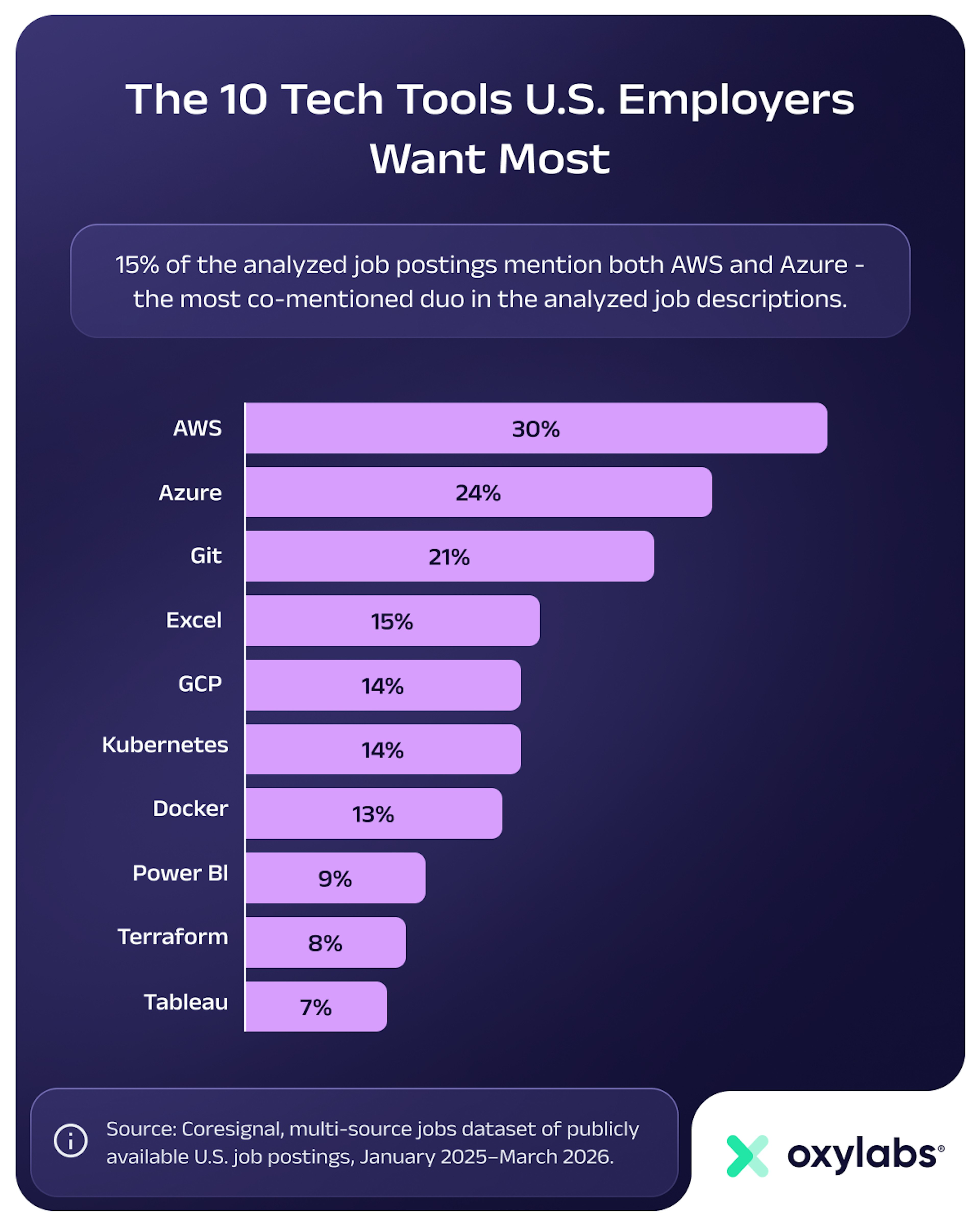
Cloud dominance doesn’t stop at the top. When counting how many job postings mention at least one of the three major cloud platforms – AWS, Azure, or GCP – the figure reaches nearly 42% of all analyzed postings. This suggests that cloud fluency has pretty much become a requirement for those considering a career in tech or seeking a more stable or lucrative position in the field.
Within the cloud category itself, AWS leads by a clear margin, mentioned 1.2 times more often than Azure and 2.1 times more than GCP. In the data warehousing space, Snowflake significantly outpaces BigQuery, appearing in roughly 6% of postings compared to BigQuery’s 2% – a gap that reflects Snowflake’s appeal as a platform-agnostic solution that can run across all cloud environments.
For DevOps tooling, Kubernetes (14%) edges ahead of Docker (13%), signaling that employers aren’t just looking for people who can build containers, but for those who can manage and scale them in production.
Two head-to-head comparisons in the data deserve particular attention. In business intelligence, Power BI has pulled ahead of Tableau – mentioned 1.2 times more frequently – likely driven by its deep integration into the Microsoft 365 ecosystem. And in the spreadsheet category, Excel is ahead of Google Sheets, and it is mentioned 38 times more often.
How Tech Tools Requirements are Distributed Across Tool Function Categories and Job Roles
The distribution of tool requirements across function categories reveals a market that is heavily weighted toward infrastructure and deployment, with more specialized data and analytics skills concentrated in narrower segments of the workforce.
Looking at the five broad tool categories analyzed, Data Storage and Infrastructure tools – primarily cloud platforms like AWS, Azure, and GCP – account for 47% of all tool mentions across tech job postings. DevOps and Developer Experience tools, led by Git and including Docker, Kubernetes, and Terraform, represent 30%.
Business Intelligence and Analytics tools – Power BI, Tableau, and Looker – account for 18%. Data Ingestion and Transformation tools such as dbt, Fivetran, Kafka, and Airbyte make up just 4%, while Orchestration and Observability tools like Airflow represent 1%.
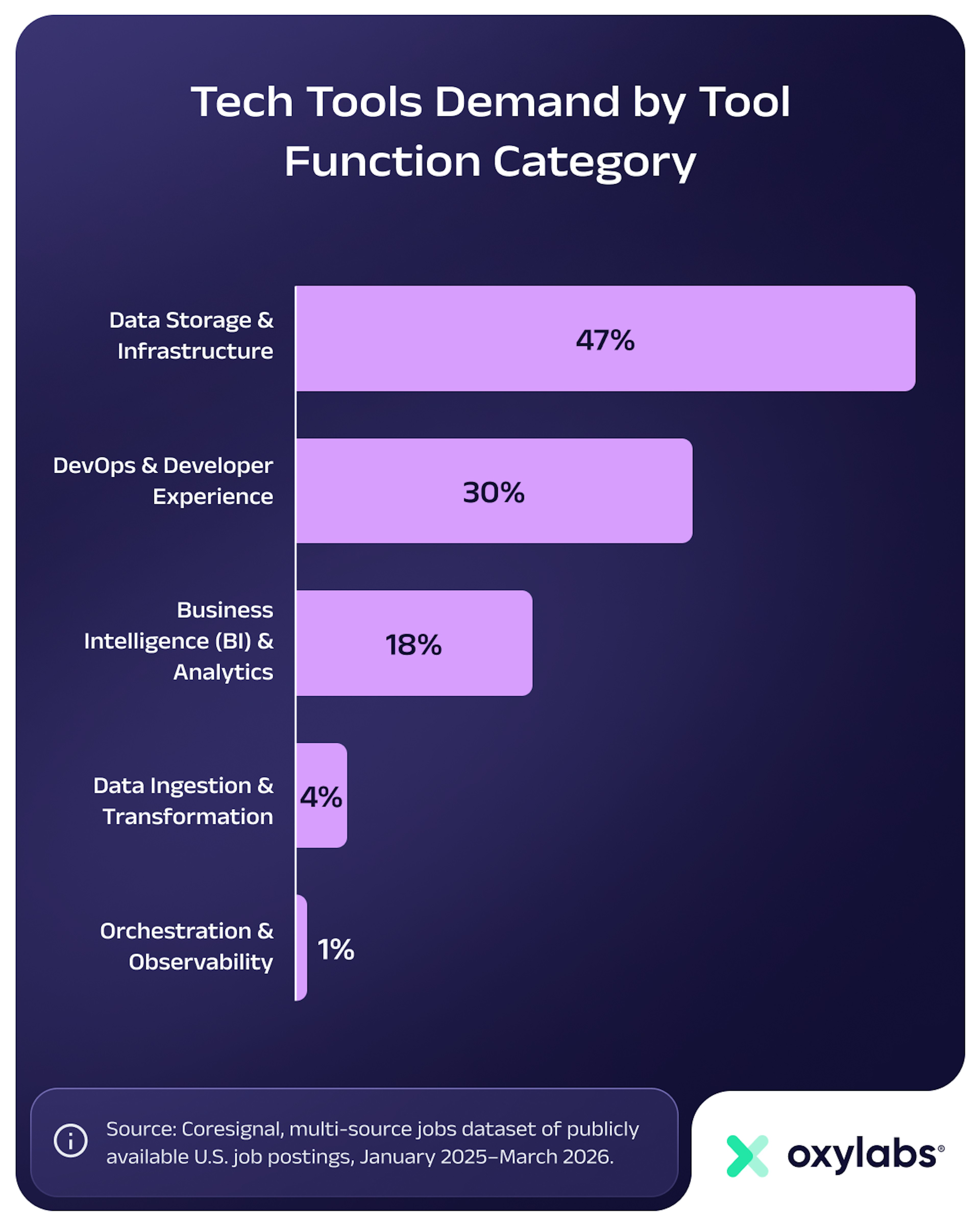
Skills related to working with large data are leading the way: data storage and cloud platforms claim the top spot, with BI and analytics tools close behind in third place. Companies are primarily focused on building and maintaining robust cloud environments, with version control and deployment tooling rounding out the top tier.
Business intelligence represents a secondary but still sizable need, appearing across a wide range of both technical and operational roles. Meanwhile, the more specialized pipeline tools – the ones data engineers use to move, clean, schedule, and monitor data – are required by a much smaller, highly specialized slice of the workforce.
This has practical implications for job seekers. Chasing the most ‘advanced’ or talked-about tools without building cloud fundamentals first is a risky strategy. The data suggests professionals should first identify their target role category, then master the toolset specific to that path.
Andrius Kūkšta, Tech Lead at Oxylabs
The role distribution itself reinforces this point. Software Engineering dominates the posting volume at 38% of all analyzed job listings. Data Science and AI/ML roles account for 14%, as does Tech and Engineering Management. DevOps, Cloud, and Site Reliability roles make up 12%, while Data Analysis and BI roles represent 11%.
Taken together, the top five role categories capture nearly 90% of all analyzed postings – meaning the vast majority of tech hiring is concentrated in a relatively small set of functional areas.
Which Tech Tools Top the List in Each Major Tech Role Category?
Breaking down tool requirements by job role reveals something the overall rankings can obscure: the same tools are not valued equally everywhere, and certain tools become dominant within specific domains.
For Software Engineers, AWS leads at 32% of postings, closely followed by Git at 31% – reflecting that version control is now treated as a baseline expectation for anyone writing or managing code.
Backend Developers see an even heavier infrastructure focus: AWS appears in 51% of listings, with Kubernetes (36%) and Docker (30%) also prominent, underscoring how closely backend work is tied to managing services at scale.
Full Stack Developers show a similar pattern, with AWS at 47% and Git at 40%. Frontend Developers have different requirements: Git leads at 34% while AWS drops to 20%, as frontend work centers more on framework-specific tools and methodologies outside this analysis's scope.
For Data Engineers and Architects, cloud proficiency is non-negotiable. AWS (47%), Azure (42%), and GCP (24%) lead the list. Spark (30%) and Snowflake (26%) reflect a strong emphasis on large-scale data processing and warehousing, while Databricks (23%) and Airflow (14%) point to the importance of unified analytics platforms and pipeline orchestration.
For Data Scientists and AI/ML professionals, cloud platforms again dominate – AWS (37%), Azure (30%), GCP (25%) – with Git (19%) and Spark (16%) also featuring prominently. Spark’s presence here reflects its importance in handling the large datasets required to train machine learning models.
For Data Analysts and BI Specialists, the cloud recedes and dedicated analytics platforms take over. Power BI and Excel lead at 43% and 41% respectively, with Tableau close behind at 36%. These tools, along with Looker, represent the gold standard for business reporting and data visualization in this role category.
DevOps and Site Reliability Engineers face the highest infrastructure demands in the entire dataset: AWS at 58% and Azure at 45%, with Kubernetes (39%) and Terraform (38%) also heavily featured – reflecting the centrality of container orchestration and infrastructure-as-code in modern operations work.
For Cybersecurity professionals, cloud security knowledge is the clear priority, with AWS (39%), Azure (35%), and GCP (20%) leading requirements which confirms that security expertise has become inseparable from cloud platform fluency.
For Tech and Engineering Managers, cloud platform familiarity is expected even at the leadership level: AWS (33%), Azure (22%), and GCP (18%). The slightly lower percentages compared to hands-on engineering roles indicates that modern technical leadership requires a solid understanding of the infrastructure their teams build and maintain.
Which Industry Has the Biggest Share of Job Postings With Tech Tools Requirements
The sector breakdown of the data reveals a tech job market heavily concentrated in a handful of industries.
The Tech, Data, and Telecom industry dominates by a wide margin, accounting for 45% of all analyzed job postings. This sector outpaces every other by a factor of three or more, reinforcing its role as the primary engine for tech employment in the U.S.
The top requirements here – AWS, Azure, and Git – reflect a cloud-native, version-control-first profile consistent with software development and data infrastructure work.
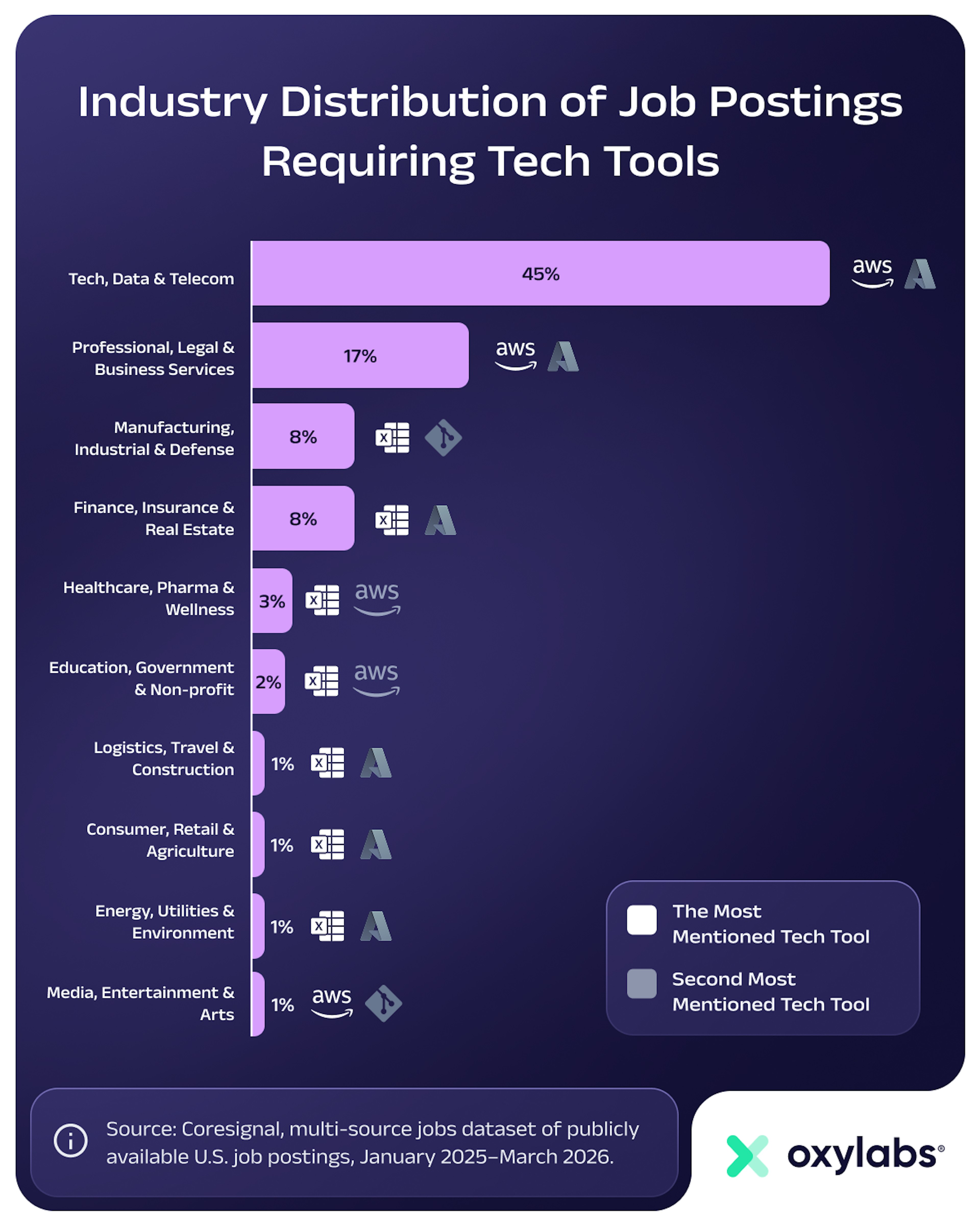
Professional, Legal, and Business Services follows at 17%, with Manufacturing, Industrial, and Defense and Finance, Insurance, and Real Estate each accounting for 8%. All other industries individually represent less than 3% of the market, confirming that demand for advanced tech tools is heavily concentrated at the top.
Finance and Professional Services show a tool profile similar to the core tech sector, with cloud platforms and Git leading requirements – a sign that data-driven operations have become the norm in these fields too.
One industry stands out as a notable addition to the cloud-native camp: Media, Entertainment, and Arts. Despite not being a traditional tech sector, it shows strong demand for AWS and Git, suggesting that modern content creation, streaming infrastructure, and digital production pipelines now require the same data management and development foundations as dedicated tech companies.
For job seekers, the concentration of demand has a clear implication: targeting roles within Tech, Data, and Telecom – or within data-driven pockets of Finance and Professional Services – offers the best alignment with the high-demand cloud and DevOps toolsets that the market currently rewards.
Leading States by Number of Tech Job Postings
Tech hiring isn’t spread evenly across the map, and the pattern says as much about infrastructure as it does about population.
California leads by a wide margin, accounting for 13% of all analyzed job postings, followed by Texas (8%) New York (5%), and Virginia (4%). The rest of the states have 3% or less job postings mentioning at least one tech tool. For the most part, this ranking simply tracks state population – bigger states post more jobs.
Virginia is the exception, and it’s a telling one. Despite ranking well outside the top 10 most populous states, Virginia posts nearly three times as many tech jobs per 100,000 residents as the average U.S. state – more than California, Texas, or any other major hiring hub on a per-capita basis.
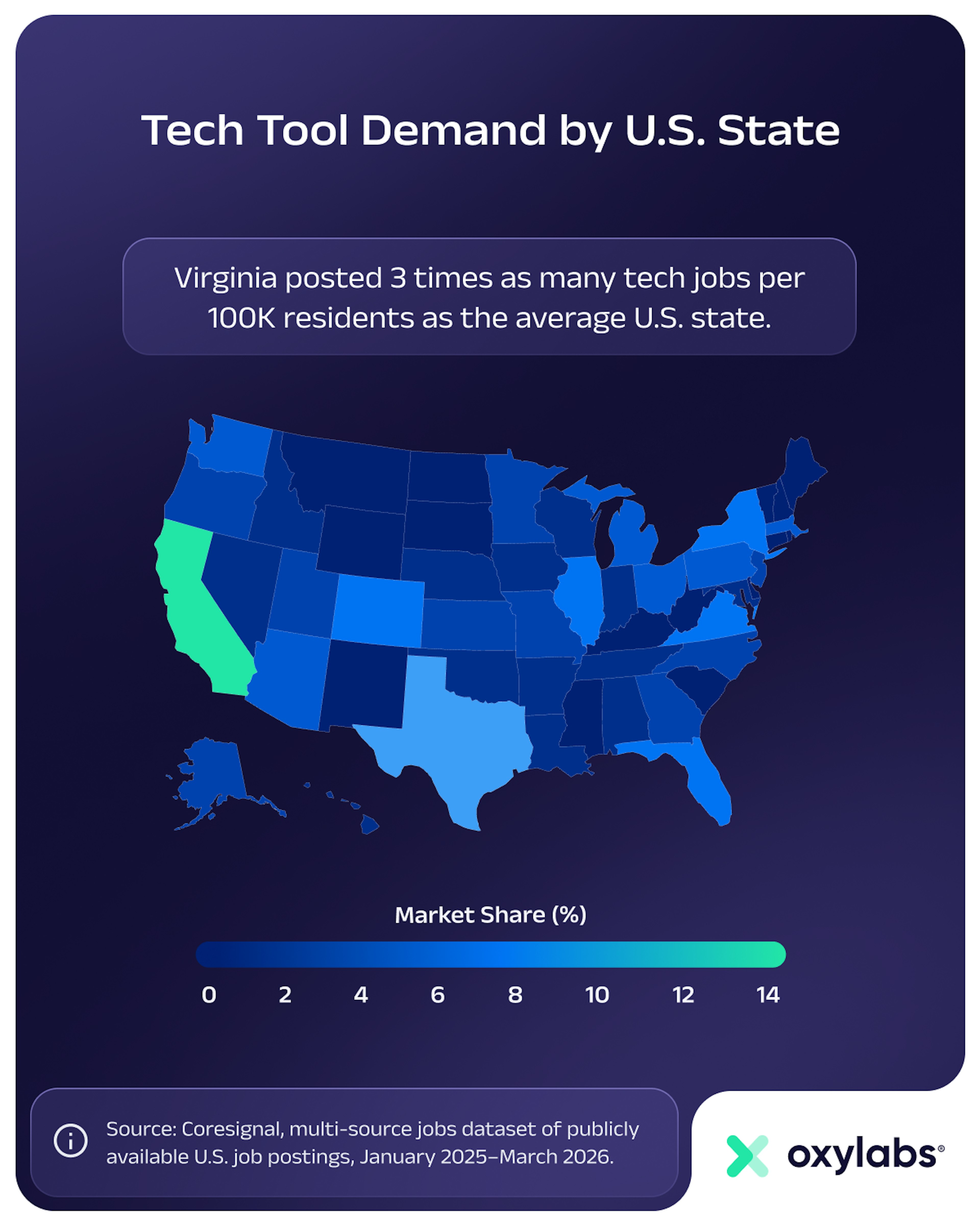
The reason isn’t population, it’s plumbing: Virginia hosts the largest concentration of data centers in the world, serving AWS, Microsoft, Google, Meta, and other cloud giants. When a state houses the physical infrastructure the cloud runs on, it also houses the jobs needed to build, secure, and maintain it.
Cloud allegiance also splits geographically, though less dramatically. AWS is the most-requested platform in the large majority of states. Azure takes the lead in a specific cluster: Minnesota, Wisconsin, North Dakota, Michigan, Nebraska, Oklahoma, Arkansas, Louisiana, Tennessee, Kentucky, and Indiana – a footprint concentrated in the Upper Midwest and parts of the South, likely reflecting regional enterprise ties to Microsoft’s ecosystem in sectors like manufacturing, agriculture, and healthcare that dominate those state economies. Everywhere else, AWS wins.
What the Data Tells Job Seekers and Employers
The findings land at an uncomfortable moment for the U.S. labor market. Tech layoffs have been accelerating through 2025 and into 2026, with companies from Meta and Microsoft to Oracle pointing to AI-driven efficiency as justification for workforce reductions. At the same time, tech job postings hit a three-year high in April 2026. More competition, more openings – but also more noise about which skills actually matter.
The tools employers are asking for aren’t the ones dominating social media discussions or developer surveys. They’re the ones appearing in hundreds of thousands of real job descriptions – and cloud platforms, version control, and infrastructure tooling lead by a wide margin.
For job seekers, the practical takeaway is that picking a direction matters more than mastering as many tools as possible. A data engineer and a BI analyst may work in the same company, on the same data, but require almost entirely different skillsets. The data shows that professionals who build deep fluency in the tools specific to their target role – rather than chasing generalist breadth – are positioning themselves for the roles that are actually being posted.
Andrius Kūkšta, Tech Lead at Oxylabs
Cloud skills, in particular, represent the closest thing to a safe bet this market offers. With nearly 42% of all analyzed job postings requiring at least one of the three major cloud platforms, and DevOps roles showing the highest concentration of infrastructure requirements in the entire dataset, the message is consistent: companies are investing heavily in building and maintaining cloud environments, and they need people who can work in them.
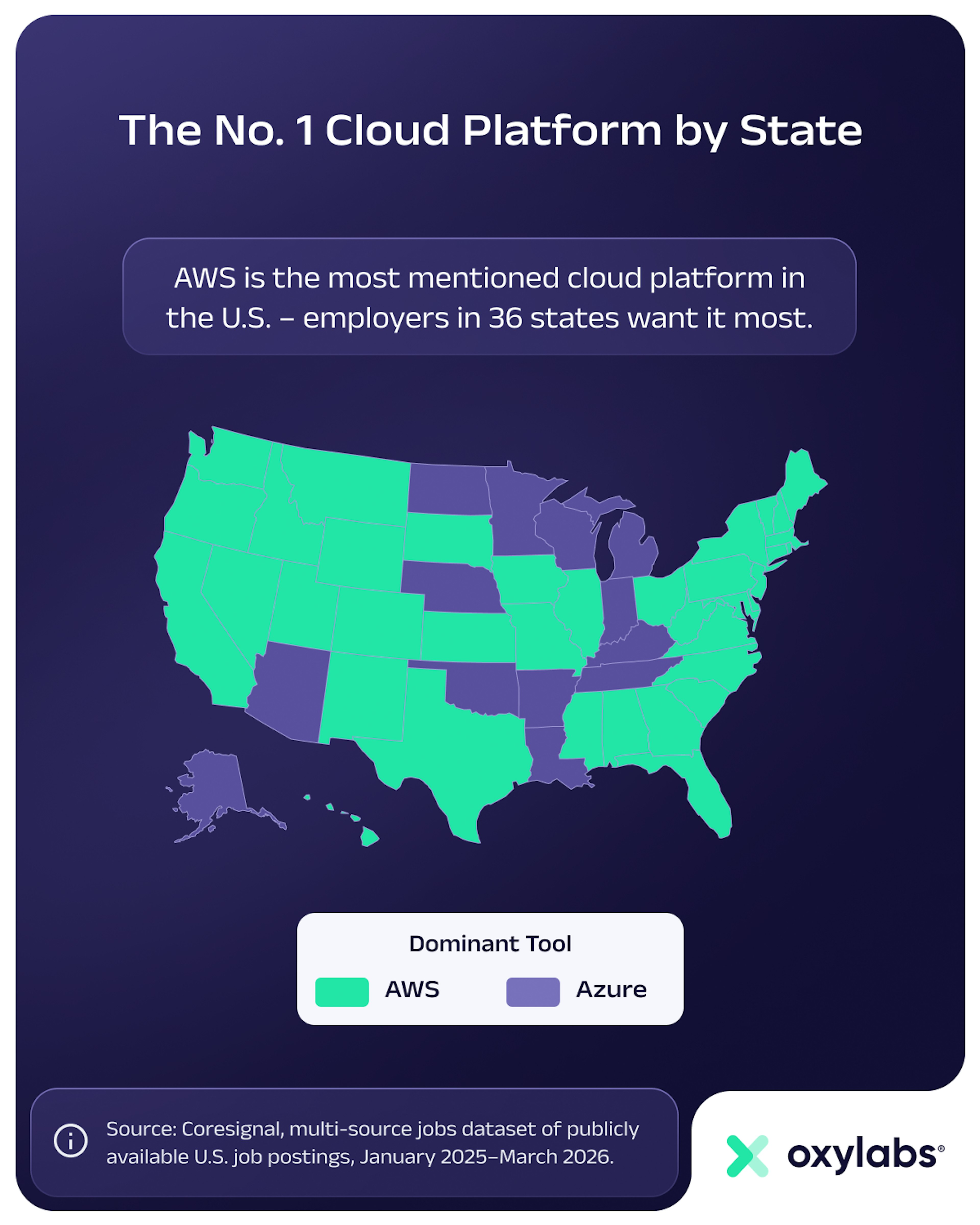
For job seekers weighing relocation as part of a job search strategy, the takeaway is straightforward: population centers like California, Texas, and New York offer the most listings in absolute terms, but Virginia stands out as the country’s most concentrated tech labor market relative to its size – and job seekers there, or anywhere in the Azure-leaning states listed above, may want to weight their cloud skills accordingly.
For employers, the data points to where competition for talent will be fiercest. DevOps, cloud infrastructure, and data engineering roles sit at the intersection of high demand and specialized skill requirements – exactly the areas where a clear understanding of the market, rather than gut instinct, will determine whether a hire succeeds or a role goes unfilled.
Methodology
Data Sources and Scope
This report is based on roughly 850,000 U.S. job postings published between January 2025 and March 2026, drawn from Coresignal’s multi-source jobs database, which aggregates listings from across the open web.
Identifying Tech Tools
Standardizing Messy Data
Measuring Demand
What the Numbers Can and Can’t Tell You
Key Terms
Limitations
Frequently Asked Questions
What is the most in-demand cloud platform in the U.S. tech job postings?
AWS appears in 30% of analyzed U.S. tech job postings from 2025 through Q1 2026. It is mentioned 1.2 times more frequently than Microsoft Azure and 2.1 times more than Google Cloud Platform.
Which tech role has the highest demand in the U.S. job market?
What tools do AI-focused companies like OpenAI, Anthropic, and NVIDIA look for in candidates?
Which industry outside of tech hires the most professionals with advanced tech tool skills?
Forget about complex web scraping processes
Choose Oxylabs' advanced web intelligence collection solutions to gather real-time public data hassle-free.
About the authors
Oxylabs Research
Data-driven Storytellers
Oxylabs Research is the research and storytelling team at Oxylabs. We use ethical, compliant Oxylabs scraping tools to collect only publicly available web data – never private, paywalled, or personal data – and turn it into clear, timely insights that help everyone make sense of a fast‑changing technological, economic, and social reality. Our work is designed to support original reporting and analysis by journalists and to serve the broader public good. If you’re working on a story or investigation and need reliable web data to back it up, get in touch at press@oxylabs.io.

Andrius Kūkšta
R&D Tech Lead
Andrius Kūkšta is a Tech Lead in the R&D team at Oxylabs. Over more than eight years there, he has progressed through roles including Analyst, Software Engineer, ML Engineer, Data Engineer, and R&D Engineer. He has contributed to several core products and is the author or co-author of five patents based on Oxylabs technologies. His work focuses on the latest AI and emerging technologies, translating trends into practical solutions. Outside of work, he is involved in sports analytics for the basketball club Žalgiris Kaunas.
All information on Oxylabs Blog is provided on an "as is" basis and for informational purposes only. We make no representation and disclaim all liability with respect to your use of any information contained on Oxylabs Blog or any third-party websites that may be linked therein. Before engaging in scraping activities of any kind you should consult your legal advisors and carefully read the particular website's terms of service or receive a scraping license.