
AI Grounding and How to Anchor Your AI Agent


 AI Summary:
AI grounding connects a model to verified data sources at inference time so it answers from real facts rather than memory, reducing hallucinations, supplying knowledge past the training cutoff, and keeping AI agents accurate without retraining. RAG and real-time web retrieval do the grounding, fine-tuning shapes behavior – most production systems combine all three.
Ask an AI agent about a competitor's price today, and it may give you a confident answer that was true two years ago. AI grounding is the fix: it connects a generative AI model to verified data sources at the moment it answers, so its AI outputs rest on real world data and not on what the model remembers from its training data. For a grounded AI agent that takes actions, searches the web, or supports customers, grounding is what separates a useful tool from an expensive guesser.
This guide explains what grounding is, how AI grounding works, the data sources and best practices behind it, and how it differs from RAG and fine-tuning. Grounding reduces AI hallucinations dramatically, but it doesn't eliminate them, so we'll look at its limits too. The guide ends with a simple workflow for grounding an AI agent in live web data. If you want a broader primer first, see our guide to data grounding.
What is grounding in AI?
Grounding in AI is the practice of anchoring the responses of large language models (LLMs) to verified external data sources, such as documents, knowledge bases, databases, APIs, or live web pages, instead of relying only on patterns learned during training. Grounding connects AI outputs to verified data sources for accuracy: a grounded AI system looks things up before it answers, while ungrounded AI answers from memory.
Think of two students sitting the same exam. One has only what they memorized; when they don't know something, they guess. That's a model without grounding. The other has an open book and can check the facts first. Grounded AI is the second student.
You'll see the idea described in several ways: AI grounding, grounding AI, grounded AI, or grounding LLMs. They all mean the same thing: making sure an AI model's output can be traced back to real, relevant information from current sources. Grounding helps prevent fabricated outputs in high-stakes settings like customer support, research, pricing, and compliance, and it matters for any workflow where AI agents act on what they find. (Researchers also describe embodied grounding, which links AI to physical-world actions; this guide focuses on grounding in data.)
How AI grounding works
The grounding process happens at inference time, the moment a user or an agent sends a query. The model itself isn't retrained. Instead, a grounding layer (sometimes called a context layer) fetches relevant data and hands it to the model inside its context window. This is in-context learning: the model works from retrieved evidence it was never trained on. Effective grounding requires a source of authority, a retrieval mechanism, and constraints. Here's how grounding works in most setups:
User query: a user or agent asks a question or starts a task.
Retrieval: the retrieval layer searches the right source, such as a vector store, a database, a knowledge graph, an API, or the live web, using keyword search, semantic search, or both.
Context injection: the most relevant passages are added to the model's prompt alongside the original question.
Generation: the model answers using that context, ideally citing the specific documents behind each claim.
Verification (optional): a check compares the answer against the retrieved data before it reaches the user.
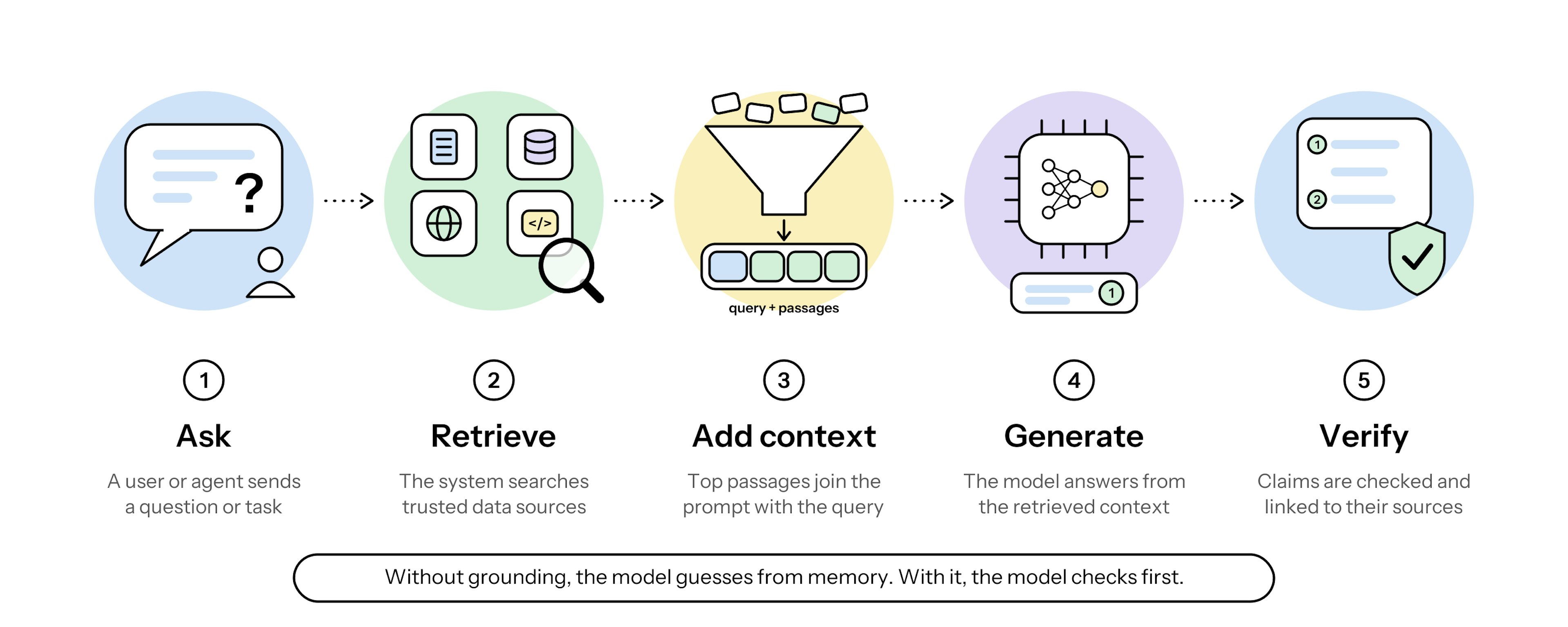
AI grounding process in five steps: user query, retrieval, added context, model generation, and verification
The quality of the answer depends heavily on steps 2 and 3. A strong model fed poor or stale contextual data will still produce a poor answer, and grounding quality can degrade over time, so it needs continuous monitoring.
Data sources you can use for grounding AI
The right data type and source depend on how fast your information changes and who owns it. Grounding techniques can draw on many external data sources, and the most common are:
Internal documents and knowledge bases: policies, manuals, wikis, and support articles. Stable, private, and ideal for answers based on your own data.
Databases and data warehouses: structured data such as product catalogs, inventory, orders, and customer records. Historical data like past customer interactions lets AI tailor its communications.
APIs and tools: live system data like order status, CRM records, or weather and market feeds, reached through tool calls.
Search engine results: fresh, ranked pages that help an agent discover relevant content on a topic.
Live web pages: the most current source of actual data on prices, reviews, competitor activity, news, and product availability. This is where grounding gets hardest, because pages change constantly and are built to resist automated access. Our guide on how to feed AI agents real-time web data covers the practical side.
Most production systems mix several of these: internal data for company knowledge, plus the web for anything that changes by the hour. Choosing the right sources, or data selection, is the first design decision in any grounding architecture.
Best practices for grounding an AI model
Start with clean, structured data. Data quality sets the ceiling for grounding, because the model is only as good as its source data. Deduplicate, remove noise, and keep formats consistent. Our guide to AI-ready data shows how to prepare it.
Prefer authoritative sources. Rank official documentation, first-party data, and reputable external sources above forums and scraped aggregators.
Keep data fresh. Set update schedules for static sources, and use real-time retrieval for anything time-sensitive.
Retrieve less, but better. Passing a handful of relevant passages beats dumping whole pages into a limited context window. Use sensible chunking and relevance ranking, and return structured output such as JSON or Markdown where you can, so key data points are easy to extract.
Require citations. Instruct the model to answer only from the retrieved data and to link its sources, so people can check every claim and you can measure citation accuracy.
Handle missing data explicitly. If retrieval returns nothing useful, the model should say so rather than fill the gap from memory.
Test and monitor. Build a set of test questions with known answers, track how often responses match their sources, and feed the results, including human feedback, back in through feedback loops. Treating grounding as an ongoing process, not a one-time setup, keeps quality from slipping.
Benefits of AI grounding
Grounding changes what an AI system can be trusted to do. The main benefits are:
Fewer hallucinations. Models predict likely text; they don't check facts. Grounding anchors AI outputs to evidence, which makes it one of the most effective ways of reducing AI hallucinations. It reduces them dramatically, but it doesn't eliminate them entirely.
Current answers. Every model has a training cutoff. Grounding lets it answer questions about anything after that cutoff, from last week's product launch to this morning's price change, without retraining. It limits dependency on past training data, so the system works with current facts.
Traceable, auditable output. Grounded systems provide citations for their information, which creates an audit trail for AI claims. Users can verify answers, teams can debug them, and trust, accountability, and compliance improve.
Domain expertise without retraining. A general-purpose model can act like a specialist in your catalog, policies, or market simply by looking up the right contextual data. Specific context also means fewer generic responses, and drawing on real-time organizational and customer data makes personalization better.
Lower cost to keep current. Updating a data source is far cheaper and faster than retraining or fine-tuning a model each time the facts change. Grounded architectures simplify updates: you change the linked data, not the model.
More dependable agents. An agent that acts on grounded data makes better decisions, like repricing a product or flagging a stock shortage, because it works from facts instead of assumptions. Grounding also helps AI systems manage context and follow business rules and constraints.
Difference between AI grounding, RAG, and fine-tuning
These three terms are often mixed up, but they sit at different levels. AI grounding is the goal: answers anchored to real, verified data. Retrieval augmented generation (RAG) and fine tuning are techniques, and only one of them is a grounding method. RAG is by far the most common.
| Criteria | AI grounding | RAG | Fine-tuning |
| What it is | The overall goal of tying outputs to verified data | A technique that retrieves documents and adds them to the prompt | A technique that retrains the model on new examples |
| Changes the model? | No | No | Yes, updates its weights |
| Data freshness | As fresh as the source | As fresh as the data store | Frozen at training time |
| Best for | Accuracy, freshness, traceability | Private or frequently updated knowledge | Tone, format, and specialized behavior |
| Main trade-off | Needs reliable data sources | Depends on retrieval quality | Costly and slow to update |
In short, all RAG is grounding, but not all grounding is RAG. Grounding can be achieved through many grounding techniques: live web retrieval, API calls, database queries, knowledge graphs, or context placed directly in the prompt. Fine-tuning, by contrast, teaches a model how to behave; it isn't a reliable way to teach it what is true today.
Most production systems combine them: fine-tune for style and format, use RAG for stable internal knowledge, and add live retrieval for anything that changes fast. For agents that decide for themselves when and where to retrieve, see our guide to agentic RAG. For a deeper look at the full picture, read our data grounding guide.
Simple guide to grounding AI agent workflows
AI agents need grounding more than chatbots do, because they don't just answer questions: they act on what they find. The easiest way to build a grounded AI agent on live web data is to give it two capabilities, finding the right pages and reading them, and to connect both through a standard protocol.
Oxylabs Web API covers both. Its /search endpoint returns search results so an agent can discover relevant pages, and its /scrape endpoint fetches a page and returns clean content, handling interruptions, rendering, and proxies behind the scenes. Connected through MCP (Model Context Protocol), these become tool calls your LLM can make on its own, with no custom scraping code. Together they form the retrieval layer of your agent.
Here's an example. An online electronics store uses an AI pricing agent to check whether its top products are priced competitively:
Pull the store's own data. The agent reads the product list and current prices from the store's catalog.
Find competitors. Through the Oxylabs Web API, connected via MCP, it calls /search to find competitor listings for each product.
Read the live prices. It calls /scrape on those pages to get the actual prices as they appear today.
Compare and recommend. The LLM compares competitor prices with the store's own and suggests updates, with a source link for every figure.
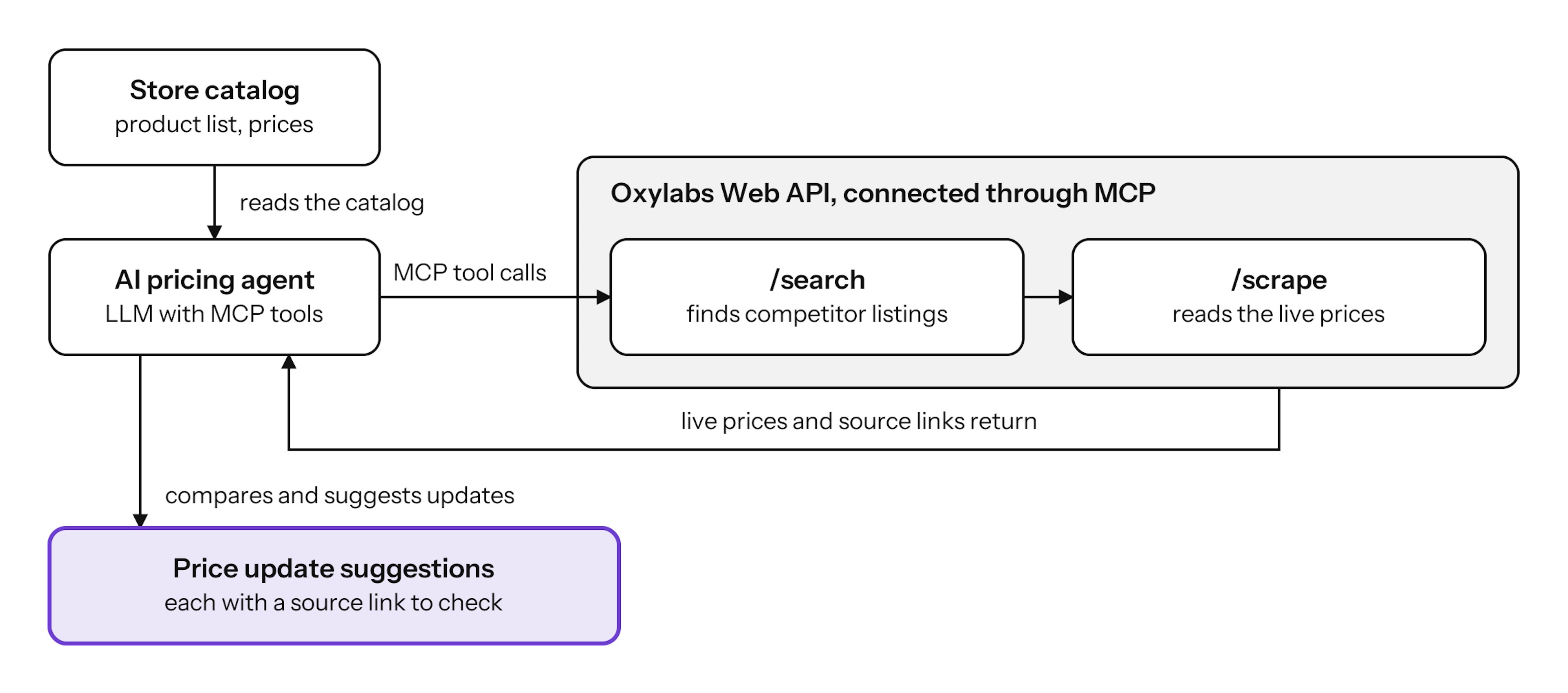
AI grounding workflow for a pricing agent
Because every recommendation is built on retrieved data and links back to its source, a human can verify each suggestion in seconds before approving a price change. The same pattern works for market research, lead enrichment, travel and availability checks, and brand monitoring. Browse more use cases to see where grounding fits your own workflows, or talk to a data expert about setting it up.
Frequently asked questions
Can grounding eliminate AI hallucinations completely?
No. Grounding reduces AI hallucinations dramatically, but it can't remove them entirely. Models can still misread the retrieved evidence, blend it with outdated memory, or fill gaps when retrieval returns weak results. Poor or stale source data leads to poor answers too. The best defense is layered: good sources, clear instructions to answer only from the provided context, required citations, and regular testing.
How can you tell if an AI answer is grounded?
Why do AI agents need real-time grounding?
What is the difference between grounded and ungrounded AI?
What are the most common AI grounding techniques?
What does a grounding architecture need to work?
How do you keep AI grounding accurate over time?
Access data faster than ever before
Help us shape the future of Web Intelligence Index.
About the authors
Shinthiya Nowsain Promi
Technical Content Researcher
With a background in Computer Science, Shinthiya likes to turn technical jargons into clear, perspective-driven writing that rewards a reader's time rather than wasting it.

Andrius Kūkšta
R&D Tech Lead
Andrius Kūkšta is a Tech Lead in the R&D team at Oxylabs. Over more than eight years there, he has progressed through roles including Analyst, Software Engineer, ML Engineer, Data Engineer, and R&D Engineer. He has contributed to several core products and is the author or co-author of five patents based on Oxylabs technologies. His work focuses on the latest AI and emerging technologies, translating trends into practical solutions.
All information on Oxylabs Blog is provided on an "as is" basis and for informational purposes only. We make no representation and disclaim all liability with respect to your use of any information contained on Oxylabs Blog or any third-party websites that may be linked therein. Before engaging in scraping activities of any kind you should consult your legal advisors and carefully read the particular website's terms of service or receive a scraping license.
Related articles



Get the latest news from data gathering world