
Agentic RAG Explained, From How It Works to Where It Fits

Shinthiya Nowsain Promi
Last updated on
2026-08-10
11 min read
 AI Summary:
Agentic RAG is a retrieval architecture where an AI agent decides what to retrieve, judges whether the results are good enough, and searches again until it can answer – rather than running the same retrieve-then-generate sequence on every query. This guide covers how the loop works, single agent vs. multi-agent designs, where agentic RAG is worth its cost and where it isn't, and the tools you need to build one.
Most retrieval systems answer a question the same way every time: embed the query, fetch the top matching chunks, and hand them to a model. Agentic RAG breaks that fixed sequence apart and puts an AI agent in charge of it, letting the system decide what to look up, judge whether the results are good enough, and go back for more when they aren't.
That single change – from a pipeline that runs to an agent that decides – is what separates agentic RAG systems from the retrieval augmented generation setups most teams built first. This guide covers what agentic RAG is, how the loop actually works, where RAG agents earn their cost, and which tools you need to build one.
What is Agentic RAG?
Agentic RAG is an architecture in which one or more AI agents control the retrieval process, rather than executing a hardcoded retrieve-then-generate sequence. The agent reasons about the user query, chooses which retrieval tools and data sources to call, evaluates the retrieved context, and loops until it has enough supporting context to answer – or until it hits a budget you've set.
To see what changed, it helps to remember what standard RAG does. Retrieval augmented generation pairs a language model with an external knowledge base so that responses draw on retrieved data rather than training weights alone. The model never stops using what it learned in training – retrieval competes with that prior knowledge rather than replacing it, which is why weak retrieval produces confident wrong answers instead of an honest blank.
It's a two-phase pipeline: retrieve, then generate. Production versions get sophisticated inside those phases – hybrid search, metadata filters, query expansion, a reranker – but the sequence itself is fixed. Every query takes the same path, whether it needs to or not.
That works well for straightforward lookups. It has no recourse on complex queries. Ask a traditional RAG pipeline "how did our EU refund policy change between the 2024 and 2026 contracts, and does it conflict with the vendor terms?" and it will run one vector search against a blended query, retrieve a muddle of loosely relevant chunks from three different documents, and generate a confident answer built on incomplete evidence.
Agentic RAG turns retrieval into a decision process instead of a single step. The same query gets decomposed into sub-questions, each routed to the right source, each result checked for relevance, and the answer assembled only once the agent has the pieces it needs. The retrieval component stops being a fixed function call and becomes one of several tools an agent can reach for.
The core distinction is control flow. In standard RAG, a developer decides in advance what happens. In agentic RAG, the model decides at runtime.
How agentic RAG works
An agentic RAG pipeline is a loop, not a line. The specific implementations vary, but nearly all of them cycle through three phases: plan, retrieve and evaluate, then generate and feed back.
Planning: how the agent decides what to retrieve
Everything starts with the agent interpreting the user query rather than embedding it verbatim. A planning step typically handles several jobs at once:
Intent classification. Does this question need retrieval at all? "Reformat this list as a table" doesn't. Skipping unnecessary retrieval is one of the cheapest wins in the whole architecture.
Query decomposition. Complex tasks get split into sub-queries that can be resolved independently. Comparison questions, multi-hop questions, and anything with conditional logic ("if the contract is post-2025, check clause 4") need this.
Query rewriting. User phrasing is rarely optimal for vector search. Agents commonly expand acronyms, add domain terms, and generate several query variants.
Query routing. A routing agent picks the destination for each sub-query: the vector database for unstructured data, SQL for structured data, a live web search for anything time-sensitive, an internal API for account state.
That last point matters more than it sounds. Classifying query complexity first – an approach usually called adaptive RAG – lets you route simple questions down a cheap path and reserve multi step reasoning for the hard ones. You get most of the accuracy benefit without paying agentic costs on every request.
Retrieval and evaluation: pulling and validating context
The retrieval phase in an agentic system is plural. The agent may run vector retrieval against a knowledge base, hit a keyword index, call external tools, and pull external data from the web in the same turn – often in parallel.
The part that doesn't exist in standard RAG is what comes next: grading. Before anything reaches the generation stage, a grader (usually the LLM itself, prompted as a judge, sometimes a smaller fine-tuned classifier) scores the retrieved documents for relevance and sufficiency. Depending on the verdict, the agent can:
Accept the context and move on.
Rewrite the query and search again.
Switch sources. This is what corrective RAG does when internal retrieval scores poorly: it falls back to web search for supporting context rather than answering from weak evidence.
Decompose further, if the results reveal the question was broader than it looked.
Give up gracefully and tell the user it doesn't have the answer, which is a genuinely valuable behavior.
Reranking usually sits here too. A cross-encoder reranker rescores the candidate set with far more precision than the original embedding similarity, and it's one of the highest-leverage components in the whole pipeline for relatively little latency.
This validation loop is where most of the accuracy gain in agentic RAG comes from. It's also where most of the failure modes live, which we'll get to.
Generation and feedback: producing the answer and learning from it
Once the agent is satisfied with the retrieved context, response generation proceeds much as it does in standard RAG: the model synthesizes an answer from the supporting evidence, ideally with citations back to source documents.
Many agentic RAG applications add a verification pass after generation – a hallucination check that compares the draft answer against the retrieved data and asks whether every claim is actually supported. If it isn't, the answer goes back for another round. This is a self-verification step, often called Self-RAG – a version where the model is specially trained to flag its own decisions as it works, marking whether it needs to look something up, whether what came back is actually relevant, and whether the answer it just wrote is backed by the sources. Most teams don't train anything. They get close to the same behavior by asking an off-the-shelf model to check its own work.
That distinction matters, because these feedback loops don't retrain the model. Nothing updates weights during a conversation. What actually improves over time is everything around the model – trace logs from production runs surface which queries fail, those become evaluation cases, and the fixes land in prompts, routing rules, chunking strategy, or the knowledge base itself. Continuous improvement in agentic RAG is an engineering discipline supported by observability, not an emergent property of the agent. Some teams do close the loop harder by fine-tuning routers or graders on collected traces, but that's a deliberate offline step.
The diagram below shows how a query moves through an agentic RAG pipeline.
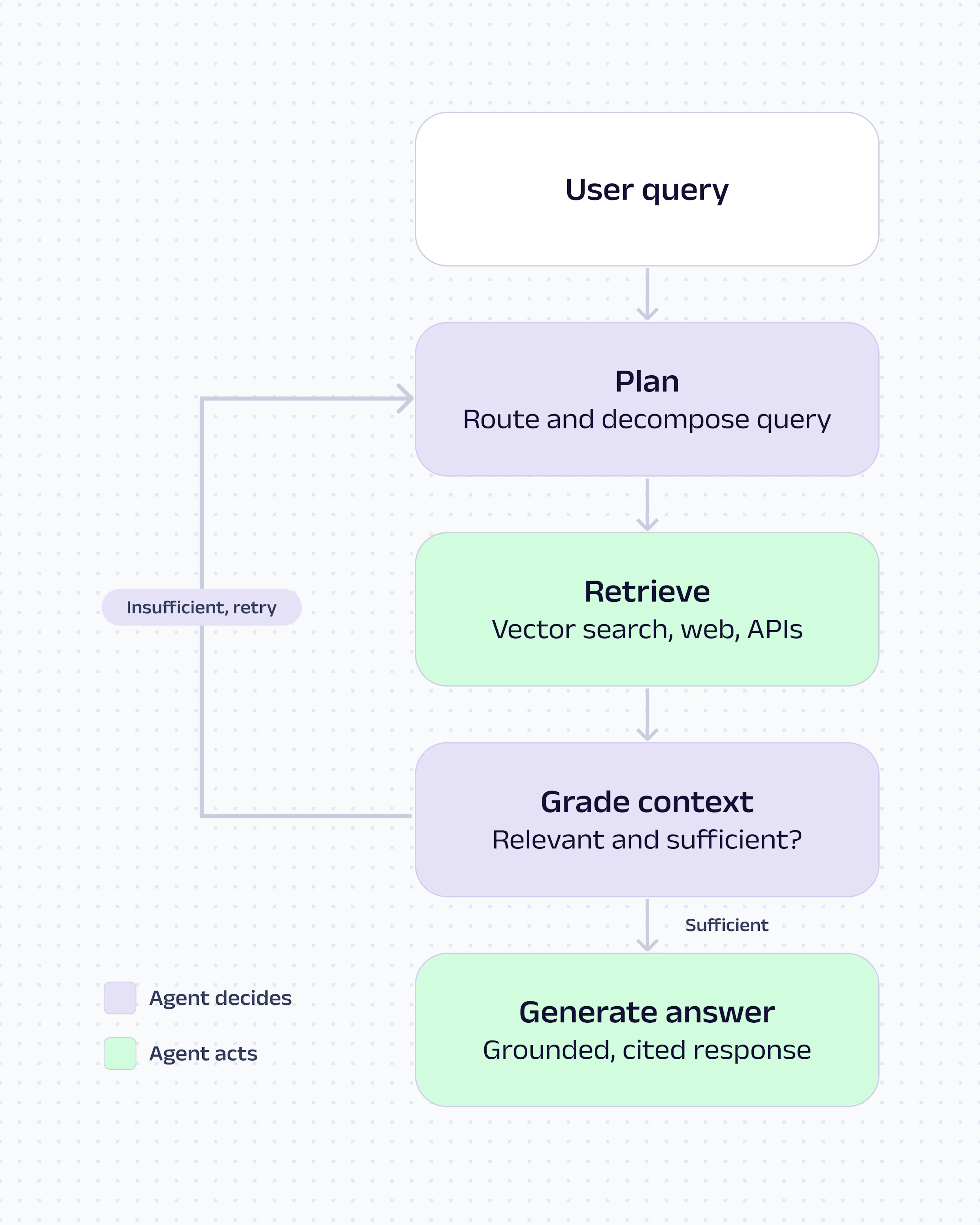
Agentic RAG pipeline
Most teams reach for multiple agents before they've hit anything that requires them, and pay for it in tokens and debugging time. To keep an agentic system debuggable and affordable, start with one agent. Move to multi agent only when you can point at the specific limitation forcing the change.
Single agent RAG vs multi agent RAG
Two architectural shapes dominate.
Single agent RAG puts one agent in charge of everything, most commonly a ReAct agent that loops through thought, action, and observation until the task is done. It has a set of retrieval tools and decides for itself which to call and when. It's simpler to build, easier to debug, cheaper to run, and it's the right starting point for most projects.
Multi agent RAG distributes the work. A master agent decomposes the task and delegates to specialists: one agent that only queries the SQL warehouse, one that handles document retrieval, search agents that work the live web, a critic that reviews the assembled answer. Multiple agents help when sources are genuinely heterogeneous or when different subtasks need different tools and prompts. They also multiply token consumption and introduce coordination failures that single agent setups simply don't have.
RAG agents in practice: a few examples
A few patterns that show up repeatedly in production:
Customer support with live account context. A support assistant that answers policy questions from documentation, but recognizes when a question is about this customer and calls the billing API for real account state before answering. The agent decides which source applies; a static pipeline can't.
Competitive and market monitoring. An agent tracks pricing, product changes, and coverage across competitor sites and news sources, pulling fresh external data on a schedule and on demand. Internal documents don't contain today's competitor pricing, so live web retrieval is non-negotiable here.
Financial and legal document analysis. Questions across filings and contracts are almost always multi-hop – comparisons across periods, cross-references between clauses. Agentic retrieval reliably outperforms single-pass RAG on this class of question, at the cost of a few seconds of extra latency.
Internal knowledge assistants. Enterprise data management is messy: wikis, ticketing systems, code repositories, spreadsheets, and a decade of Slack. A routing agent that knows which system holds which kind of answer is the difference between a useful assistant and a search box that returns the wrong wiki page.
Deep research assistants. Given an open-ended prompt, autonomous agents plan a research path, gather sources iteratively, notice contradictions, and keep going until coverage is adequate. This is agentic RAG at its most visible – and its most expensive.
For a broader look at how agents are being deployed beyond retrieval, our AI agent examples roundup covers a wider set of use cases.
Why more companies are implementing agentic RAG pipelines
The push toward agentic RAG pipelines comes from a few converging pressures.
Static pipelines hit an accuracy ceiling. Teams that shipped standard RAG in 2023 and 2024 usually found the same thing: retrieval was fine on simple questions and unreliable on the questions users actually cared about. Adding chunking tweaks and better embeddings helped, but the fixed one-shot control flow was the real limit.
Grounding requirements got stricter. In regulated and high-stakes domains, "probably correct" isn't a deployable standard. A pipeline that grades its own evidence and can decline to answer is far easier to defend than one that always produces something. This is the broader problem of data grounding – tying model output to verifiable sources – and agentic retrieval gives you more places to enforce it.
Real answers span multiple systems. Very few business questions live entirely inside one vector database. Once you need structured data and unstructured data and live web results in the same answer, you need something that can choose between them.
Tooling matured. Model tool-calling became reliable, agent frameworks stabilized, and standards like the Model Context Protocol made connecting AI agents to external tools far less bespoke than it was before MCP arrived in late 2024.
Counter-pressure worth naming: context windows also grew enormously, and for a small corpus – a product manual, a policy handbook – loading everything into the prompt often beats building a retrieval system at all. The tradeoff doesn't vanish. You pay for the full corpus on every single query, and retrieval accuracy inside very long contexts degrades rather than holding flat. Prompt caching softens the cost side considerably but doesn't remove either problem. Agentic RAG is for corpora too large, too fresh, or too fragmented for that.
Pros and cons of agentic RAG
Advantages
Handles complex queries – multi-hop, comparative, conditional – that break single-pass retrieval.
Self-corrects. Bad retrieval gets caught and retried instead of silently poisoning the answer.
Uses multiple data sources and tools through one interface.
Adapts effort to difficulty; simple questions can skip retrieval entirely.
Produces inspectable traces. You can see which sources the agent chose and why.
Degrades honestly. A well-built agent can say it doesn't know.
Disadvantages
Slower. Planning, grading, and verification each add an LLM call on top of the standard RAG process, so expect several seconds end to end.
More expensive. Those extra calls each carry their own context, and multi agent designs multiply the token volume rather than adding to it.
Harder to test. Nondeterministic control flow means the same input can take different paths.
More failure surface. Routers misroute, graders rubber-stamp, loops don't terminate.
Overkill for simple lookups, where it adds cost and latency and no accuracy.
The practical resolution is usually hybrid: route simple queries down a fast standard RAG path and reserve the agentic loop for questions that need it.
Main challenges when scaling RAG agents
Five problems account for most production incidents.
Runaway loops. An agent that can retry retrieval will, on some queries, retry forever – never satisfied, never terminating. Hard caps on iterations, tool calls, and total token budget aren't optional. Every loop needs an exit condition that fires regardless of the agent's opinion.
Graders that never say no. LLM-as-judge relevance grading is prone to approving nearly everything, which quietly turns your agentic system back into a single-pass pipeline wearing a costume. Calibrate graders against a labeled set and check the rejection rate; if it's near zero, the grader isn't working.
Retrieved content is untrusted input. A scraped page can carry instructions aimed at the agent, not the user – and in an agentic system that text reaches the component choosing the next tool call. Treat retrieved documents as data, never as instructions, and keep tool permissions narrow.
Context overflow. Iterative retrieval accumulates documents. Several rounds in, you're pushing an enormous, redundant context at the model, which degrades answer quality and inflates cost simultaneously. Deduplication, reranking, and compression between rounds keep this in check.
Cost and latency stacking. Costs add across parallel agents and multiply across loop iterations – a three-agent system that averages three retrieval rounds isn't 3x a standard pipeline, it's closer to 9x. Teams routinely discover their per-query cost is an order of magnitude above the naive estimate. Instrument token usage and latency per span from day one – retrofitting observability onto a live agentic system is miserable.
Two more that bite at scale: retrieval quality is usually the actual bottleneck, not agent cleverness – no amount of reasoning rescues a knowledge base with bad chunking. And data freshness decays silently; an agentic RAG system pointed at a stale index gives confidently wrong answers with excellent reasoning traces.
Top tools that make agentic RAG possible
Data collection and retrieval
The retrieval layer sets the ceiling for everything above it. If your agent can't reach relevant information, no framework will save it.
Oxylabs covers this layer for agentic RAG systems that need live external data:
Web Scraper API – structured extraction from any site, with Markdown output that drops straight into an LLM context window without cleanup.
Fast Search API – sub-second organic search results, built for search agents that need web results inside a latency budget.
Agent Browser – browser automation for JavaScript-heavy and login-gated targets that plain HTTP requests can't reach.
Residential Proxies – 175M+ IPs across 195 countries for reliable, geo-accurate access at scale.
AI Grounding and pre-indexed web data – fresh web content for RAG and agentic workflows without running collection infrastructure yourself.
Agent frameworks and orchestration
LangGraph models agentic workflows as stateful graphs with cycles, conditional edges, and checkpointing – a natural fit for retrieve-grade-retry loops. LlamaIndex remains the most retrieval-focused option, with strong routing and query engine abstractions. CrewAI organizes work as role-based crews. AutoGen pioneered conversation-driven multi-agent collaboration, but entered maintenance mode in late 2025; that lineage now continues as the community fork AG2 and Microsoft's Agent Framework, which merges AutoGen with Semantic Kernel. Haystack targets production RAG pipelines with a component model. OpenAI Agents SDK and Pydantic AI offer lighter-weight typed alternatives. The framework is essentially your agent harness – it defines how the model receives tools, keeps state, and recovers from errors.
Vector databases and indexes
Pinecone, Weaviate, Qdrant, Milvus, Chroma, and pgvector all serve as the vector database behind the retrieval layer. Selection usually comes down to hybrid search quality, metadata filtering, and operational fit rather than raw ANN performance.
Embeddings and reranking
Embedding models from OpenAI, Cohere, Voyage, and the open BGE family handle vectorization; cross-encoder rerankers such as Cohere Rerank and BGE reranker rescore candidates before they reach the model. Reranking is consistently one of the best accuracy-per-dollar upgrades available.
Evaluation and observability
Ragas, DeepEval, LangSmith, Langfuse, and Arize Phoenix measure retrieval precision, groundedness, and answer relevance, and trace every span with its cost and latency. For agentic systems this isn't optional tooling – without traces you cannot debug a nondeterministic loop.
Connectivity
The Model Context Protocol standardizes how AI models reach external tools and data sources, which cuts the integration work of wiring AI agent tools into a retrieval pipeline considerably.
Wrapping up
Agentic RAG is best understood as a trade: you give up the predictability and speed of a fixed pipeline in exchange for a system that can handle questions a fixed pipeline gets wrong. That trade pays off on complex, multi-source work and wastes money on simple lookups.
Whatever architecture you land on, the retrieval layer decides the ceiling. An agent with excellent reasoning and a stale, incomplete knowledge base produces well-argued wrong answers. Reliable access to fresh, structured, high-coverage data is the part worth getting right first. If you are starting your first agentic project journey, check out our blogs on data grounding, semantic chunking, semantic search tools, what RAG is, agentic search and AI agent examples to understand how everything works.
Frequently asked questions
What is an AI agent?
An AI agent is a system built around a language model that pursues a goal by reasoning about what to do, acting through external tools, observing the results, and adjusting its next step. What makes it an agent rather than a chatbot is autonomy over its own control flow – it chooses the sequence instead of following a script. Our guide to AI agent examples covers how this plays out across real use cases.
What is a RAG agent?
How does agentic RAG differ from traditional RAG?
What is adaptive RAG?
Is agentic RAG always better than standard RAG?
Can agentic RAG use multiple data sources and tools?
Does agentic RAG reduce hallucinations?
How do you keep an agentic RAG knowledge base current?
About the author
Shinthiya Nowsain Promi
Technical Content Researcher
With a background in Computer Science, Shinthiya likes to turn technical jargons into clear, perspective-driven writing that rewards a reader's time rather than wasting it.
All information on Oxylabs Blog is provided on an "as is" basis and for informational purposes only. We make no representation and disclaim all liability with respect to your use of any information contained on Oxylabs Blog or any third-party websites that may be linked therein. Before engaging in scraping activities of any kind you should consult your legal advisors and carefully read the particular website's terms of service or receive a scraping license.
Related articles




Explore Oxylabs Residential Proxies
175M+ ethically sourced IPs built for the highest reliability.

Get the latest news from data gathering world
Scale up your business with Oxylabs®
Explore Oxylabs Residential Proxies
175M+ ethically sourced IPs built for the highest reliability.