
Agentic Search: How It Works and Where It Breaks


 AI Summary:
Agentic search is a retrieval approach where an AI agent plans its own queries, calls multiple tools, evaluates what comes back, and searches again until it can answer – rather than returning a ranked list for the user to sort through. This guide explains how the retrieval loop works step by step, the three types of search agents you'll encounter, why agentic search breaks in production, and the AI agent tools that make up a reliable data layer.
Agentic search is what happens when you stop treating search as a single query and start treating it as a task an AI agent has to work through. Instead of firing off one keyword string and returning ten blue links, an agentic search system reads the user intent, plans a sequence of queries, calls multiple tools, checks whether the results actually answer the question, and searches again if they don't. It's the difference between handing someone a library catalog and handing them a researcher.
The concept is easy to demo and surprisingly hard to run. This guide covers what agentic search is, how the retrieval loop works step by step, the three types of search agents you'll encounter, and the failure modes that only show up once real traffic hits your stack.
What is agentic search?
Agentic search is a retrieval approach where a large language model acts as a reasoning engine that decides what to search for, where to search, and when it has gathered enough information to answer. Rather than executing one lookup against a search engine and passing the output straight to the model, the agent breaks a request into sub-questions, runs them across multiple sources, evaluates what comes back, and iterates until it can produce a comprehensive answer.
Traditional search optimizes for one thing: matching a query to relevant documents and ranking them. The human does the rest – opening tabs, discarding junk, reconciling contradictions, reformulating the query when the first attempt misses. Agentic search moves that work inside the system. The agent handles query planning, source selection, and synthesis, so the output is an answer with citations rather than a list of candidates.
This matters most for complex queries that no single query can satisfy. "Which of our top five competitors changed pricing in the last quarter, and how?" isn't one search. It's a competitor lookup, five pricing page fetches, a comparison against historical data, and a written summary. A search engine returns links. A search agent returns the comparison.
Two things make this possible: models that can reason well enough to plan multi-step retrieval, and a data layer reliable enough to feed them. The first is largely solved. The second is where most agentic search projects run into trouble.
How agentic search works
Under the hood, agentic search is a loop, not a pipeline. Here's the step-by-step sequence most implementations follow.
1. Intent parsing. The agent receives a request in natural language and works out what's actually being asked – the entities involved, the time frame, the output format, and any constraints the user didn't state explicitly.
2. Query planning. The agent decomposes the request into sub-questions and drafts the queries that will answer them. A question about a product launch might become one query for the announcement, one for pricing, and one for reactions. This is the step that separates agentic search from a wrapper around a search box.
3. Tool selection. The agent picks which of its available tools fits each sub-question. Web search for anything current, a vector store for internal documentation, a database for structured data, a browser for pages that need interaction. The agent harness – the runtime that exposes these tools to the model and executes its calls – handles authentication, usually via an API key per tool, and returns results in a format the model can read.
4. Retrieval. Queries go out, often in parallel. Results come back as search snippets, full page content, structured JSON, or retrieved passages from a knowledge base.
5. Evaluation. The agent reads what it got and judges it. Are these relevant results, or did the query miss? Is the content current? Do two sources contradict each other? This reflection step is what makes agent behavior look deliberate rather than mechanical.
6. Refinement. If the evaluation fails, the agent rewrites its queries and goes back to step 4. It might narrow the phrasing, switch to a different source, or drop a sub-question that turned out to be a dead end.
7. Synthesis. Once the agent has enough coverage, it composes a single answer from multiple sources, ideally with citations back to the retrieved material.
Steps 4 through 6 are the loop, and how tightly you control it determines whether your system is thorough or expensive. More iterations mean better coverage, higher latency, and higher token spend. Most production systems cap iterations somewhere between three and eight, then force synthesis with whatever the agent has.
The whole sequence can be squeezed into four simple moves, with one of them running more than once. Here’s how it looks:
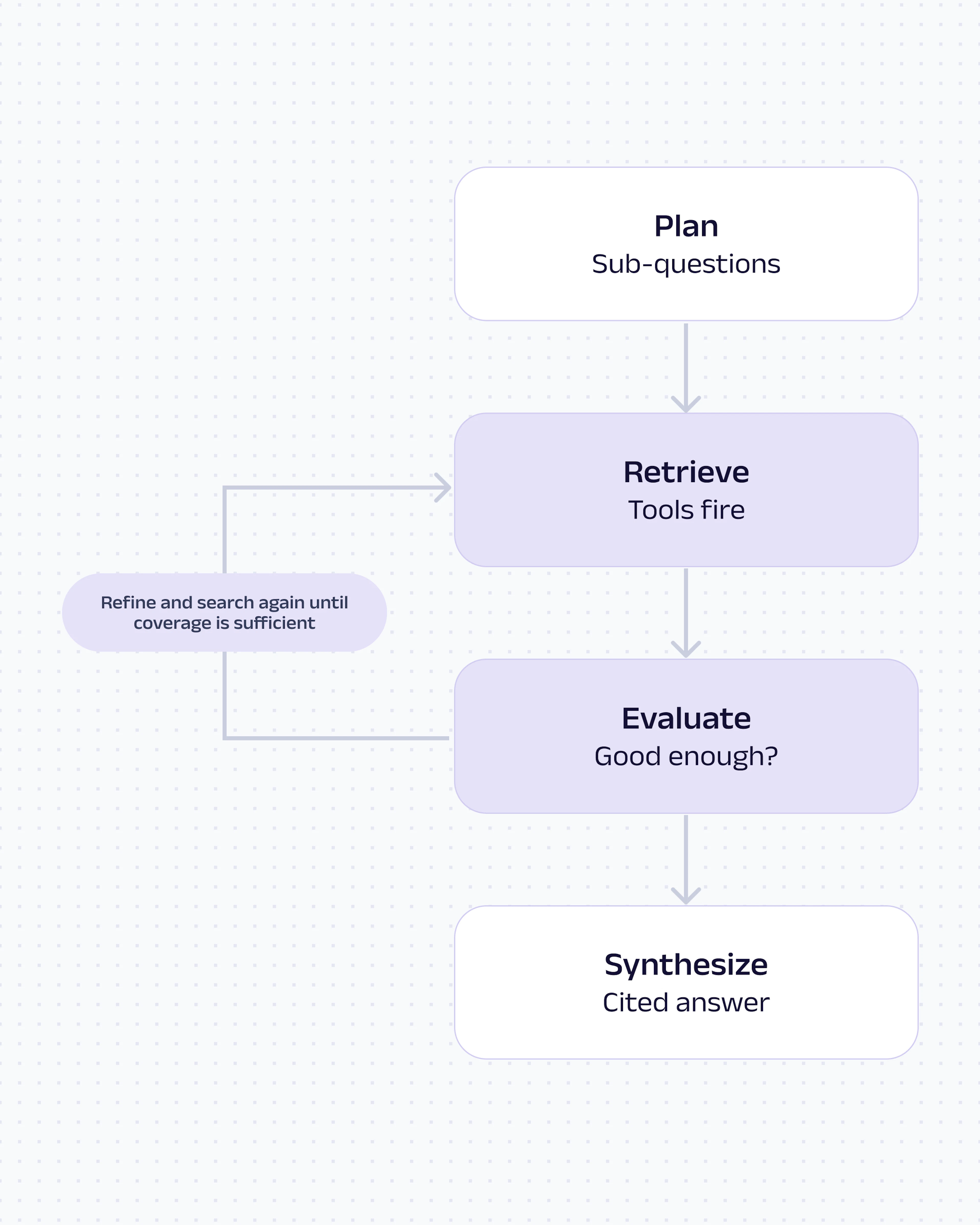
Agentic search pipeline
The three types of search agents
Search agents aren't one architecture. In practice, they fall into three broad agent types, distinguished by how much autonomy the agent has over its own control flow.
Conversational agents
Conversational agents search inside a dialogue. The user asks something, the agent decides whether it needs to retrieve anything, does so, and answers – then carries the context forward into the next turn. ChatGPT with browsing enabled, Perplexity, and most AI-powered research assistants sit here.
The defining trait is that the user stays in the loop. The agent doesn't need to get everything right on the first pass because the human will clarify, push back, or redirect. That tolerance for imperfection makes conversational agents the easiest type to ship and the most forgiving of a mediocre data layer – a failed fetch becomes "I couldn't find that, want me to try another angle?" rather than a broken workflow.
Flow agents
Flow agents run search as a step inside a larger automated process, with no human watching. A lead enrichment job that looks up every new signup, a monitoring agent that checks competitor pricing every morning, a compliance workflow that verifies vendor details against public registries – all flow agents.
Here the tolerance for failure drops to near zero. There's nobody to say "that looks wrong." If the retrieval step returns a restricted page or a stale cache, the bad data flows straight into a CRM, a report, or a downstream decision. Flow agents are where live search for AI agents stops being a nice feature and becomes an infrastructure requirement.
Vertical agents
Vertical agents specialize in one domain and search a curated set of sources with domain-specific logic. A legal research agent that queries case law databases, a travel agent that checks airline inventory, a medical literature agent that works through PubMed. The narrow scope lets them encode expert judgment: which sources rank highest, what a good result looks like, when to stop.
Vertical agents usually produce the best answers for complex tasks in their domain and the worst answers outside it. They're also the type most dependent on consistent access to a small number of high-value sources – which makes them the most vulnerable to a single upstream site changing its structure or tightening its access rules.
What breaks agentic search in production
The demo works. The pilot works. Then you scale, and the failure modes arrive in a predictable order. Let's see what are the reasons that can be the reason to break agentic search during production.
Rate limits and server-side defense systems
A single user runs one search. An agent running the loop above might fire twenty requests to answer one question, and a flow agent doing that across a queue of tasks generates traffic that looks nothing like human browsing – high frequency, no mouse movement, perfectly regular timing.
Target sites respond accordingly. You get rate-limited, CAPTCHA-walled, or handed a stripped-down page – often silently. The worst version isn't a hard interruption; it's a soft one, where the site returns a stripped-down page or a "please verify you're human" interstitial with a 200 status code. Your agent reads that page as content, finds nothing useful, and either hallucinates around the gap or burns iterations searching for information it already technically fetched.
This is why agentic search projects that start with a raw HTTP client end up rebuilding proxy rotation, header management, and retry logic they never planned for. It's also why the reliability of the fetch layer matters more than the sophistication of the agent sitting on top of it.
Stale or unreliable page content
An agent can only reason over what it receives. Feed it a cached copy from three weeks ago and it will confidently report last month's pricing as current. Feed it a JavaScript-rendered page fetched without a browser and it will see an empty shell where the content should be.
Parsing is the other half of the problem. Modern pages are mostly navigation, cookie banners, and promotional modals. If your extraction step hands the model raw HTML, you're spending context window on markup and asking the model to find the signal. Clean, structured extraction – content separated from chrome, ideally normalized into consistent fields – measurably improves answer quality, because the model spends its reasoning on the question instead of on the page layout. This is the same data grounding problem that affects every retrieval-augmented system: the model is only as accurate as the context it's given.
Runaway search loops
The refinement loop that makes agentic search powerful is also the thing most likely to run away from you. An agent that can't find a satisfying answer will keep trying. It rephrases, broadens, tries a new source, rephrases again – and because each iteration adds the previous results to its context, the cost per iteration climbs as the returns fall.
Common triggers: a question with no available answer, a target site that returns errors the agent interprets as "try a different query," or an evaluation prompt so strict that no result ever passes. Left uncapped, a single request can consume hundreds of thousands of tokens and several minutes of wall-clock time before anyone notices.
The fixes are unglamorous and effective. Cap iterations. Set a token and time budget per request. Track query similarity across iterations and stop when the agent starts repeating itself. Return a partial answer with an explicit gap rather than an expensive non-answer.
AI agent tools for a reliable data layer
Most of what breaks agentic search is a tooling problem, not a model problem. Four categories of AI agent tools cover the gaps.
Web search and extraction tools. The agent's connection to the open web at query time. You want fast, structured results rather than raw HTML – search results returned as clean JSON, page content stripped of navigation and ads. Latency matters here more than in traditional scraping, because every extra second lands inside a loop that may run several times per user request. Oxylabs Fast Search API returns organic results in seconds for exactly this pattern, and Web Scraper API handles full-page extraction with proxy rotation and server-side defense handling built in, so your agent code doesn't have to.
Knowledge base and RAG retrieval tools. For anything proprietary or stable – internal documentation, past tickets, product specs – vector search over your own corpus is faster and cheaper than hitting the web. This is standard RAG territory, and when the agent decides at runtime whether and how to query it, you're doing agentic RAG.
Browser automation tools. Some sources can't be fetched, only navigated: login-gated dashboards, multi-step forms, interfaces that render content only after user action. A headless browser exposed as a tool lets the agent click, scroll, and wait for content the same way a person would.
Observability and evaluation tools. Log and trace every tool call the agent makes – the query, the source, the latency, the token cost, the iteration number. Without this you can't tell a slow request from a runaway loop, and you can't tell a bad answer caused by bad reasoning from one caused by a flagged fetch. Offline evals on a fixed set of questions catch regressions before they hit production, which is the only reliable way to know whether a prompt change improved anything.
The pattern across all four: the model does the reasoning, the tools do the fetching, and the quality of your agentic search system is capped by whichever layer is weakest. In most deployments, it's the data layer.
Wrapping up
Agentic search replaces the single query with a loop – plan, retrieve, evaluate, refine, synthesize – and that loop is what lets an AI agent handle complex challenges a search engine can only hand back as links. The reasoning side of this is largely a solved problem. The hard part is everything underneath: fetching pages that don't interrupt you, extracting content clean enough to reason over, and keeping the loop from running away.
Build the data layer first. Give the agent fast search, reliable extraction, a browser for the pages that need one, and enough tracing to see what it's doing. The reasoning takes care of itself when the retrieval is solid. For more on the foundations, see our guides on data grounding, semantic chunking, semantic search tools, what RAG is, and what agentic RAG is.
Frequently asked questions
What are search agents?
Search agents are AI agents whose primary job is finding information. They take a request in natural language, plan a set of queries, call search and extraction tools to gather information, evaluate the results, and repeat until they can produce an answer. The distinguishing feature is autonomy over the retrieval process: a search agent decides what to look up and when to stop, rather than executing a fixed sequence someone else wrote.
What's the difference between agentic search and agentic RAG?
What's the difference between agentic search and traditional search?
Does agentic search replace vector databases?
Is agentic search the same as AI search?
About the authors
Shinthiya Nowsain Promi
Technical Content Researcher
With a background in Computer Science, Shinthiya likes to turn technical jargons into clear, perspective-driven writing that rewards a reader's time rather than wasting it.

Andrius Kūkšta
R&D Tech Lead
Andrius Kūkšta is a Tech Lead in the R&D team at Oxylabs. Over more than eight years there, he has progressed through roles including Analyst, Software Engineer, ML Engineer, Data Engineer, and R&D Engineer. He has contributed to several core products and is the author or co-author of five patents based on Oxylabs technologies. His work focuses on the latest AI and emerging technologies, translating trends into practical solutions. Outside of work, he is involved in sports analytics for the basketball club Žalgiris Kaunas.
All information on Oxylabs Blog is provided on an "as is" basis and for informational purposes only. We make no representation and disclaim all liability with respect to your use of any information contained on Oxylabs Blog or any third-party websites that may be linked therein. Before engaging in scraping activities of any kind you should consult your legal advisors and carefully read the particular website's terms of service or receive a scraping license.
Related articles


One API to Get Fresh Web Data: Introducing Oxylabs Web API
Shinthiya Nowsain Promi
2026-10-14

What Is AI-Ready Data? A Practical Guide to Data Readiness

Danielė Virinaitė
2026-10-12
Explore Oxylabs Residential Proxies
175M+ ethically sourced IPs built for the highest reliability.

Get the latest news from data gathering world
Scale up your business with Oxylabs®