
Best Web Search API: 10 Providers Compared for 2026


Shinthiya Nowsain Promi
Last updated on
2026-09-22
13 min read
 AI Summary:
The best web search API gives AI agents, RAG pipelines, and SEO tools programmatic access to fresh web data through a single API call. This guide compares 10 providers for 2026 – including Oxylabs' Fast Search API, Firecrawl, Tavily, Exa, Parallel, SerpApi, and Brave Search API – across price, latency, free tiers, output formats, and MCP support. It also explains how SERP, AI-native, and independent-index APIs differ, so you can match the right option to your use case.
Picking the best web search API is now one of the more consequential infrastructure decisions for teams building AI agents, RAG pipelines, and SEO tools. A search engine API gives your application programmatic access to fresh results from across the web through a single API call, without maintaining your own crawler or search index. But the market changed fast in 2025 and 2026: some legacy options are being retired, new AI-native search APIs arrived, and pricing shifted. This guide compares the 10 best web search APIs of 2026 on price, latency, output, and agent support so you can match the right tool to your use case.
Overview of top web search API providers
The table below summarizes the core details for each provider. We dive deeper into every option further down, but this is the quick reference for price, free tier, latency, output, and MCP or agent support.
| Provider | Category | Starting price | Free tier | Typical latency | Output | MCP/agent support |
|---|---|---|---|---|---|---|
| Oxylabs Fast Search API | Real-time SERP data | Web Scraper API from $49/mo; AI Studio from $12/mo | Free trial + 10K AI Studio credits | Under 1s | Structured JSON | Yes (MCP, AI Studio, LangChain, n8n) |
| Firecrawl | AI-native search + extraction | ~$16/mo (Hobby) | 1,000 credits/mo | ~1s | Markdown, JSON | Yes (SDKs, LangChain, LlamaIndex, CrewAI) |
| Tavily | AI-native search for RAG | $30/mo or $0.008/credit | 1,000 credits/mo | ~1–2s | Structured JSON + citations | Yes (LangChain, MCP) |
| Exa | Neural / semantic search | $7 per 1K (pay-as-you-go) | $20 signup + ~$10/mo credits | Sub-150ms (Instant) to seconds | JSON + full content | Yes (MCP, SDKs) |
| Parallel | AI-native search for agents | $1 per 1K (Turbo/Fast) | Up to 5,000 requests/mo | ~200ms (Turbo) | Compressed JSON excerpts | Yes (hosted MCP) |
| SerpAPI | SERP API (80+ engines) | $75/mo (5,000 searches) | 250 searches/mo | ~2–5s | Structured JSON | Yes (SDKs, LangChain) |
| Brave Search API | Independent web index | $5 per 1K | $5 monthly credits | Sub-second | JSON, LLM context | Yes (official MCP) |
| Google Custom Search JSON API | Site-restricted (retiring) | $5 per 1K | 100 queries/day | ~1s | JSON | No (legacy) |
| Decodo | SERP scraper (proxy-based) | ~$29/mo | 7-day trial | Under 1s (Fast Search) | JSON, CSV, Markdown, HTML, PNG | Yes (MCP) |
| ScrapingBee | Scraping + Google SERP | $49/mo | 1,000 credits | 1–5s | JSON, HTML | SDKs (Python, Node) |
What is a web search API and how does it work?
A web search API is a service that takes a query and returns search results as structured data, usually structured JSON, through a single API call. Instead of loading a results page in a browser and parsing raw HTML yourself, you send an API key and a query, then receive titles, links, descriptions, and often full page content in a clean, machine-readable format.
Under the hood, web search APIs work in one of three ways, and the difference matters more than any feature checklist:
SERP APIs reproduce search engine results from existing search engines like Google or Bing. They manage proxy rotation, CAPTCHA management, and parsing on your behalf, then return Google search results as structured JSON. These are the natural fit for SEO tools, rank tracking, and competitive analysis, where you need the same organic results and search engine results that a real user sees.
AI-native search APIs return cleaned, LLM-ready content rather than raw links. Many combine search and built-in content extraction in one API call, handing back markdown or structured text that a model can reason over directly. These are built for agentic RAG, LLM grounding, and AI search for agents.
Independent index APIs run their own search index and web crawler, so results come from a first-party index rather than a proxy of existing search engines. This gives direct access to web content without depending on a third party's terms.
Real-time search is the common thread: whichever category you choose, the goal is fresh web data that keeps an app, agent, or LLM accurate and current.
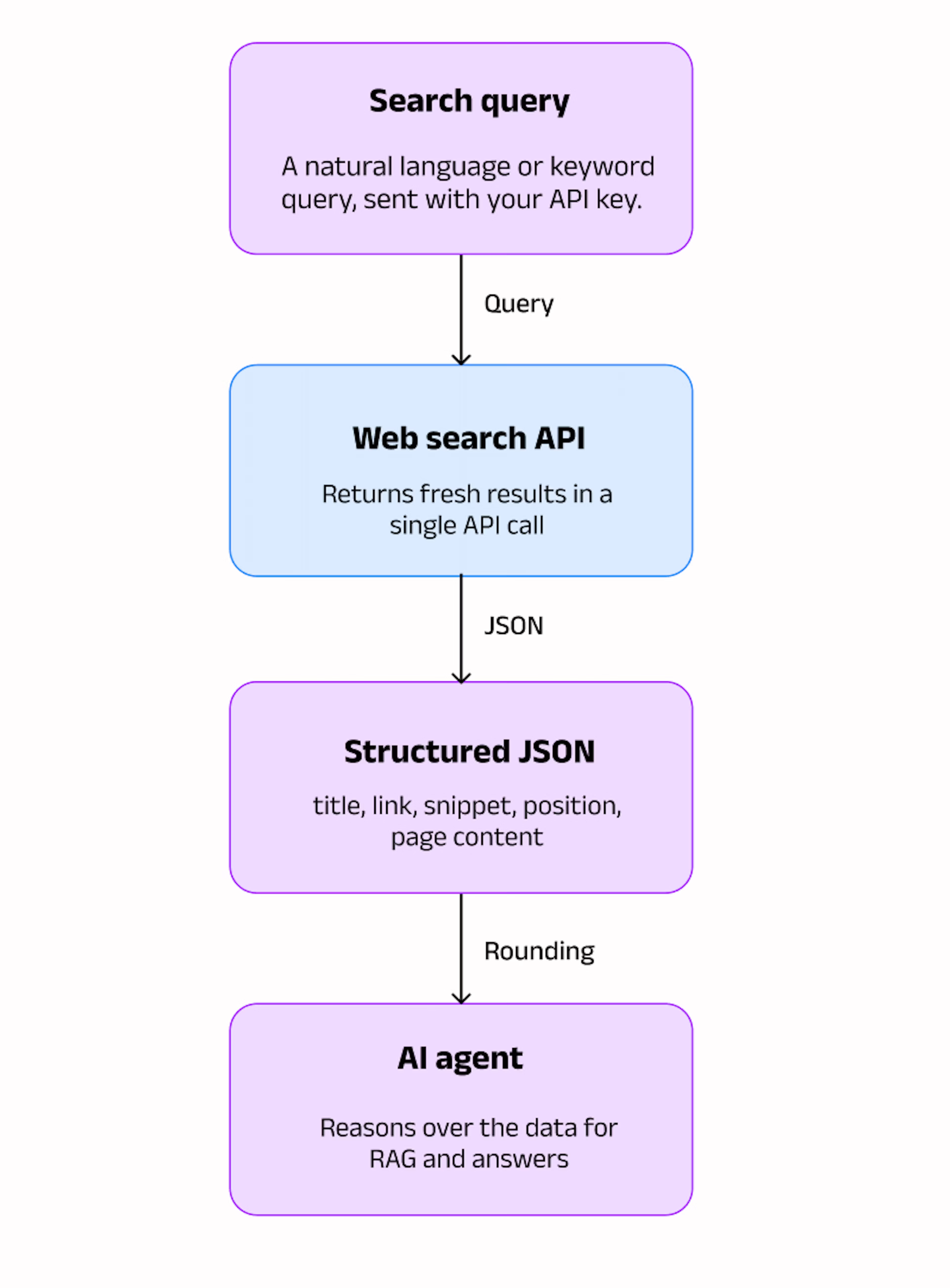
How web search APIs work
Our web search API comparison methodology
We evaluated each web search API against the criteria that decide real-world fit for AI and SEO workloads:
Result quality and coverage. Ranking quality, snippet quality, and how large or specialized the underlying search index is.
Latency. The API's response time in milliseconds. Lower latency matters most for real-time agent loops and multi-step agent workflows.
Data freshness. How quickly the search index updates, which is critical for date-sensitive and real-time search use cases.
Output formats. Whether you get basic search metadata, raw HTML, structured JSON, or full page content with built-in content extraction.
Pricing and free tier. Cost models, rate limits, free credits, and whether pricing is per request, per credit, or per result.
Compliance. GDPR alignment and zero data retention policies that ensure user queries are not stored.
Agent and MCP support. Availability of an MCP server, SDKs, and native integrations for AI tools and automation platforms.
Citations and provenance. The ability to trace answers back to source pages, which is essential for trustworthy RAG.
Documentation and SDKs. Clear docs, error management, and proper request handling for smooth integration.
Wherever possible, testing should employ real queries to assess API performance rather than relying on advertised figures alone. Uptime SLAs are also worth weighing for enterprise applications where reliability is non-negotiable.
10 best web search APIs
1. Oxylabs Fast Search API

Oxylabs’ Fast Search API is a high-speed, lightweight SERP scraper built specifically for AI and ML teams that need real-time search results at scale. It returns data in near real-time (under one second) and is designed to handle high-volume querying, comfortably processing millions of queries per day with guaranteed uptime.
The lightweight design is the key trade-off. For each search results page, the API returns a structured JSON payload with 10 organic results plus top stories and news, where each result includes the essentials: title, link, description, and SERP position. It intentionally leaves out ads, featured snippets, and extra metadata to maximize speed and scalability. When you need that richer data, the full Oxylabs Web Scraper API covers ads, AI Overviews, snippets, knowledge graph data, and more.
On the AI side, Oxylabs ships an official MCP server and AI Studio, a suite that includes AI-Search, AI-Scraper, AI-Crawler, AI-Map, and a browser agent, all reachable through MCP, SDKs, LangChain, and n8n. That makes it straightforward to wire real-time search data into agentic AI tools and RAG pipelines. Infrastructure runs on 177M+ IPs across 195 countries, backed by more than a decade of experience.
For compliance-sensitive teams, Oxylabs maintains zero data retention, holds industry-leading security certifications, aligns with global privacy standards, and covers its products with Technology E&O and Cyber Insurance.
Pros
Sub-second responses built for high-throughput, real-time AI workflows
Scales to millions of queries per day with guaranteed uptime
Strong AI tooling: MCP server, AI Studio, LangChain, and n8n
Enterprise-grade compliance, including zero data retention
Cons
Fast Search API output is deliberately lightweight; use the full Web Scraper API for ad, snippet, and knowledge graph data
Oriented toward teams building at scale rather than tiny hobby projects
Best for: teams that need fast, reliable, high-volume real-time search data to power AI agents, answer engines, and RAG at scale.
2. Firecrawl
Firecrawl is an AI-native platform that turns web pages into clean, LLM-ready markdown or structured JSON. Its /search endpoint is the differentiator: it combines search and full content extraction in a single API call, so instead of receiving 10 links you still have to fetch, you get search results with the underlying page content already extracted and cleaned.
The platform spans five core capabilities: Scrape, Crawl, Map, Search, and interactive browser actions. Search costs 2 credits per 10 results, and the free tier includes 1,000 credits per month, enough to prototype AI workflows before paying. Paid plans start around $16 per month for the Hobby tier, with higher tiers scaling into the hundreds of thousands of credits.
Firecrawl leans hard into developer experience, with official Python, Node, Go, and Rust SDKs plus native integrations for LangChain, LlamaIndex, and CrewAI. Its core is open source and self-hostable, which appeals to teams wary of vendor lock-in. It reports adoption across 150,000+ companies and more than a million developers.
Pros
Search plus built-in content extraction in one API call, returning clean markdown
Generous free tier and transparent credit pricing
Excellent SDKs and framework integrations for AI tools
Open-source core with a self-hosting option
Cons
Advanced rendering features consume credits faster, so budgeting requires care
Broad scraping focus means it is less of a pure, minimal search endpoint
Best for: developers who want web search and full page content together in one call for RAG and agent pipelines.
3. Tavily

Tavily is a web search API purpose-built for LLMs and RAG applications. Rather than returning raw HTML, it delivers clean, structured snippets and summaries with citations, ready to drop into a model's context. That RAG-first design is why it became a common default in the LangChain community. Tavily was acquired by AI cloud provider Nebius in February 2026 for a reported $275 million and continues to operate under its own brand.
The API exposes several operations: Search, Extract, Map, Crawl, and a multi-step Research call that synthesizes across sources. A basic search costs 1 credit and an advanced search costs 2, with a single Research call consuming more depending on depth. The free tier includes 1,000 credits per month with no card required, paid plans start at $30 per month for 4,000 credits, and pay-as-you-go runs $0.008 per credit.
Because Tavily returns extracted content directly, it can remove the separate scraping step in many search-triggered retrieval flows. It also supports domain include and exclude lists, topic filtering, and search-depth controls, and returns cited sources so answers stay traceable.
Pros
Designed for RAG and LLM applications, with citations built in
Clean structured output that plugs straight into agent frameworks
Simple free tier and predictable credit pricing
Strong LangChain and LlamaIndex support
Cons
Per-query cost climbs with advanced search and deep research calls
Credits do not roll over month to month
Best for: teams that want plug-and-play, cited web search for RAG pipelines and LangChain-based agents.
4. Exa

Exa (formerly Metaphor Systems) takes a different approach from every other option here: it uses embeddings for semantic search rather than keyword matching. Every indexed page is encoded as a vector, so a query returns conceptually similar pages even when the wording differs, which is powerful for research discovery and finding content that keyword-based search misses.
Exa runs on pay-as-you-go pricing with no monthly minimum. Standard search is $7 per 1,000 requests, with page contents for the first 10 results included since a March 2026 update. Deeper tiers cost $12 and $15 per 1,000, the Answer endpoint is $5 per 1,000, and standalone content retrieval is $1 per 1,000 pages. New accounts get $20 in credits at signup plus roughly $10 more each month. In early 2026, Exa launched Instant, a sub-150ms speed mode aimed at real-time agentic workflows. The company reports use by 400,000+ developers and 5,000+ companies, including Cursor.
The main caveat is that semantic search over an independent index behaves differently from Google results, so coverage of very niche or extremely time-sensitive queries can vary.
Pros
Semantic, embeddings-based search that surfaces conceptually related pages
Full page content returned for LLM reasoning
Pay-per-use with no monthly minimum and meaningful free credits
Instant mode for low-latency agent loops
Cons
Neural results differ from familiar keyword rankings and may miss some niche domains
Costs scale with extra results, content types, and deeper search modes
Best for: discovery-heavy research agents and semantic search where meaning matters more than exact keyword coverage.
5. Parallel
Parallel builds web infrastructure for AI agents, and its Search API is engineered around token efficiency. Instead of returning a list of links to go fetch, it returns ranked URLs with token-dense, compressed excerpts, which keeps the total number of downstream calls and tokens down in multi-step agent workflows.
The Search API offers multiple modes at different price and latency points: Turbo at roughly 200ms and Fast at under a second, both $1 per 1,000 requests, plus Basic and Advanced modes at $5 per 1,000 for deeper results. Pricing is per request rather than per token, so you know the exact cost of a query before you run it. The free tier advertises up to 5,000 requests per month, qualified startups can apply for credits, and the platform is SOC 2 compliant with a hosted MCP server. On the independent Artificial Analysis Search Index in August 2026, Parallel's advanced mode led the table.
Pros
Among the cheapest options at $1 per 1,000 for Turbo and Fast modes
Token-dense excerpts reduce total agent cost
Predictable per-request pricing and strong benchmark results
Multiple modes let you match spend to how much a query is worth
Cons
Deeper research tiers run seconds to minutes, so mode choice matters
Newer entrant, so the ecosystem is younger than incumbents
Best for: high-volume agent loops that need low latency, predictable pricing, and token efficiency.
6. SerpApi

SerpApi is one of the longest-running SERP API providers and remains the most feature-complete for pure search engine results. It reportedly supports 80+ search engines, including Google, Bing, Yahoo, Yandex, Baidu, DuckDuckGo, and specialized engines, and returns the richest structured output in the category: organic results, ads, People Also Ask, AI Overviews, Local Pack, Shopping, and knowledge graph data.
That depth comes at a premium. A free plan covers 250 searches per month, and paid plans start at $75 per month for 5,000 searches, which places SerpApi at the higher end on cost per search at low volume. In exchange you get excellent documentation, official SDKs, a LangChain library, and a U.S. Legal Shield offering legal protection for supported use. One item to note for continuity planning: Google filed legal action against SerpApi in December 2025; a court dismissed the case in July 2026, though the matter could be revisited.
Pros
Broadest search engine coverage and richest SERP feature parsing
Best-in-class documentation and SDK support
Established provider with a legal protection offering
Cons
Among the most expensive per search, with rigid subscription tiers
Reproduces existing search engines, so it inherits their structure and shifts
Best for: SEO tools, rank tracking, and competitive analysis that need deep SERP features and multi-engine coverage.
7. Brave Search API
The Brave Search API stands out because you are not doing proxy queries of Google or Bing. Results come from Brave's own truly independent, first-party index of the web, which has over 40 billion indexed pages, one of only a few web-scale indexes available through an open API. Brave refreshes more than 100 million pages daily and serves billions of searches monthly across its consumer search engine, and it tunes the index to reduce SEO spam.
Pricing is refreshingly simple. The Web Search endpoints, including the AI-optimized LLM Context endpoint, cost $5 per 1,000 calls, and each plan includes $5 in monthly credits that renew. Brave removed its old always-free tier in February 2026 in favor of these metered plans with recurring credits. The API is SOC 2 Type 2 certified and GDPR compliant, ships an official MCP server, and offers endpoints for web, news, images, video, local places, answers, and LLM context. Brave also markets its ability to offer true Zero Data Retention (ZDR), so queries are not stored.
Pros
Independent index of 40+ billion pages, not a proxy of other search engines
Flat, transparent $5 per 1,000 pricing with recurring credits
True zero data retention and official MCP server
Reduced SEO spam and daily index refreshes
Cons
Independent index has more long-tail gaps than Google on very niche queries
Some endpoints carry lower default concurrency limits
Best for: teams that want an independent search index with strong privacy guarantees for RAG and LLM grounding.
8. Google Custom Search JSON API

Google's Custom Search JSON API returns web or image results as JSON from a Programmable Search Engine. It gives 100 free queries per day, then costs $5 per 1,000 queries with a hard cap of 10,000 queries per day. Historically it was the go-to for developers who wanted Google search results as JSON.
The important 2026 context: this API is being retired. Google closed it to new customers and has told existing customers they have until January 1, 2027 to migrate before it is discontinued. It was also designed for site-restricted search across domains you configure, not open-web search at scale. Google now points developers toward Vertex AI Search, which searches a configured set of domains rather than the open web, so it is not a like-for-like replacement for general web search.
Pros
Official Google option with a simple JSON output
Low free daily allowance for small projects
Cons
Closed to new customers and discontinued on January 1, 2027
Built for site-restricted search, with a 10,000 queries per day cap
No open-web drop-in successor from Google
Best for: legacy integrations searching a fixed set of configured domains, though existing users should plan a migration now.
9. Decodo

Decodo (formerly Smartproxy) offers a SERP Scraper API as part of a unified web scraping platform running on its global proxy network. It ships scraping templates for Google and Bing, including Search with AI Overview, AI Mode, Lens, and Ads, with optional JavaScript rendering and precise geo-targeting. Results come back in whatever format fits your pipeline: JSON, CSV, Markdown, HTML, PNG, or XHR.
Pricing is approachable, with Core plans starting around $29 per month and effective rates that drop toward roughly $0.30 per 1,000 requests at volume, backed by a 7-day free trial. A unified API and an MCP server make it easy to plug into AI and no-code automation platforms. Decodo also offers a dedicated Fast Search API that returns real-time Google results in under a second, aimed at lightweight, high-speed lookups.
Pros
One of the lowest entry prices in the SERP category
Flexible output formats and precise geo-targeting
MCP server and quick setup for AI and no-code workflows
Backed by a large, reliable proxy network
Cons
Limited pay-as-you-go options compared with some rivals
Heavier JavaScript-rendered targets can slow response times
Best for: small and mid-sized teams that want affordable, flexible SERP data with solid proxy infrastructure.
10. ScrapingBee

ScrapingBee is a web scraping API with a dedicated Google Search API feature, aimed at developers who want general scraping and search engine results from a single tool. It manages proxy rotation and JavaScript rendering through headless browsers, and its Google endpoint parses organic results, featured snippets, sitelinks, publication dates, and People Also Ask answers with full text.
Billing uses a credit model: a basic request costs 1 credit, JavaScript rendering costs 5, and premium targets cost more, with plans starting at $49 per month for 250,000 credits and a 1,000-credit free trial. ScrapingBee is frequently praised for developer experience, with clean official SDKs and readable documentation, and typical responses land in the 1 to 5 second range.
Pros
Strong developer experience with clean SDKs and clear docs
Deep organic SERP metadata, including sitelinks and publication dates
One platform for both general scraping and Google search results
Cons
Credit multipliers for rendering and premium targets make costs harder to forecast
Broad scraping focus rather than a dedicated, minimal search endpoint
Best for: developers who want reliable Google SERP data alongside general-purpose web scraping in one API.
Main use cases for web search and search engine APIs
A web search API earns its place in very different stacks:
AI agents and agentic RAG. Real-time search keeps AI agents accurate by grounding responses in current web content, with citations and provenance so answers trace back to source pages. This is core to AI search for agents and multi-step agent workflows.
LLM grounding and RAG pipelines. AI-native search APIs return structured JSON or clean markdown that an LLM can consume directly, reducing hallucinations without a separate scraping step.
SEO tools and rank tracking. SERP APIs return organic results, ads, and search engine results as structured data for rank tracking, keyword research, and competitive analysis.
Market and price monitoring. Programmatic access to relevant pages powers competitive analysis and real-time monitoring across regions and languages.
Answer engines and chatbots. Fresh search results feed answer engines, AI chatbots, and virtual assistants that need timely, accurate responses.
Research and data collection. Semantic search and independent indexes help surface relevant pages for large-scale research and data extraction.
Choosing the right web search API
Choosing the right web search API depends on your application's use case, so start from what your app actually needs from the web, then let the category fall out of that:
Need Google's exact rankings and SERP features? A SERP API like SerpApi, Decodo, or ScrapingBee reproduces search engine results for SEO and ranking tasks. Oxylabs Fast Search API is the pick when you need those results at high volume in real time.
Building agentic RAG or LLM grounding? An AI-native search API like Firecrawl, Tavily, or Parallel returns cleaned, LLM-ready content with built-in content extraction and citations.
Doing research discovery or semantic search? Exa's embeddings-based index finds conceptually similar pages that keyword matching misses.
Want independence from Big Tech and strong privacy? Brave Search API serves results from its own index with zero data retention.
Then weigh the practical factors: cost models and rate limits, free tier and free credits for prototyping, latency, data freshness, output format, GDPR and zero data retention compliance, geographic and language support, MCP and SDK availability, and clear documentation. Always prototype on a free tier and run cost projections at your real query volume before committing, since headline per-query prices rarely capture the full bill.
If you want to delve deeper into more topics like this one, check out our blogs on web crawling, best web crawlers, or best agentic AI tools. If you want to learn more about LLMs and AI-native topics, check out our blogs about how AI agents work, agentic search, or agentic RAG.
Frequently asked questions
Is there a free web search API?
Yes. Most providers offer a free tier or free credits. Firecrawl and Tavily each include 1,000 credits per month, Exa gives $20 in signup credits plus around $10 monthly, Parallel advertises up to 5,000 requests per month, Brave includes $5 in recurring monthly credits, and Oxylabs offers a free trial plus AI Studio credits. Free tiers are ideal for prototyping before you evaluate paid plans.
Do web search APIs actually search the web?
Are search engine API and web search API the same thing?
What's the difference between a SERP API and a web search API?
How do AI agents use a web search API?
What should you look for in a web search API for RAG and LLM grounding?
Why does token efficiency matter when picking a web search API for agents?
Is a search API even needed, or can the agent just use a browser?
Do I still need a scraper if I'm using a web search API?
Forget about complex web scraping processes
Choose Oxylabs' advanced web intelligence collection solutions to gather real-time public data hassle-free.
About the author
Shinthiya Nowsain Promi
Technical Content Researcher
With a background in Computer Science, Shinthiya likes to turn technical jargons into clear, perspective-driven writing that rewards a reader's time rather than wasting it.
All information on Oxylabs Blog is provided on an "as is" basis and for informational purposes only. We make no representation and disclaim all liability with respect to your use of any information contained on Oxylabs Blog or any third-party websites that may be linked therein. Before engaging in scraping activities of any kind you should consult your legal advisors and carefully read the particular website's terms of service or receive a scraping license.
Related articles






Get the latest news from data gathering world
Scale up your business with Oxylabs®
Forget about complex web scraping processes
Choose Oxylabs' advanced web intelligence collection solutions to gather real-time public data hassle-free.