
What Is Semantic Search and How Does It Work?


Shinthiya Nowsain Promi
2026-10-07
8 min read
 AI Summary:
Semantic search returns results by meaning and intent rather than literal keyword matches, using NLP, AI, and vector embeddings to grasp what people actually mean. This guide breaks down how semantic search works step by step, how it compares to keyword, vector, and lexical search, where it struggles, and where it's used.
Semantic search is a data searching technique that interprets the meaning and intent behind a query rather than matching exact keywords. It returns relevant results even when they share no words with the search query, using natural language processing (NLP) and AI to understand how a person searches in everyday human language. This guide covers how semantic search works, how it differs from keyword, vector, and lexical search, where it falls short, and where it powers search engines and modern applications.
What is semantic search?
Semantic search is an approach to information retrieval built on semantics – the study of meaning in language. A semantic search engine represents both the query and the documents it stores as mathematical objects that capture contextual meaning, then measures how close they are in that space. Because semantic search engines compare concepts rather than characters, a search for "affordable laptop for students" can surface a "budget notebook for college" listing that contains none of the original words. This idea has roots in the semantic web, where data is structured so machines can interpret relationships between things – early visions paired a knowledge graph with an inference engine to derive new facts – though modern systems rely far more on machine learning than on hand-built ontologies.
How does semantic search work?
Modern semantic search systems turn language into numbers, then find the closest matches. Here are the five stages most semantic search algorithms move through, from the moment a user's query arrives to the moment ranked results come back.
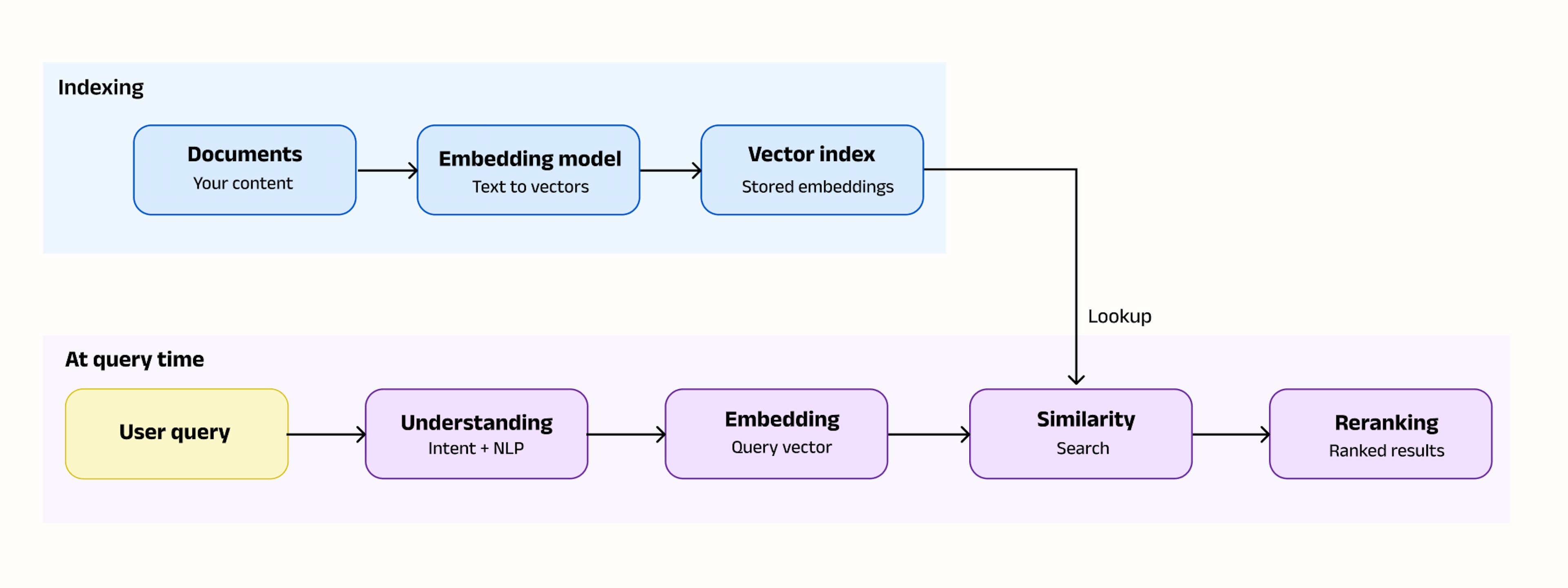
Stages of semantic search
Query understanding
When a user's query enters the system, query understanding is the first step. Natural language processing parses the text, resolves spelling and grammar, and works out the intent and context behind the words – whether the person wants a definition, a product, or a how-to. Some systems also weigh signals like search history or the user's geographical location. This stage decides what the searcher actually means, so a vague search query like "python speed" reads as a programming question, not a query about snakes.
Vector embeddings
Next, an embedding model converts both the query and the stored content into vector embeddings – long lists of numbers that represent semantic meaning in a high-dimensional space. Words and phrases with similar meanings land close together, so "car" sits near "automobile." These embeddings are produced by machine learning models trained on huge text corpora, and they are what let semantic search compare ideas instead of matching keywords.
Similarity search
With everything represented as vectors, similarity search finds the stored items whose embeddings sit nearest to the query vector. A distance metric such as cosine similarity scores how close two vectors are, and the top scorers become the candidate results. Comparing a query against millions of vectors one by one is slow, so production systems use approximate nearest neighbor algorithms to return relevant search results in milliseconds.
Indexing
Indexing is what makes that speed possible. Before any searching happens, the system builds a semantic index of all content embeddings, most often using a graph structure like HNSW (Hierarchical Navigable Small World) stored in a vector database. This index lets the engine jump straight to the most promising vectors rather than scanning the whole collection, keeping search performance high even as the amount of indexed data grows into the millions.
Reranking
The first pass favors speed over precision, so many semantic search systems add a reranking step. A more powerful model, often a cross-encoder, re-examines the top candidates and reorders them by how well each one truly answers the user's query. Reranking is more expensive per item, which is why it runs only on the shortlist. The payoff is a noticeable lift in relevance at the top of the search results.
Semantic search vs keyword search
To see what semantic search adds, it helps to understand how a traditional search engine handles keywords. Classic keyword search builds an inverted index of every term on every page, then ranks documents with statistical scoring. The best-known method is TF-IDF, which combines term frequency (how often a word appears in a document) with inverse document frequency (how rare that word is across the whole collection), so distinctive words count for more than common ones. Techniques like stemming reduce words to their root form, and synonym lists or query expansion try to bridge vocabulary gaps. This lexical approach is fast, transparent, and excellent when the user knows the exact words to type.
Its weakness is ambiguity and vocabulary mismatch. Keyword search rewards matching words, so a query and a relevant document that use different terms for the same concept may never meet, and a word with two meanings can pull in results the searcher never wanted. Semantic search closes that gap by comparing meaning rather than exact keyword matches, which is why the two are increasingly combined rather than treated as rivals.
Semantic search vs vector search
Semantic search and vector search are often used interchangeably, but they are not the same thing. Vector search is a mathematical technique for finding the vectors closest to a given vector in high-dimensional space. Semantic search is what you build with it: a full system that turns language into embeddings, runs vector search over them, and returns meaningful results. Put simply, all semantic search uses vector search, but not all vector search is semantic – the same similarity search machinery can power image recommendations, music suggestions, or fraud scoring, none of which involve language. The vector, the vector database, the index, and the scalability concerns are shared infrastructure; semantics is the layer you add on top.
What is hybrid search?
Hybrid search combines keyword scoring and vector similarity in a single pipeline, then merges the two ranked lists – commonly with reciprocal rank fusion – before an optional reranking pass. This gives you the exact-match precision of lexical retrieval and the conceptual reach of semantic search at once. Keyword scoring handles product codes, names, and rare terms that embeddings tend to smooth over, while vector similarity handles paraphrases and intent. If you are choosing between semantic and keyword search, the honest answer for most production systems is both.
Semantic search vs lexical search
Lexical search is the formal name for the word-level matching that keyword engines perform: it operates on the literal tokens in a query and a document. Semantic search operates one level up, on meaning. Where a lexical system sees the string "jaguar" as a single token, a semantic system reads the surrounding context to place it in the right semantic field – the cat, the car, or the operating system – and matches accordingly. The practical difference is understanding: lexical search matches symbols, while semantic search models what those symbols mean. Most search bars you use today blend both, leaning on lexical precision for names and identifiers and on semantic understanding for everything expressed in natural language.
How AI and LLMs power semantic search
Semantic search sits squarely in the field of artificial intelligence. The quality of the meaning it captures depends almost entirely on the AI models behind it, and recent advances in NLP and large language models have moved semantic search from a research curiosity into everyday infrastructure.
Natural language processing
Natural language processing (NLP) is the branch of AI focused on getting machines to process human language. In semantic search, NLP handles the groundwork: breaking text into tokens, resolving grammar and references, and recognizing entities so the system knows that "Apple" the company differs from the fruit. Decades of NLP research into how to represent knowledge and context in a form machines can compute are what make meaning-based retrieval feasible at all.
Large language models and RAG
Large language models (LLMs) pushed semantic search forward by producing far richer representations of language than earlier methods. They also created a headline use case: retrieval-augmented generation (RAG). In a RAG pipeline, semantic search retrieves the most relevant passages from a knowledge base, and the LLM uses that context to generate a grounded answer instead of relying on memory alone. This pairing underpins most AI assistants that answer questions over private or current data, and it is a core reason teams turn to solutions like Oxylabs' AI data pipelines to feed real-time web content into RAG workflows.
Choosing an embedding model
The embedding model is the single biggest lever on retrieval quality. Options range from hosted APIs such as OpenAI's text-embedding-3 and Voyage AI to open-source models like BAAI's BGE-M3 and NVIDIA's NV-Embed, many of them benchmarked publicly on the MTEB leaderboard. Higher benchmark scores help, but the decisive test is how a model performs on your own data, your languages, and your latency and cost limits. General-purpose embeddings also smooth over exact identifiers like SKUs, which is one more reason hybrid retrieval is common in production.
Where does semantic search fall short?
Semantic search is powerful, but it is not a default win for every situation. It demands significant computational resources: generating embeddings, storing them, and running similarity search at scale cost more in hardware and money than a lean keyword index. Accuracy depends heavily on data quality – embeddings built from messy or thin content return weak results, and the model can misjudge ambiguity or surface something plausible but wrong. Exact lookups such as order numbers or error codes are still better served by keyword search. Evaluation is its own challenge, since relevance is subjective and teams need labeled queries and metrics like nDCG to measure whether results are improving. And scalability, while solved in principle by approximate indexing, still requires careful tuning as unstructured data grows.
What are the use cases of semantic search?
Semantic search shows up anywhere people express what they want in natural language and expect relevant results in return.
E-commerce and product discovery
In ecommerce, semantic search powers product discovery that survives vague, conversational queries. A shopper who types "warm jacket for winter hiking" gets parkas and insulated shells even if those product titles never use the word "warm." Matching on intent rather than exact word matches reduces dead-end "no results" pages and supports personalization based on signals like search history. Retailers on large e-commerce platforms increasingly pair it with structured datasets of product information to keep catalogs current and lift customer engagement.
Enterprise and internal site search
Inside organizations, semantic search improves enterprise search and internal site search across wikis, tickets, contracts, and documents. Employees rarely remember the exact title of a file, so meaning-based retrieval surfaces the right document from a partial or paraphrased description. The same technology behind a public search engine improves knowledge discovery internally, cutting the time staff spend hunting for information and improving user satisfaction.
RAG and AI assistants
Retrieval-augmented generation is the fastest-growing use case. Chatbots, support assistants, and research tools use semantic search to pull relevant passages from a corpus and feed them to an LLM, so answers stay grounded in real sources rather than the model's training data. Because these assistants often need fresh, public web information, teams connect them to live data pipelines – for example, Oxylabs' Web API – to keep retrieval current.
Conclusion
Semantic search has moved from a niche research idea to the retrieval layer behind everyday tools, because it does one thing keyword search cannot: it matches meaning and intent instead of literal words. Understanding the pipeline – query understanding, vector embeddings, similarity search, indexing, and reranking – makes it easier to see where it shines, such as conversational queries, product discovery, and RAG, and where keyword or hybrid retrieval still earns its place. For most production systems, the real question is not semantic search versus keyword search, but the right blend of both, fed by fresh, well-structured data.
To delve deeper into LLMs and AI territory, see our guides on data grounding, semantic chunking, semantic search tools, agentic search, and agentic RAG.
Frequently asked questions
What is semantic search in simple terms?
In simple terms, semantic search finds results by what they mean rather than the exact words they contain. If you search "how to make my laptop faster," it understands the intent and returns performance tips even when a page never uses the word "faster." It reads your query the way a person would, not as a string of characters to match.
How is semantic search different from keyword search?
Is semantic search the same as vector search?
What is a semantic search engine?
About the author
Shinthiya Nowsain Promi
Technical Content Researcher
With a background in Computer Science, Shinthiya likes to turn technical jargons into clear, perspective-driven writing that rewards a reader's time rather than wasting it.
All information on Oxylabs Blog is provided on an "as is" basis and for informational purposes only. We make no representation and disclaim all liability with respect to your use of any information contained on Oxylabs Blog or any third-party websites that may be linked therein. Before engaging in scraping activities of any kind you should consult your legal advisors and carefully read the particular website's terms of service or receive a scraping license.
Related articles





The whole web, one API call away
Try Oxylabs' Web API to search the web and extract fresh data from any URL, ready for your AI workflows.

Get the latest news from data gathering world
Scale up your business with Oxylabs®
The whole web, one API call away
Try Oxylabs' Web API to search the web and extract fresh data from any URL, ready for your AI workflows.