
 AI Summary:
Augustinas and Mindaugas discuss the essential role of proxies in web scraping, specifically how they help avoid IP bans and CAPTCHAs by masking a user's identity. This episode highlights the reliability risks of free proxies compared to paid services and stresses the importance of ethically sourcing residential IP addresses from real devices.
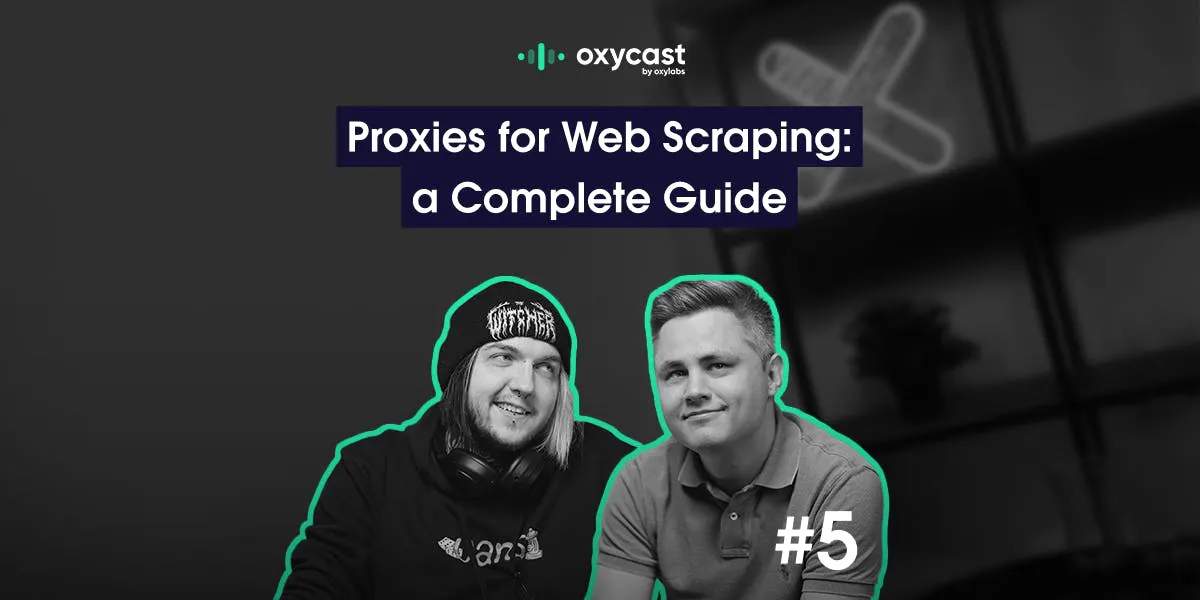
In the 5th episode of our podcast, OxyCast host and Software Engineer Augustinas Kalvis will be talking to Mindaugas Dunderis about proxies and how they go hand-in-hand with public data scraping. Let’s take a closer look at what Augustinas and Mindaugas will be discussing exactly:
What is a proxy, and what is it used for?
In its simplest form, a proxy is an intermediary between you and the website you’re visiting; it changes your IP address and masks your true identity. Proxies can be used for different purposes, one of them being web scraping. Some websites may not be particularly keen on bots scraping their data, which may result in CAPTCHAs or IP bans. However, with a proxy, you can change your IP address multiple times and avoid these issues when scraping large entities of public data.

Free vs. paid proxies: why proxy origins matter
Across the internet, you may come across free proxies available for anyone to use. Of course, not paying a penny sounds appealing, doesn’t it? However, using free proxies from shady sources poses many risks, Mindaugas explains – it’s not known how they’re obtained and what other people may be using them for. Not to mention, free proxies can be highly unreliable when it comes to scraping large amounts of public data.
Keep all that in mind when picking a reputable free proxy provider. Trusty providers are usually paid services, but they tend to offer some free proxies for smaller tasks.
Using paid proxies will only secure you and your acquired data and ensure a smooth data delivery process.

“Scraping at scale requires reliability. When you’re running a project that requires constant, uninterrupted data flow, you need reliable, fast-paced, always-available proxies. Meanwhile, the free proxies you’re using today may not even be available tomorrow.”
– Mindaugas Dunderis, Product Owner at Oxylabs
How are Residential Proxies acquired?
One of the most common proxy types is Residential Proxies – these proxies use real IP addresses supplied by Internet Service Providers to homeowners. Residential Proxy IP addresses are attached to real, physical devices, and using them makes it easy to replicate organic human behavior.
As Mindaugas mentions many times in the episode, the origins of a proxy are highly important. It’s actually crucial that Residential Proxies are acquired in an ethical manner whereby homeowners give consent and are financially rewarded. In the podcast, Mindaugas goes into more detail about the proxy acquisition process, specifically in Oxylabs. You can also check some of our blog posts where we talk about the Residential Proxy procurement process that adheres to the highest ethical standards in our company:

Final note
We hope you’ll enjoy this episode and find it insightful. Besides the topics we mentioned above, Augustas and Mindaugas will also discuss why a location of a proxy may be important when scraping; they also compare Residential vs. Datacenter Proxies and which one is best suited for specific cases. Finally, Mindaugas will tell why Oxylabs calls themselves a “front runner in innovations” and share what unique features we offer.
As always, if you have any questions or a topic you want our experts to cover, feel free to email us at events@oxylabs.io. We highly value your feedback and promise to look into every suggestion!
Forget about complex web scraping processes
Choose Oxylabs' advanced web intelligence collection solutions to gather real-time public data hassle-free.
About the author

Vytenis Kaubrė
Technical Content Researcher
Vytenis Kaubrė was a Technical Content Researcher at Oxylabs. Creative writing and a growing interest in technology fueled his work, where he researched and crafted technical content while honing his skills in Python. Off duty, he could often be found working on personal projects, learning about cybersecurity, or relaxing with a book.
All information on Oxylabs Blog is provided on an "as is" basis and for informational purposes only. We make no representation and disclaim all liability with respect to your use of any information contained on Oxylabs Blog or any third-party websites that may be linked therein. Before engaging in scraping activities of any kind you should consult your legal advisors and carefully read the particular website's terms of service or receive a scraping license.
Related articles


Oxylabs Launches IP Transparency Tool for Next-Level Visibility into Ethically-Sourced Residential Proxies

Vytautas Kirjazovas
2026-09-10

Get the latest news from data gathering world
Scale up your business with Oxylabs®
Forget about complex web scraping processes
Choose Oxylabs' advanced web intelligence collection solutions to gather real-time public data hassle-free.