

 AI Summary:
A setup guide for Oxylabs Residential Proxies, real residential IP addresses for collecting public data without disruptions. Walks through creating a proxy product instance and sending a first cURL request, then setting location targeting (down to city or ZIP) and session control to keep the same IP. Also covers advanced filters by IP version and operating system, a response-codes table, the Endpoint Generator for building and exporting endpoints, and where to track usage stats.
Oxylabs Residential Proxies are all about ethically sourced IPs associated with real internet users and real households. With these IP addresses, you can access region-exclusive content and collect public data without disruptions.
In this guide, you’ll find all the essential information needed for a smooth start with Oxylabs Residential Proxies. You can also teach your coding assistant or AI agent all about Residential Proxies in just a few steps with Agent Skills. Learn how.
Setting up Residential Proxies
1. Register and create an instance
To start with Residential Proxies, head to the Oxylabs Dashboard and create an account.
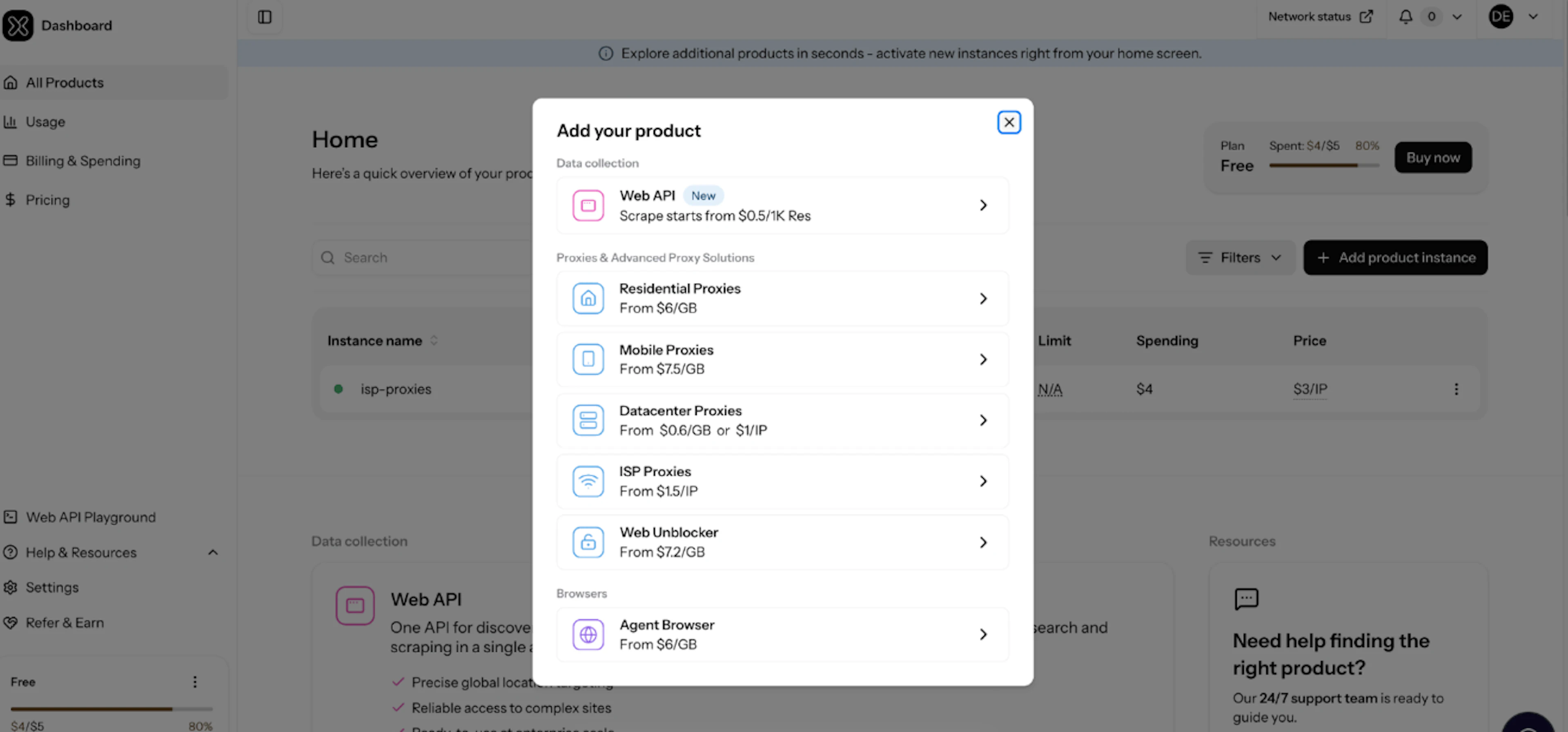
There, click + Add product instance and select Residential Proxies. Then set an instance name, choose an authentication method, and create the product instance.
2. Get instance credentials
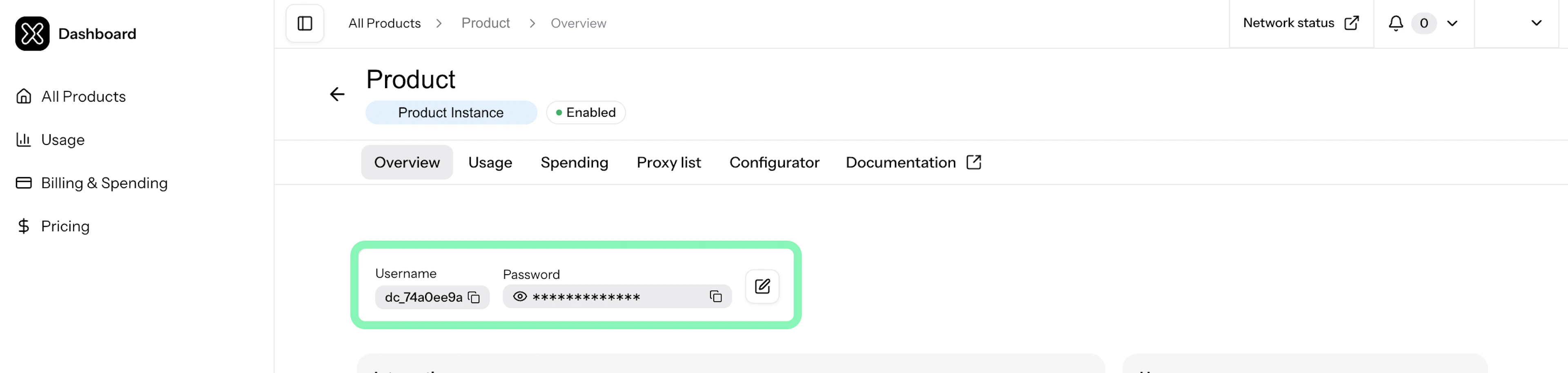
Open your Residential Proxies instance from the dashboard home section. There, look for your new proxy instance credentials at the top of the overview. These credentials are your access to the IPs.
Starting with Residential Proxies
Making a basic request
Once a product instance is created, you can use a simple cURL test example that you can run in your terminal or any other setup you’re using.
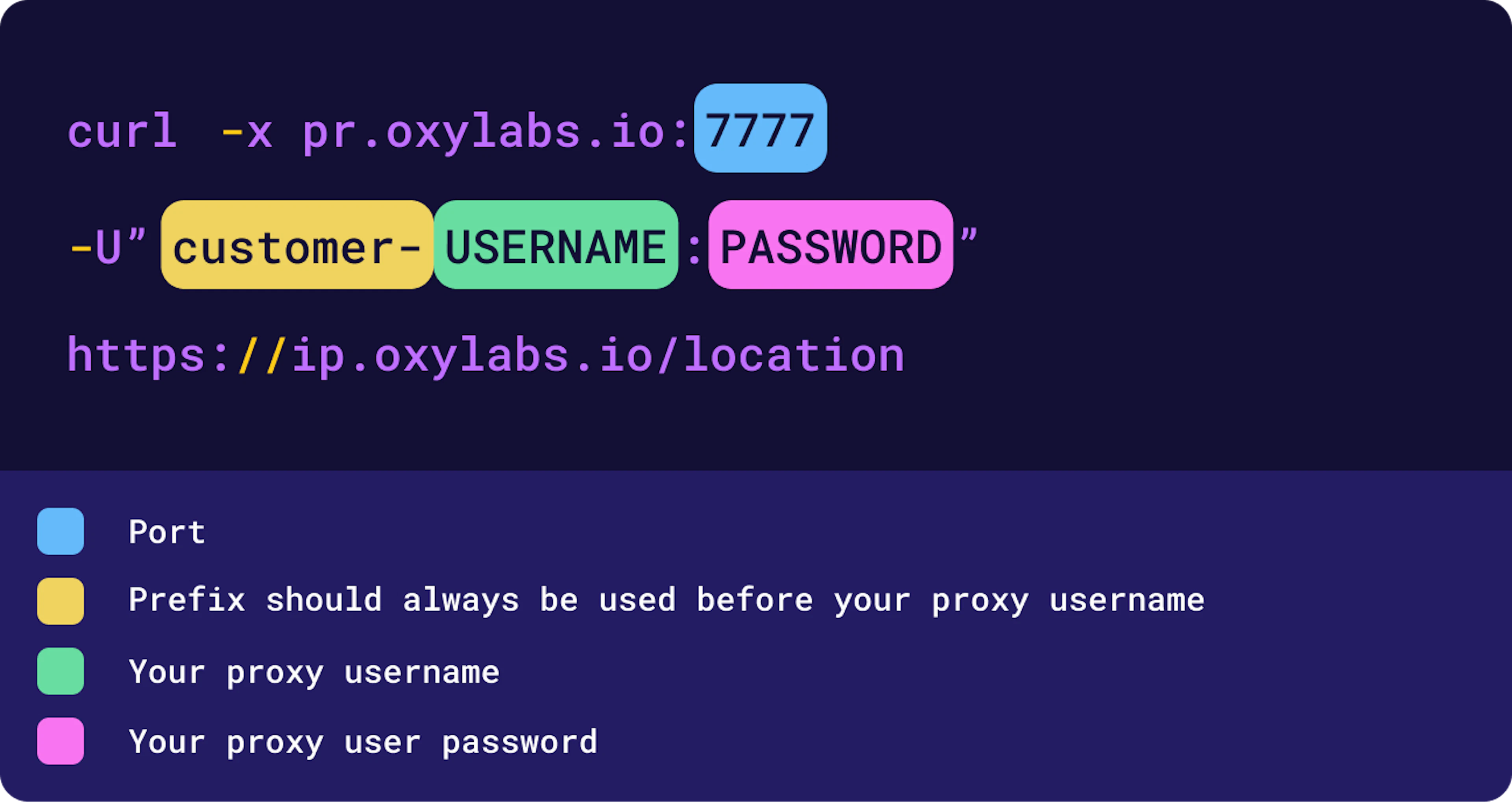
Here's the same query in the code format for you to copy:
curl -x pr.oxylabs.io:7777 -U "customer-USERNAME:PASSWORD" https://ip.oxylabs.io/locationPaste the given cURL in your terminal or other setup, replace USERNAME and PASSWORD with your credentials, execute the request, and then you’ll get your Residential IP address.
Location settings
Using a single backconnect entry node, you can set up targeting on the following levels via additional parameters in the username:
Below is a sample credentials structure with the country and city parameters:
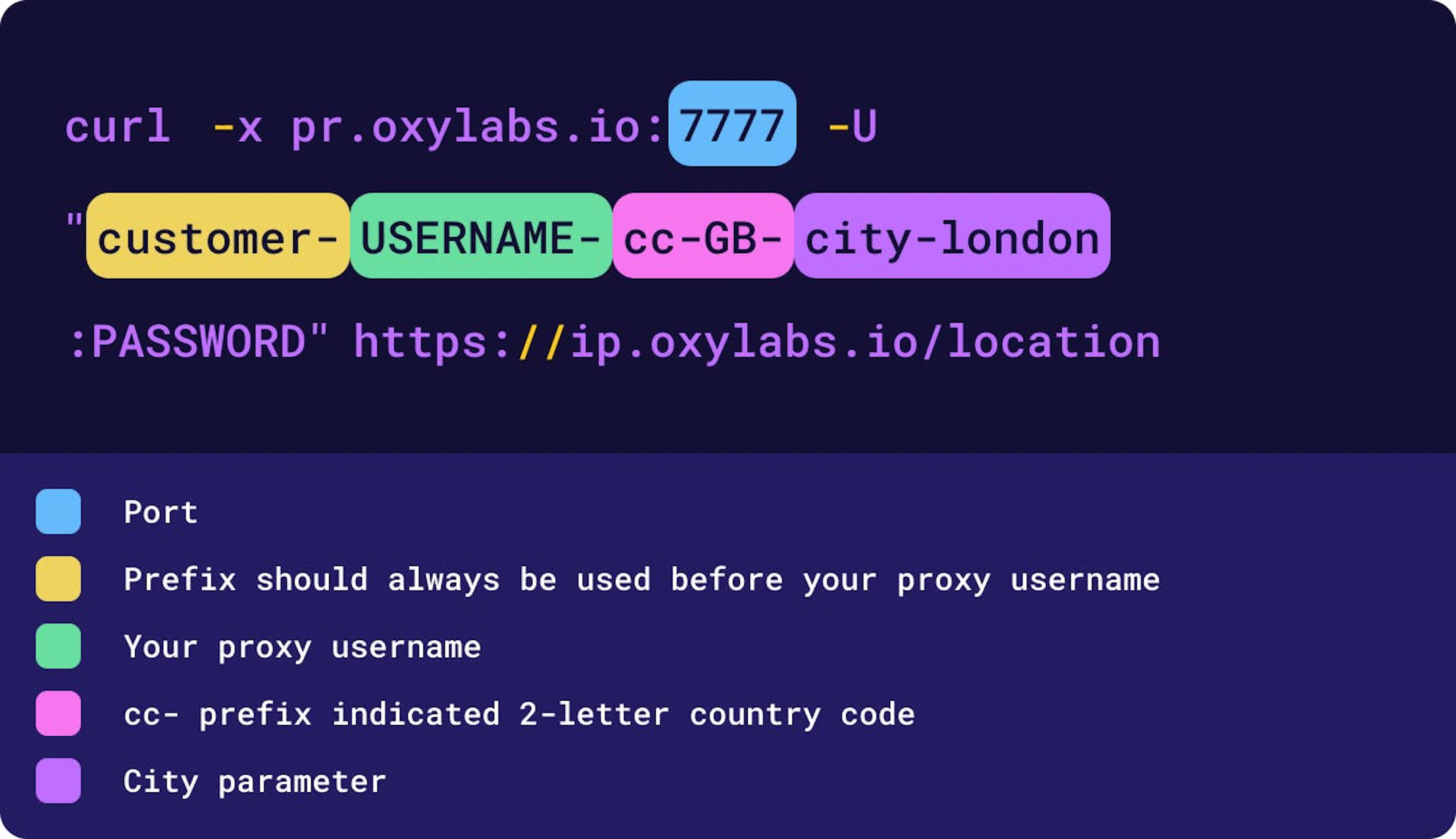
Here's the same query in the code format for your convenience:
curl -x pr.oxylabs.io:7777 -U "customer-USERNAME-cc-GB-city-london:PASSWORD" https://ip.oxylabs.io/locationSession control
You can also use session control to keep the same proxy for multiple requests. You can do so by adding sessid-abc12345 to your username string.
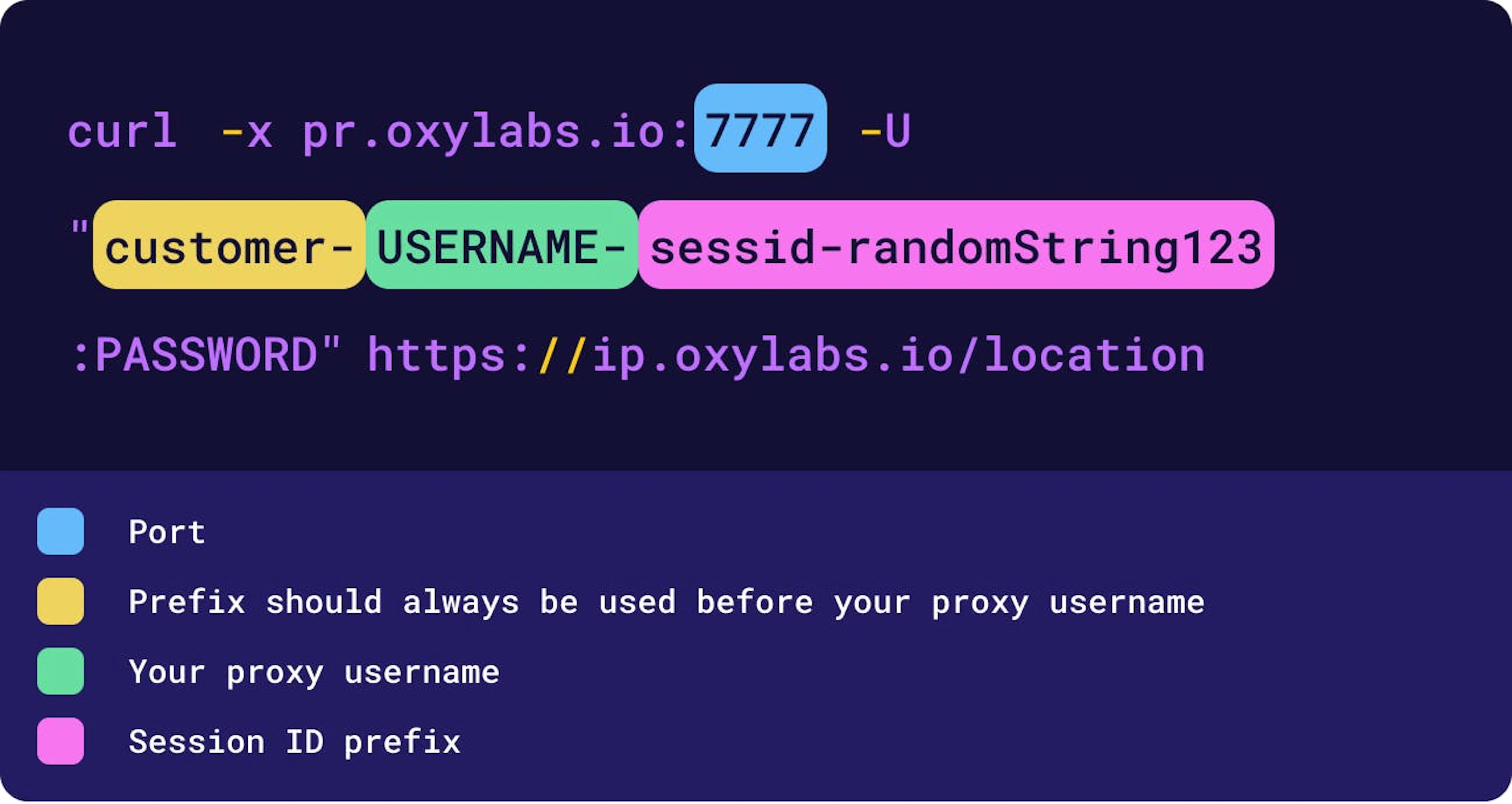
Here's the same query in the code format for your convenience:
curl -x pr.oxylabs.io:7777 -U "customer-USERNAME-sessid-randomString123:PASSWORD" https://ip.oxylabs.io/locationThe default session time is 10 minutes. However, you can prolong it up to 24 hours with the help of the sesstime parameter. See the list of all the supported parameters and how to use them in our documentation here.
If you need the same IP for the whole session, you can also use the sessid_oneip parameter. This session type keeps the original IP for as long as the proxy is available, up to the configured session duration. Unlike standard sessid sessions, no new IP will be assigned if the original proxy IP becomes unavailable. Instead, the request will return a 502 error.
Note: You’ll need to replace USERNAME and PASSWORD in the cURL example with your proxy user credentials. Keep in mind that each request returns a new IP address as Oxylabs Residential Proxies rotate automatically.
For more details or examples in other programming languages, visit our documentation.
Proxy protocols
Oxylabs Residential Proxies support four primary connection protocols depending on your scraping requirements:
HTTP (http://) and encrypted HTTPS (https://) for traditional web automation
SOCKS5 (socks5h://) for broad TCP/UDP traffic
HTTP/3 (via MASQUE) for native QUIC connections.
While standard HTTP/HTTPS and SOCKS5 endpoints cover the majority of traditional scraping tasks, HTTP/3 provides native compatibility for more reliable connections with sites running modern web infrastructure. To explore full technical specifications, port details, and setup requirements for each protocol, visit our Protocols Documentation.
Advanced filters
Advanced filters allow you to narrow down the Residential Proxy pool based on the Internet Protocol (IP) version or platform (operating system) by using additional parameters in the proxy username string.
Note: Enabling advanced filtering may require a short KYC verification process.
IP version
IP version filtering allows you to filter proxies by Internet Protocol (IP) version. By default, Residential Proxies include both IPv4 and IPv6 addresses, but now the proxy pool can be filtered to receive only IPv4 or only IPv6 proxies.
What to do:
Decide which IP version is supported by your target website.
Add the ipversion parameter to your proxy username string.
Use ipversion-4 to receive IPv4 proxies or ipversion-6 to receive IPv6 proxies.
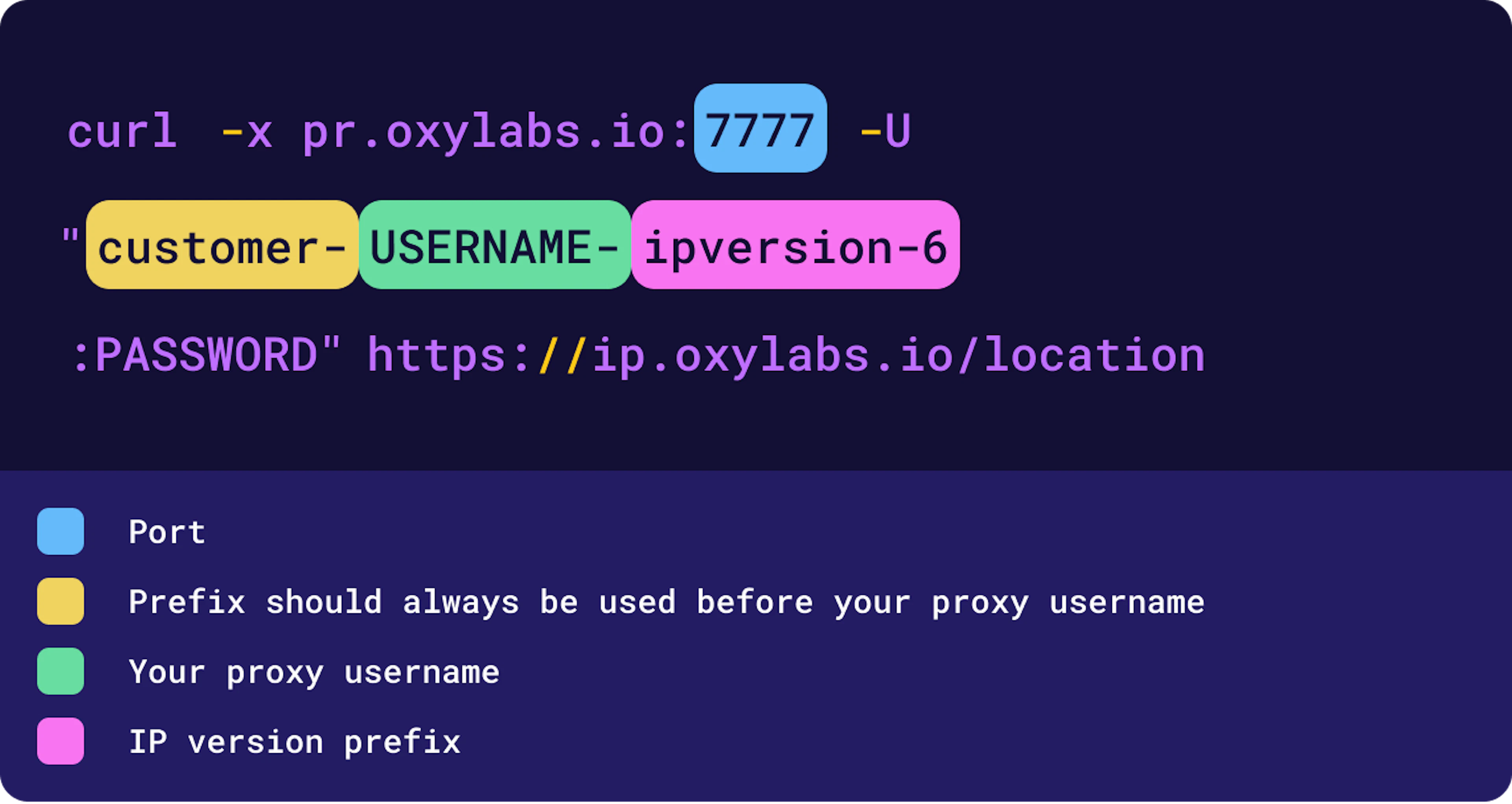
Below is the same example of a request using the IP version parameter but in code:
curl -x pr.oxylabs.io:7777 -U "customer-USERNAME-ipversion-6:PASSWORD" https://ip.oxylabs.io/locationNote: Residential Proxies are dynamic, so availability cannot be guaranteed when combining IP version filtering with specific locations (for example, city or ZIP code).
Platform (OS)
Platform filtering lets you select the operating system of the residential proxy for the Transmission Control Protocol (TCP) connection. This makes it easier for the proxy’s device environment to match your client setup.
What to do:
Identify the operating system your request is intended to match.
Add the platform parameter to your proxy username string.
Select one of the available values: windows, macos, linux, android, or ios.
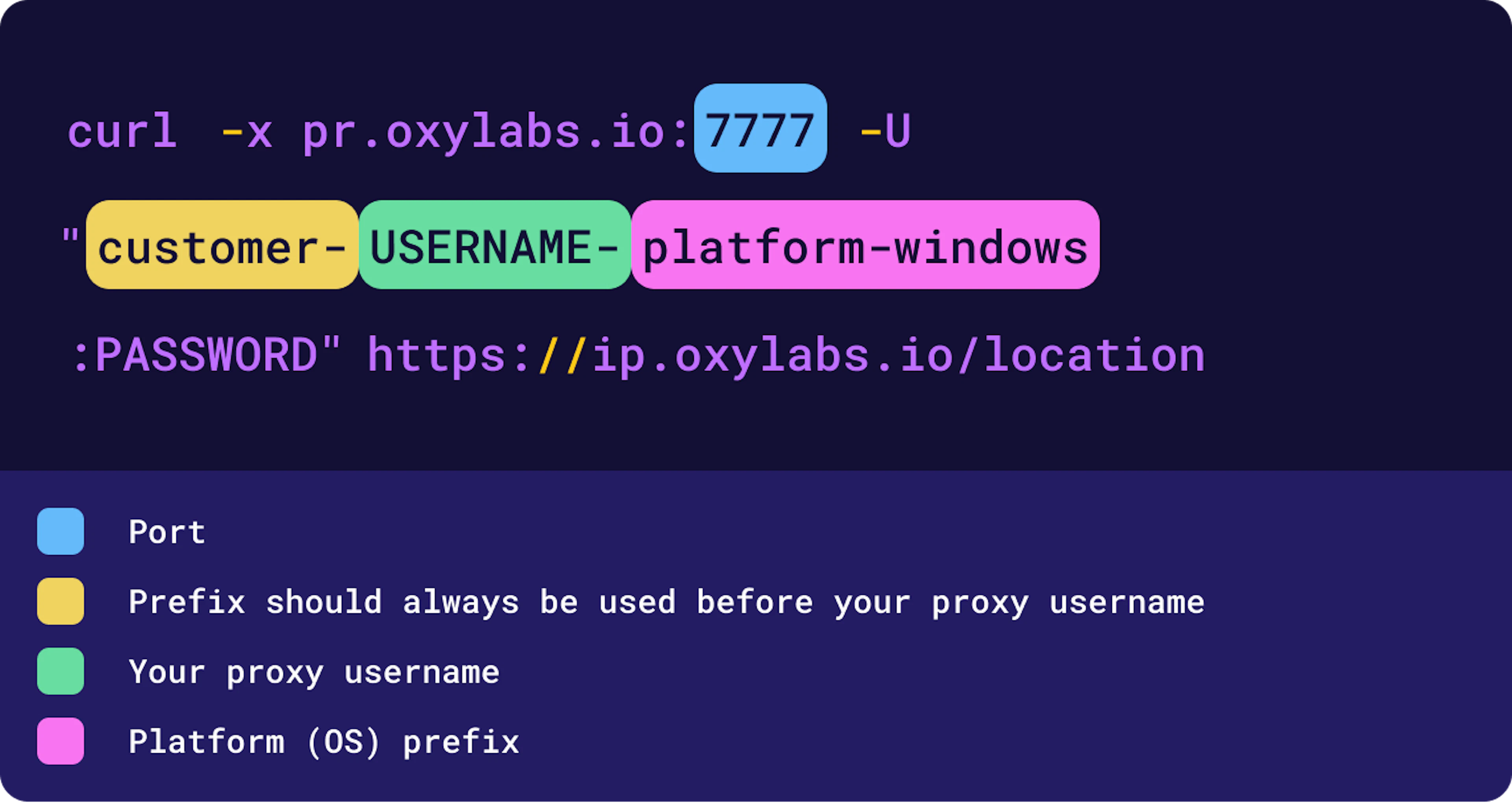
Here’s how a request with the platform parameter looks in code:
curl -x pr.oxylabs.io:7777 -U "customer-USERNAME-platform-windows:PASSWORD" https://ip.oxylabs.io/locationNote: Advanced filters can also be used alongside location targeting and session control covered above. For more details on advanced filtering, see our documentation.
Response codes
See the most common response codes in the table below:
| Response code | Error message | Description |
|---|---|---|
400 |
Bad Request | The request lacked a specified host for connection or encountered a general error while parsing an HTTP request. |
407 |
Proxy Authentication Required | The request is missing proxy authentication details, or the provided username or password is incorrect. |
500 |
Internal Server Error | The proxy server has encountered an internal error. |
502 |
Bad Gateway | The IP associated with your session ID is no longer accessible, or our available exit nodes do not match your specified criteria at the moment. |
522 |
Timeout | A proxy server didn't receive a timely response from the upstream server. Please attempt the request again. |
525 |
No Exit Found | The proxy was unable to locate an exit node that fulfills the request. |
Requests with errors originating from our infrastructure will additionally include an X-Error-Description response header, which will contain details about the error and what you should do next to resolve it. If you encounter any other response code, contact our 24/7 Customer Support for help.
Using Endpoint Generator
The Endpoint Generator is an automated tool in Oxylabs Dashboard that’s designed to generate custom lists of Residential Proxy endpoints. Endpoint Generator can be found in your Residential Proxy product instance Overview.
We suggest using our Endpoint Generator to easily retrieve a list of endpoints by selecting the necessary parameters. With this tool, you can retrieve a list of endpoints that include:
Region – a region based on your location.
Proxy protocol – choose from available proxy protocols: HTTP, HTTPS, or SOCKS5.
Endpoint type – you can choose between backconnect or country entry.
Location settings – select a specific proxy country or city location. Alternatively, leave Any to get a random proxy location.
Session type – you can choose from a sticky session to keep your IP address, a rotating session to get a new IP address with each new request, or a one-IP sticky session that doesn’t switch IPs if the connection breaks before the session duration ends.
Session duration – Choose the session duration on the slider for your sticky session between 1 minute and 24 hours.
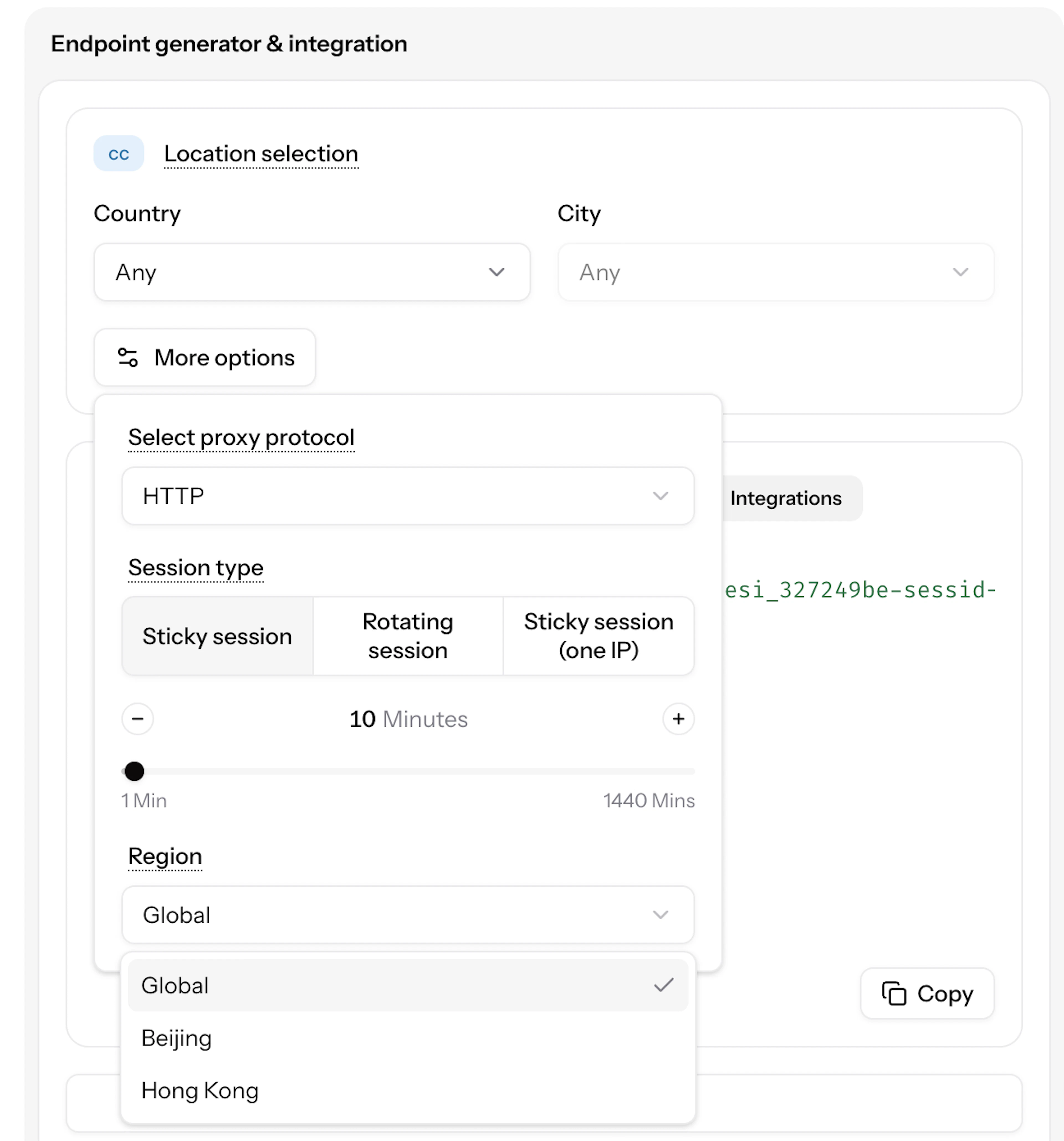
Once you have the parameters set up, choose from popular options like cURL, Python, PHP, Node.js, GO, Java, or get integration details (host, port, username/password, and connection protocol)
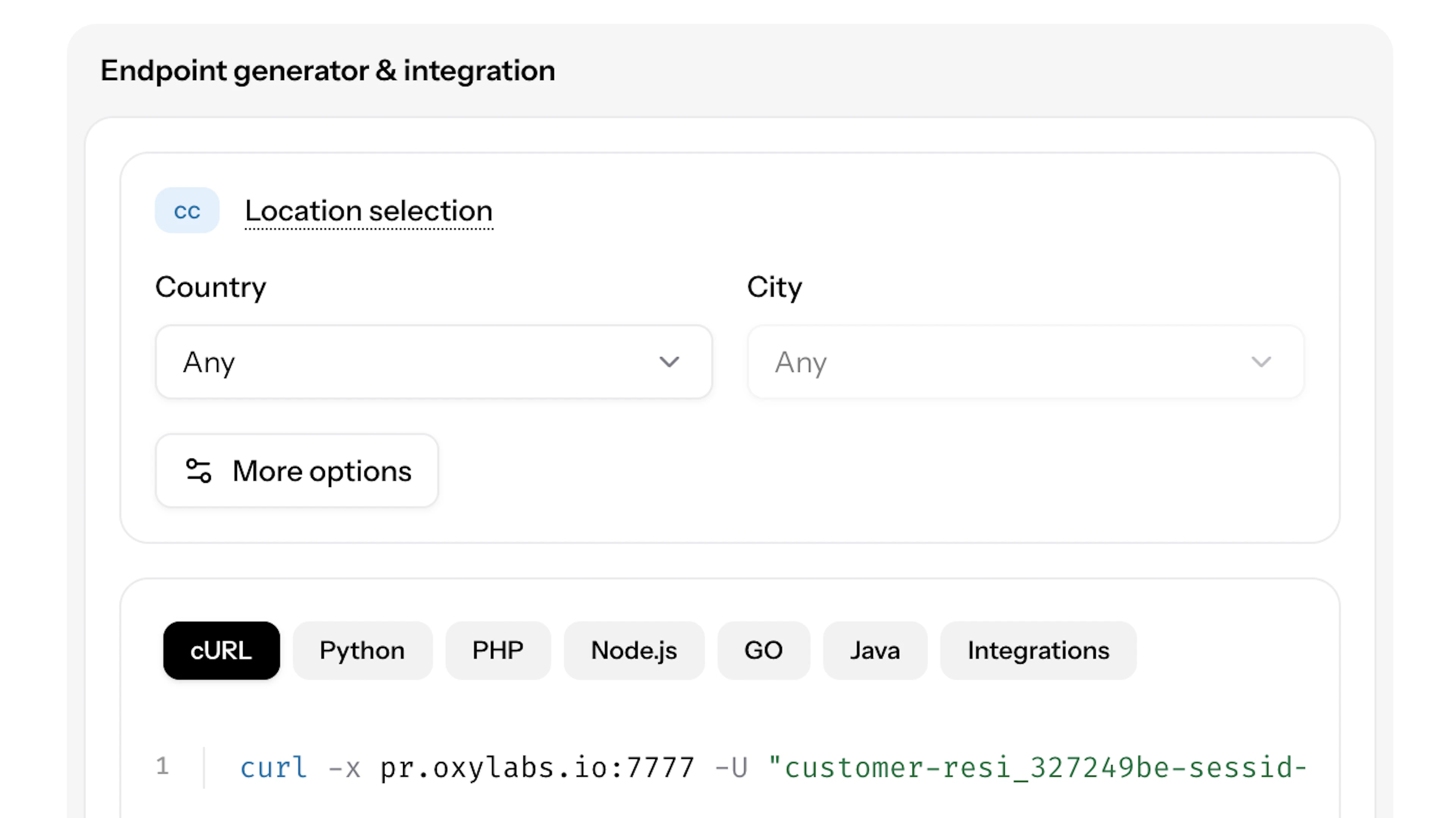
Overall, the Endpoint generator is a more convenient way to set up your endpoints and export them. You can find more detailed information in our documentation.
Note: The purpose of the Endpoint generator is to create endpoints only. You need your own terminal or other setup to put the endpoints to use.
Usage statistics
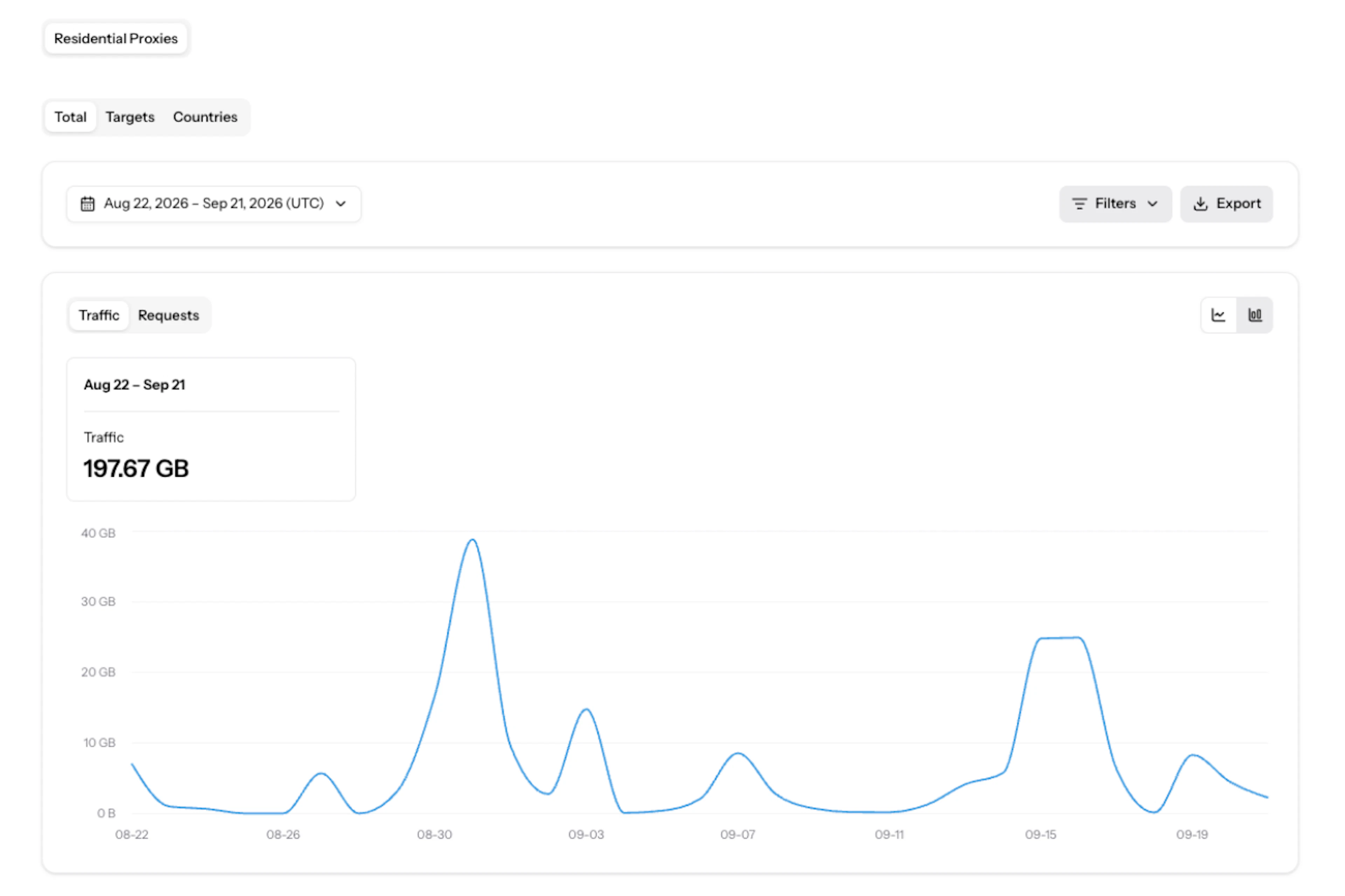
The Usage section of your product instance lets you see detailed information on how much traffic you use in any time range, check daily breakdowns, and track the number of successful or failed requests. You can see usage graphs for any selected period and filter by targets or countries.
Additional resources
If you have any questions or want to give Oxylabs Residential Proxy Servers a try with the free credits we offer, contact our Support Team. Learn how to fix common proxy error codes, such as 502 Error Cloudflare by following our guides.
Also, check out other developer-focused resources for more insights:
People also ask
Are there any restricted targets?
Yes. To prevent abuse, some websites are restricted on our Residential Proxy network. The list includes but is not limited to:
All Apple domains, including iTunes and App Store
All Google domains, including Play Store
Entertainment (e.g., Playstation)
Banking and other financial institutions
Government websites
Streaming
Ticketing
LinkedIn
Mailing
If you have questions about a specific target, please contact our Customer Support team for more information.
Is Public API available with Residential Proxies?
Is whitelisting authentication available?
What is Oxylabs’ refund policy?
What is an Endpoint generator, and when should I use it?
What are the technical requirements to start using Residential Proxies?
How do you create a fingerprint for successful scraping jobs?
Can I get a free trial for Residential Proxies?
Which protocols are supported by Oxylabs Residential Proxies?
About the author

Maryia Stsiopkina
Former Senior Content Manager
Maryia Stsiopkina was a Senior Content Manager at Oxylabs. As her passion for writing was developing, she was writing either creepy detective stories or fairy tales at different points in time. Eventually, she found herself in the tech wonderland with numerous hidden corners to explore. At leisure, she does birdwatching with binoculars (some people mistake it for stalking), makes flower jewelry, and eats pickles.
All information on Oxylabs Blog is provided on an "as is" basis and for informational purposes only. We make no representation and disclaim all liability with respect to your use of any information contained on Oxylabs Blog or any third-party websites that may be linked therein. Before engaging in scraping activities of any kind you should consult your legal advisors and carefully read the particular website's terms of service or receive a scraping license.
Related articles


Residential Proxies starting at $6
Make the most of our stable proxy pool with over 175M Residential IPs covering 195 countries.

Get the latest news from data gathering world
Scale up your business with Oxylabs®
Residential Proxies starting at $6
Make the most of our stable proxy pool with over 175M Residential IPs covering 195 countries.