
Best Web Scraping Companies in 2026



Enrika Pavlovskytė
Last updated by Danielė Virinaitė
2026-10-05
9 min read
 AI Summary:
This article reviews several web scraping companies and the technologies they offer. These web scraping services range from AI-powered automation and no-code platforms to advanced APIs and proxy networks. The solutions are designed to help businesses collect web data efficiently so they can gain competitive intelligence and make better strategic decisions.
Web data has become a key resource for businesses, driving strategic decisions and competitive insights. With the market projected to grow at a 13.2% CAGR through 2036, more companies are turning to web scraping solutions to collect and analyze data efficiently.

What is web scraping?
Web scraping is an automated process of collecting large amounts of publicly available web data to inform strategic business decision-making. You can read more about web scraping and how it’s used on our blog.
From AI-powered automation to no-code platforms and even free web scraping tools, data extraction has become more advanced and accessible. As a result, this boom in web scraping services allows businesses to collect more competitive intelligence and make better strategic decisions. However, with so many providers offering different levels of service, whether fully managed solutions or self-serve tools, choosing the right one can be challenging.
In this blog post, we’ll examine some of the top web scraping companies. From well-known industry leaders to hidden gems with remarkable capabilities, we aim to provide a comprehensive overview of the market landscape.
How to choose the best web scraping company?
To choose a web scraping solution company that will respond to your needs the best, you should consider the following features:
Technology: Are you looking to access challenging targets or employ a no-code solution? Depending on your answer, you may need to pinpoint various technologies to ensure the desired outcome.
Ease of use: Examine your own expertise and compare it with the company's length of operation, how well established it is, and whether it suits your needs.
Scalability: What’s suitable for you at the moment of purchase may change as you grow. Check if the provider has the resources to support you all the way.
1. Oxylabs
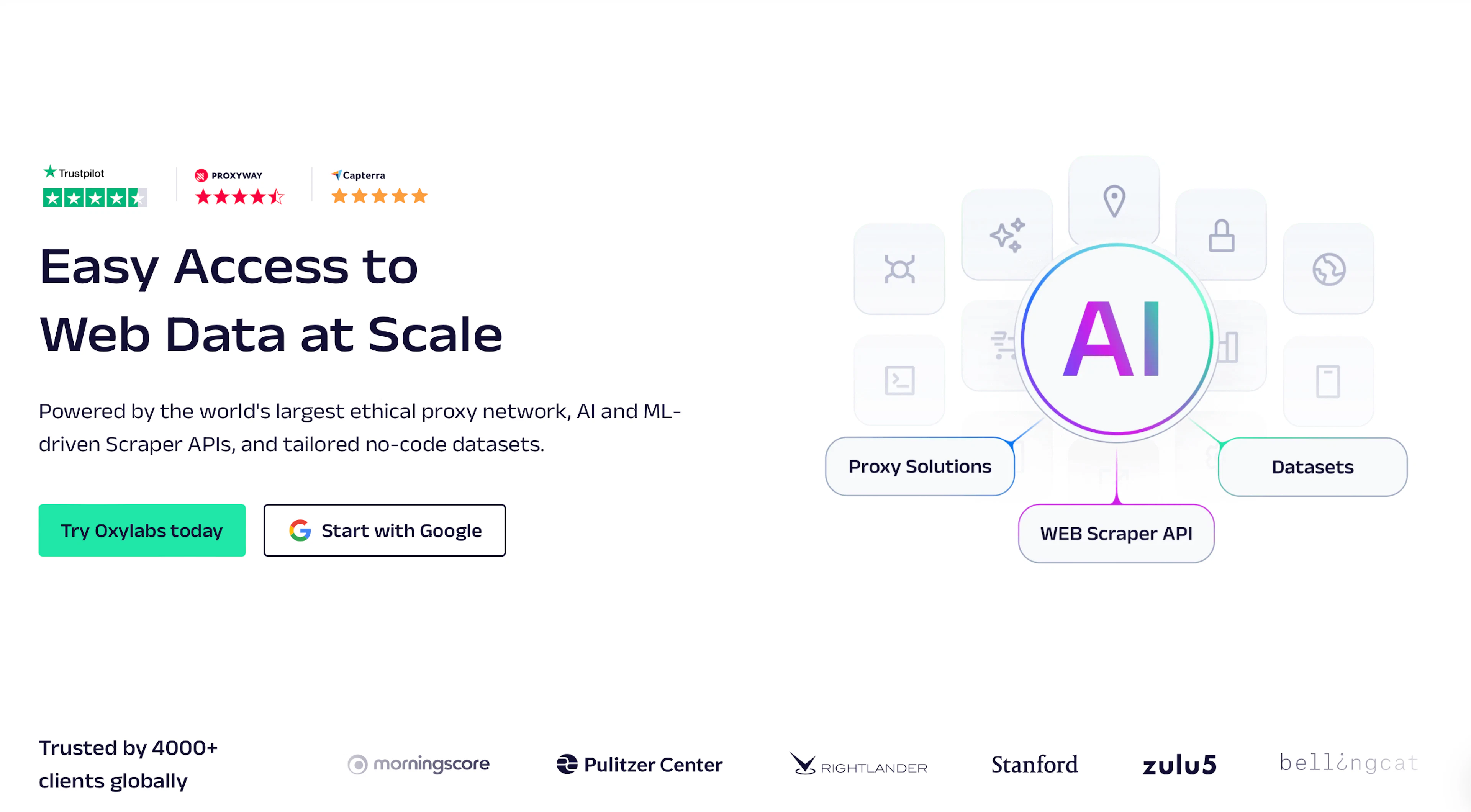
Oxylabs homepage
Robust tools, excellent customer service, and spotless reputation – that's what makes Oxylabs one of the market leaders in web scraping. Founded in 2015, the company consistently delivers high-quality data gathering solutions to companies of all sizes. They’re also one of the most versatile web scraping services providers, offering solutions tailored to diverse business needs.
Products and technologies
| Data delivery | HTML, CSV, JSON |
|---|---|
| Support | 24/7 support, dedicated account managers |
| Self-service | Yes |
Oxylabs offers a comprehensive suite of proxy solutions, including Residential, Datacenter, and ISP Proxies. Their Residential Proxies provide a vast pool of over 100 million IPs, ensuring high success rates and minimal response times. These proxies are designed to navigate complex scraping challenges, effectively handling blocks and CAPTCHAs.
For users seeking automated data extraction, Oxylabs' Web Scraper API* serves as an all-in-one solution, making it one of the best web scraping APIs on the market. This API handles tasks from URL crawling and managing anti-bot measures to precise data parsing and delivery. It incorporates advanced features such as proxy rotation, JavaScript rendering, and AI-driven fingerprinting to ensure reliable and efficient data retrieval.
In addition to their proxy and data scraping services, Oxylabs has introduced innovative products like OxyCopilot, an AI-powered assistant designed to streamline data collection without manual coding. They also offer ready-to-use datasets tailored for various industries, ranging from market research to cyber security, enabling businesses to access structured data without the complexities of large-scale data collection.
Pricing
Web Scraper API – plans begin at $0.5 per 1K results
Proxies – Residential ($8/GB), Dedicated Datacenter ($6.75/month), Mobile ($9/GB)
Web Unblocker – starting at $75 per month
*Product update: We now offer Web API, a new product for web scraping and search. You can use it for scraping projects like the ones discussed here. Read the Web API documentation to learn more.
2. ScrapingBee
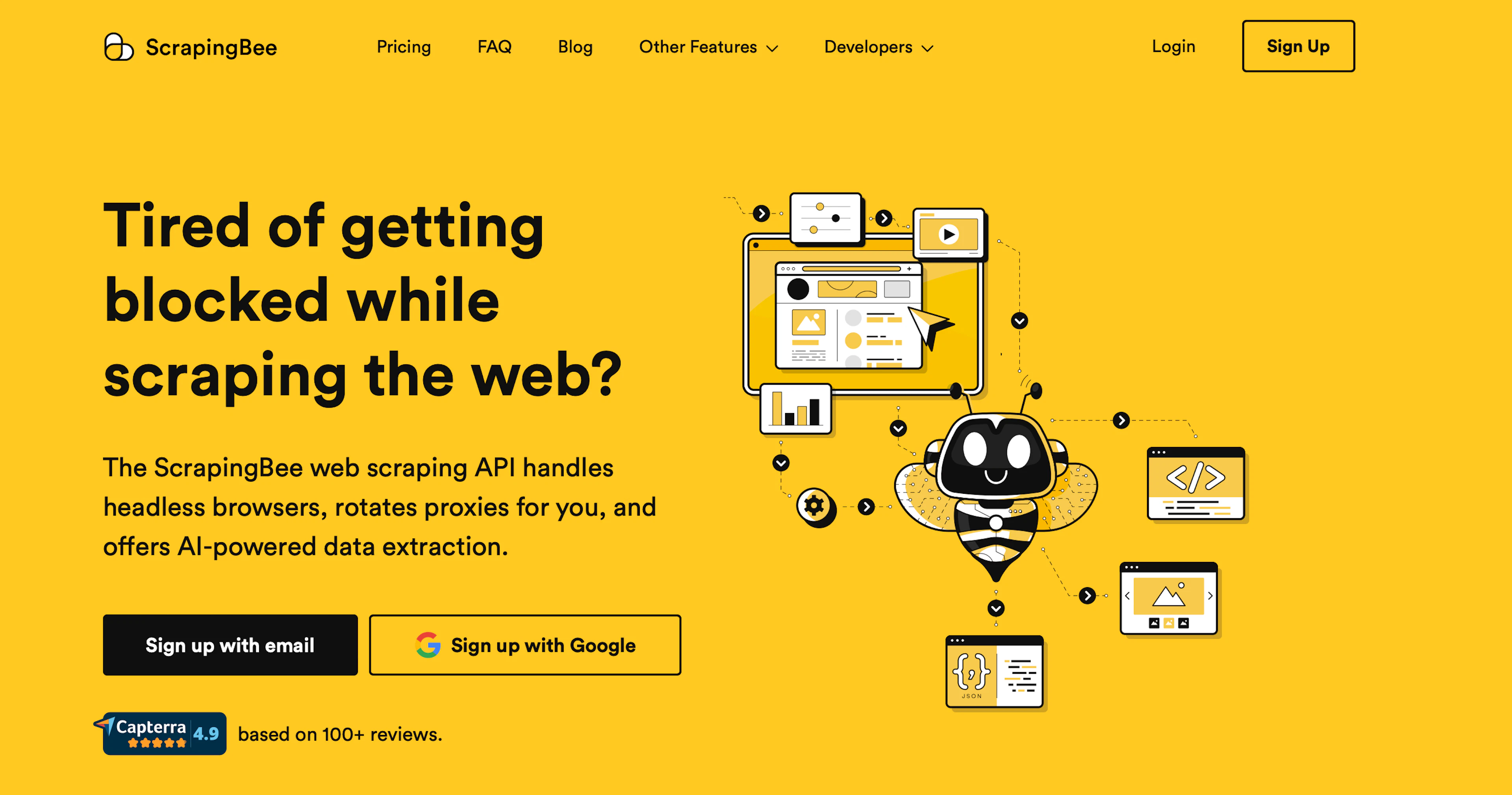
ScrapingBee homepage
ScrapingBee is a company founded in Toulouse in 2019. They offer an advanced web scraping API solution that simplifies web data extraction for businesses by handling complexities like headless browser management, proxy rotation, JavaScript rendering, and more.
Products and technologies
| Data delivery | HTML, JSON. If needed, JSON response can be converted into other formats like CSV or XML |
|---|---|
| Support | Standard support, available via email, live chat, or knowledge base |
| Self-service | Yes |
ScrapingBee stands out by offering features like custom JavaScript execution, screenshot capabilities, search engine scraping, and AI-powered data extraction, which is especially useful for scraping dynamic, JavaScript-heavy websites. With flexible pricing plans and integration options, including integration with Make for no-code web scraping, the company caters to both developers and teams needing scalable data collection.
Unlike some simpler tools, ScrapingBee is more powerful but may require some technical expertise to unlock its full potential.
Pricing
Web scraping API – plans begin at $49 per month
3. Apify
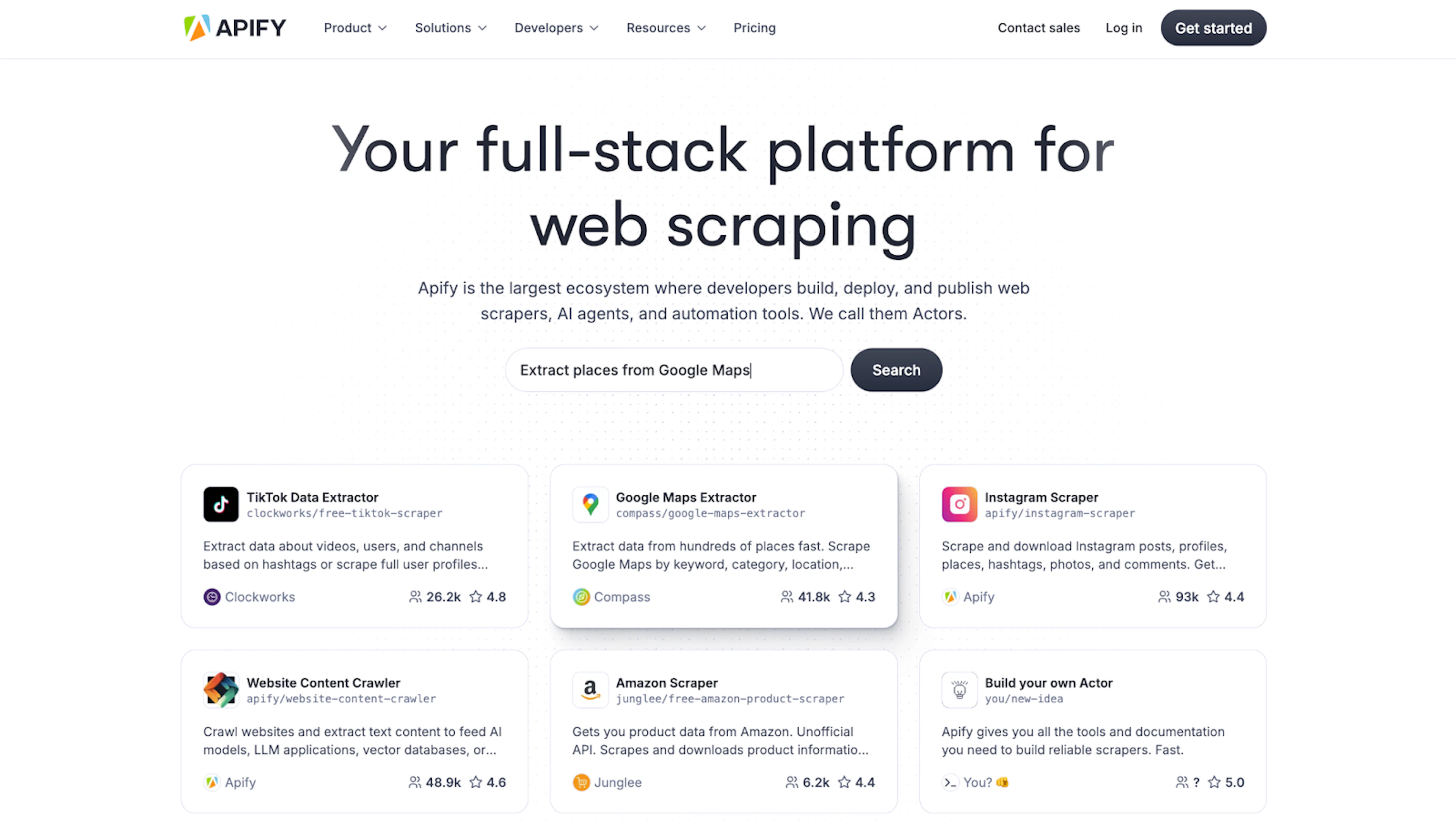
Apify full-stack web scraping services with thousands of pre built scrapers.
Apify is a full-stack platform for web scraping, known for its developer-friendly tools and extensive marketplace of ready-to-use scrapers. Since its founding, the company has built a strong reputation among businesses and developers alike for offering flexible solutions to build, deploy, and publish web scrapers, AI agents, and automation tools.
Products and technologies
| Data delivery | JSON, CSV, XML, Excel, HTML, and RSS. Users can access data via the Apify API, webhooks, or integrations with services like Google Drive and Amazon S3 . |
|---|---|
| Support | Email support, account managers for enterprise plans |
| Self-service | Yes |
Apify offers a wide range of powerful tools for web scraping and automation, built around its flagship product – Actors. These serverless cloud programs let users automate tasks such as data extraction, web crawling, and browser automation. With over 4,500 ready-to-use Actors in the Apify Store, users can quickly deploy solutions or develop custom Actors using JavaScript or Python to fit their unique needs.
To support complex scraping workflows, Apify integrates advanced features like proxy rotation with datacenter and residential IPs, headless browser automation via Puppeteer and Playwright, and browser fingerprinting protection. The platform also includes robust scheduling options for automated runs, as well as APIs and webhooks for seamless integration with external systems. Additionally, users can propose new Actor ideas – whether it's a scraper, automation tool, AI agent, or integration – and Apify may build it for free if it's valuable to the community.
Pricing
Free plan – $5 to spend in Apify Store or on your own Actors
Starter plan – $39/month & pay as you go
Scale plan – $199/month & pay as you go
Business plan – $999/month & pay as you go
4. Decodo (ex. Smartproxy)
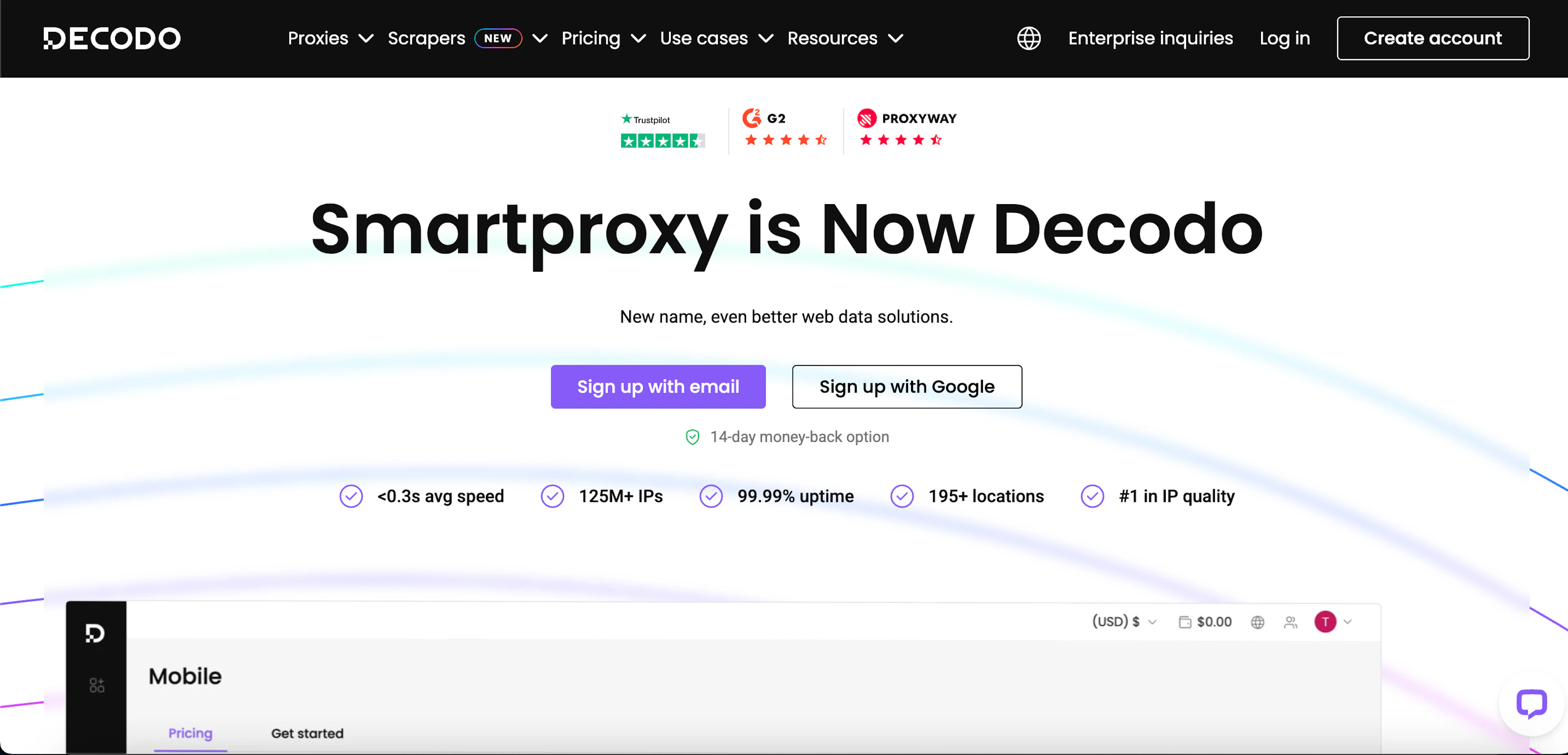
Decodo (ex. Smartproxy) homepage
Decodo (ex. Smartproxy) is a beloved choice for web scraping tools that perfectly combine performance and price. In fact, the company was founded with the goal of providing options that suit both large corporations and small businesses alike.
Products and technologies
| Data delivery | HTML, CSV, JSON |
|---|---|
| Support | 24/7 support, account managers |
| Self-service | Yes |
Decodo (ex. Smartproxy) offers a comprehensive range of proxy solutions, including Residential, Datacenter, ISP (Static Residential), and Mobile Proxies. Their Residential Proxies provide access to over 65 million IPs across 195+ locations, ensuring high success rates and swift response times. These proxies are designed to handle complex large-scale projects, effectively managing blocks and CAPTCHAs, making them ideal for content aggregation across multiple sources.
For users seeking automated data extraction, Decodo (ex. Smartproxy) provides a suite of Scraping APIs, such as the Web Scraping API and eCommerce Scraping API. These tools facilitate efficient data collection by handling tasks from URL crawling to data parsing, incorporating features like proxy rotation and anti-bot protection to ensure reliable data retrieval.
Pricing
Scraping APIs – $50/month
No-code Scraper – $50/month
Proxies – Residential ($12.5/GB), Dedicated Datacenter ($7.5/month), Mobile ($40/GB)
5. Octoparse
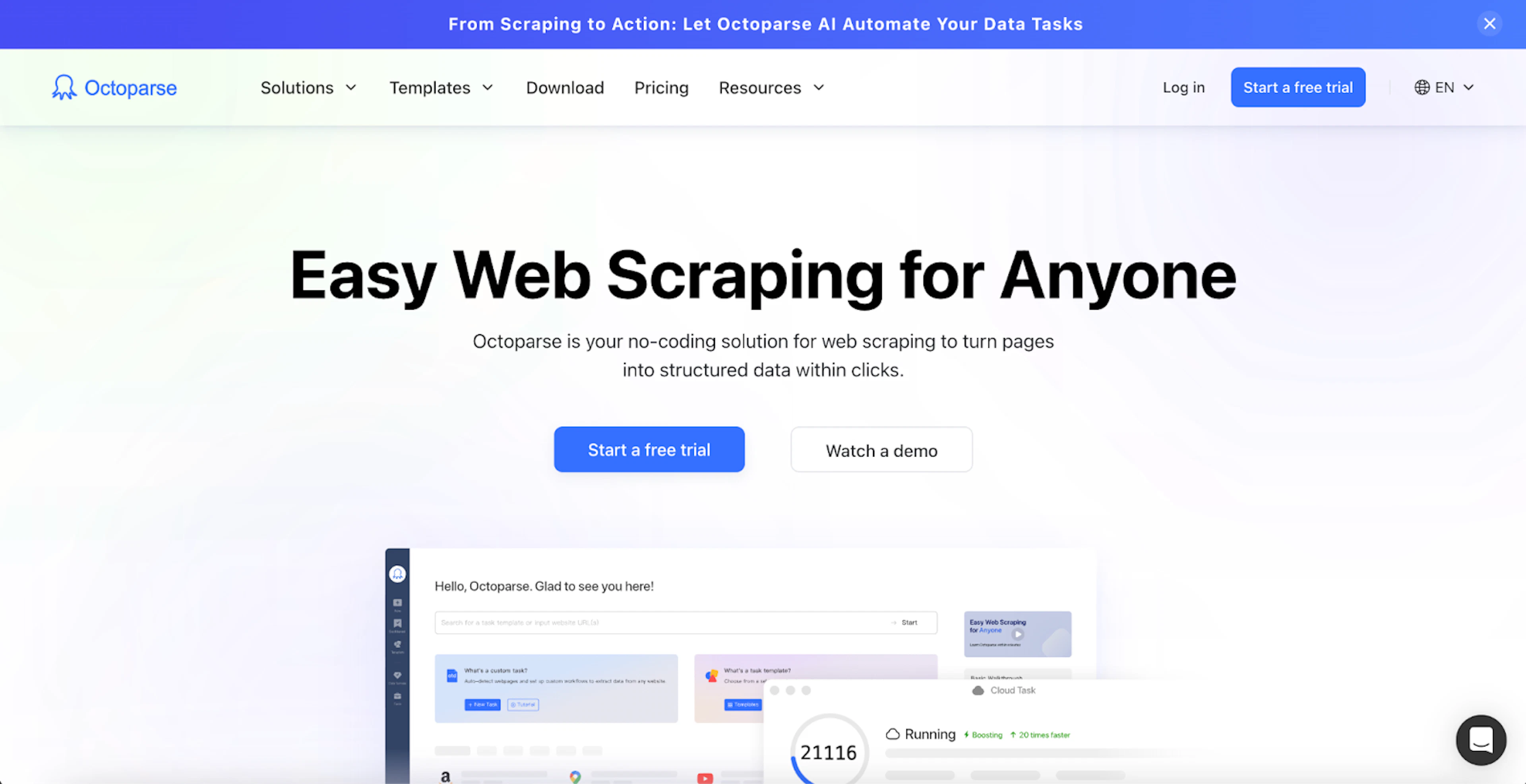
Octoparse homepage
Octoparse is a no-code web scraping platform that enables users to transform web data into structured formats effortlessly. Designed for both beginners and professionals, Octoparse offers a user-friendly interface and a suite of advanced features to handle complex data extraction tasks.
Products and technologies
| Data delivery | Excel files, CSV, JSON, XML, integration with databases |
|---|---|
| Support | Standard support, priority support for higher-tier plans |
| Self-service | Yes |
Octoparse's web scraping solutions revolve around an intuitive, drag-and-drop workflow designer, allowing users to create custom scraping tasks without coding. The platform automatically detects web elements, facilitating precise data extraction. It supports features like pagination, infinite scrolling, AJAX-loaded content, and scheduled extractions, ensuring reliable data collection even from dynamically generated websites. To prevent anti scraping measures, Octoparse includes built-in IP rotation and CAPTCHA-solving mechanisms.
Another notable feature is Octoparse AI, an automation suite that enhances data workflows. It integrates AI-driven automation capabilities, including machine-learning-powered web data recognition, intelligent scheduling, webhooks, and API integrations.
Pricing
Free Plan – $0/month
Standard Plan – $99/month
Professional Plan – $249/month
Enterprise Plan – Contact sales
6. Bright Data
Bright Data homepage
Bright Data is another big name in the data scraping companies market with a long track record of known products. Just like Oxylabs, it’s one of the first names that pops into the head when talking about a professional web scraping infrastructure.
Products and technologies
| Data delivery | Multiple formats including CSV, JSON, HTML |
|---|---|
| Support | 24/7 support, priority support, account managers |
| Self-service | Yes |
Bright Data offers a wide range of proxy services, including Residential, Datacenter, Mobile, and ISP Proxies. Their Residential Proxy network has over 72 million IPs, enough for to choose from for any data extraction tasks.
For advanced scraping needs, Bright Data's Web Scraper IDE is its flagship tool. This integrated development environment offers pre-built code templates equipped with functionalities for JavaScript rendering and proxy configuration. With built-in debugging tools and straight proxy integration, it can be used for the development and deployment of custom scrapers.
Pricing
Proxies – Residential ($15/GB), Datacenter ($0.11/GB), Mobile ($40/GB)
SERP API – $3/CPM
Web Unlocker – $3/CPM
7. WebAutomation
Web Automation homepage
WebAutomation is dedicated to making web data extraction accessible to everyone, regardless of technical expertise. Founded with the mission to simplify data collection, they specialize in no-code web scraping solutions that empower users to extract information effortlessly.
Products and technologies
| Data delivery | CSV, JSON, Excel, XML |
|---|---|
| Support | Email and chat support (tiered availability depending on plan) |
| Self-service | Yes |
WebAutomation’s cloud-based platform offers a point-and-click interface, allowing users to build custom extractors without writing a single line of code. For those who prefer a ready-made solution, WebAutomation provides a marketplace of pre-built extractors for popular websites.
WebAutomation’s platform provides advanced functionalities such as IP rotation, CAPTCHA solvers, and dynamic scraping, which ensures that users can handle even the most sophisticated data extraction tasks with minimal effort. Their standout feature is its no-code extraction tool, which enables users to set up scraping tasks without any technical expertise. For more advanced users or businesses requiring a tailored solution, WebAutomation also offers custom scraping services, where they can build specific data extraction tools based on your unique needs.
Pricing
Starter Plan – $74 per month – made for small projects with basic data scraping needs
8. ScrapeHero
ScrapeHero homepage
ScrapeHero has been delivering enterprise-grade data solutions since 2014, focusing on affordability and data quality. Known for offering custom scraping solutions, they cater to a wide variety of industries, including sales intelligence, business monitoring, and journalism. Their platform is particularly valued for its user-friendly interface, which makes it easy for non-technical users to set up and manage web scraping tasks.
Products and technologies
| Data delivery | JSON, CSV, Excel |
|---|---|
| Support | Email support, priority support for high-tier users |
| Self-service | Yes (ScrapeHero Cloud users) |
ScrapeHero offers powerful scraping solutions through their pre-built crawlers and APIs. These tools enable users to scrape popular websites easily, with minimal setup required. Their crawlers allow users to scrape websites simply by inputting URLs, and the platform handles all the complexities behind the scenes. For more automated solutions, ScrapeHero offers APIs that users can integrate into their systems, reducing the need for manual intervention and allowing for smooth automation.
In addition to their crawlers and APIs, ScrapeHero offers a cloud platform with easy integration options. This makes storing and managing scraped data more convenient, especially for businesses handling large datasets.
Pricing
Crawlers – $5/month (300 pages)
APIs – $5/month (100 API calls)
9. Sequentum
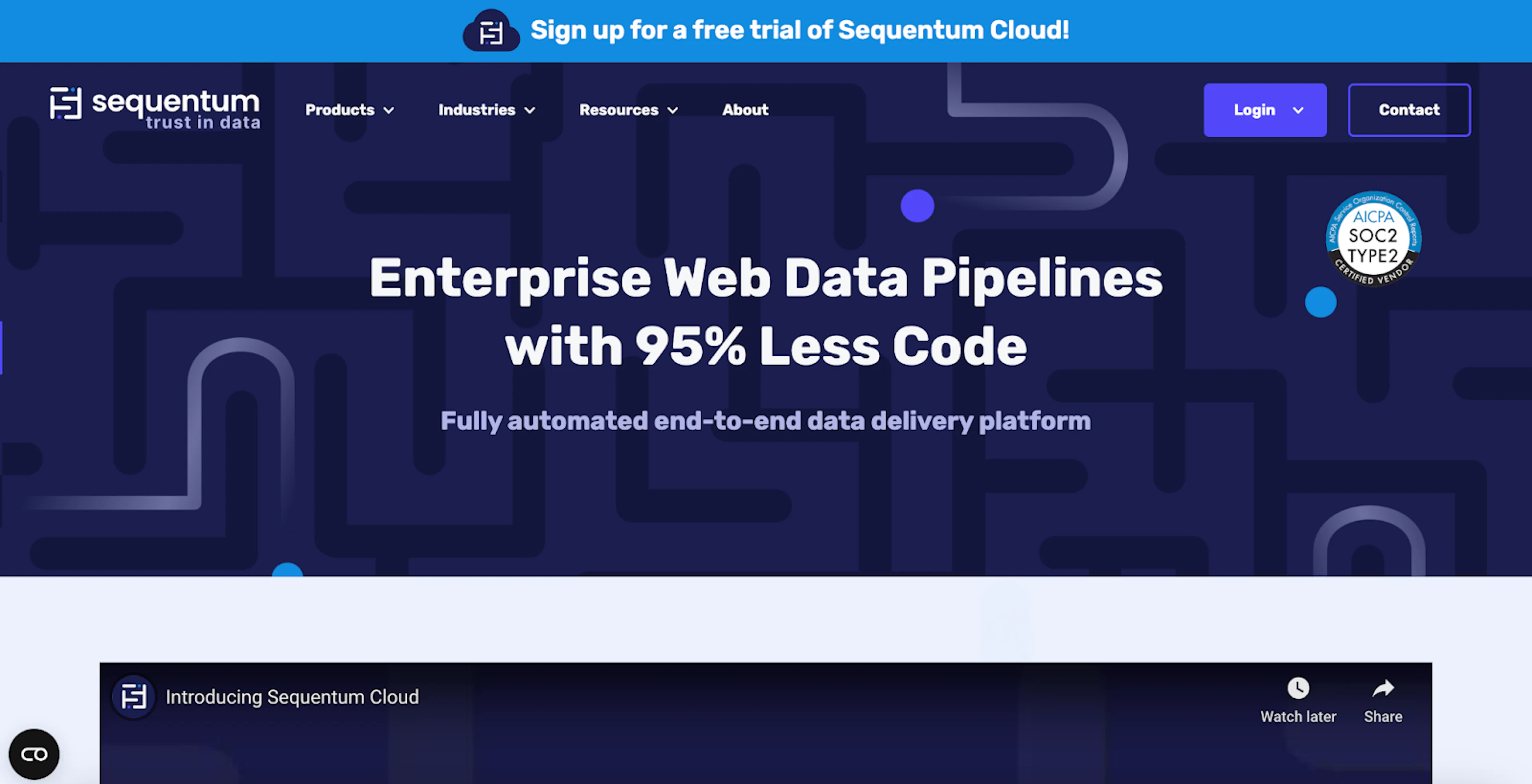
Sequentum homepage
With over 15 years of experience, Sequentum provides enterprise-grade data extraction solutions tailored for both government and private sectors. Naturally, they place a lot of importance on compliance and ensure their processes are transparent, observable, and auditable.
Products and technologies
| Data delivery | Any |
|---|---|
| Support | Email support, support tickets |
| Self-service | Yes (for Marketplace users) |
Sequentum’s Enterprise Data Platform allows users to build, manage, and deploy web scraping agents with extensive customization options. Users can automate large scale scraping with a point-and-click system while integrating common programming languages like Python, C#, JavaScript, and Regular Expressions. The platform offers flexible deployment models, including on-premise, cloud, and hybrid options.
For businesses that require a fully managed solution, Sequentum provides data-as-a-service, where their team handles all of the processes to extract data, including setup, maintenance, and compliance monitoring.
Pricing
Available on demand.
10. Grepsr
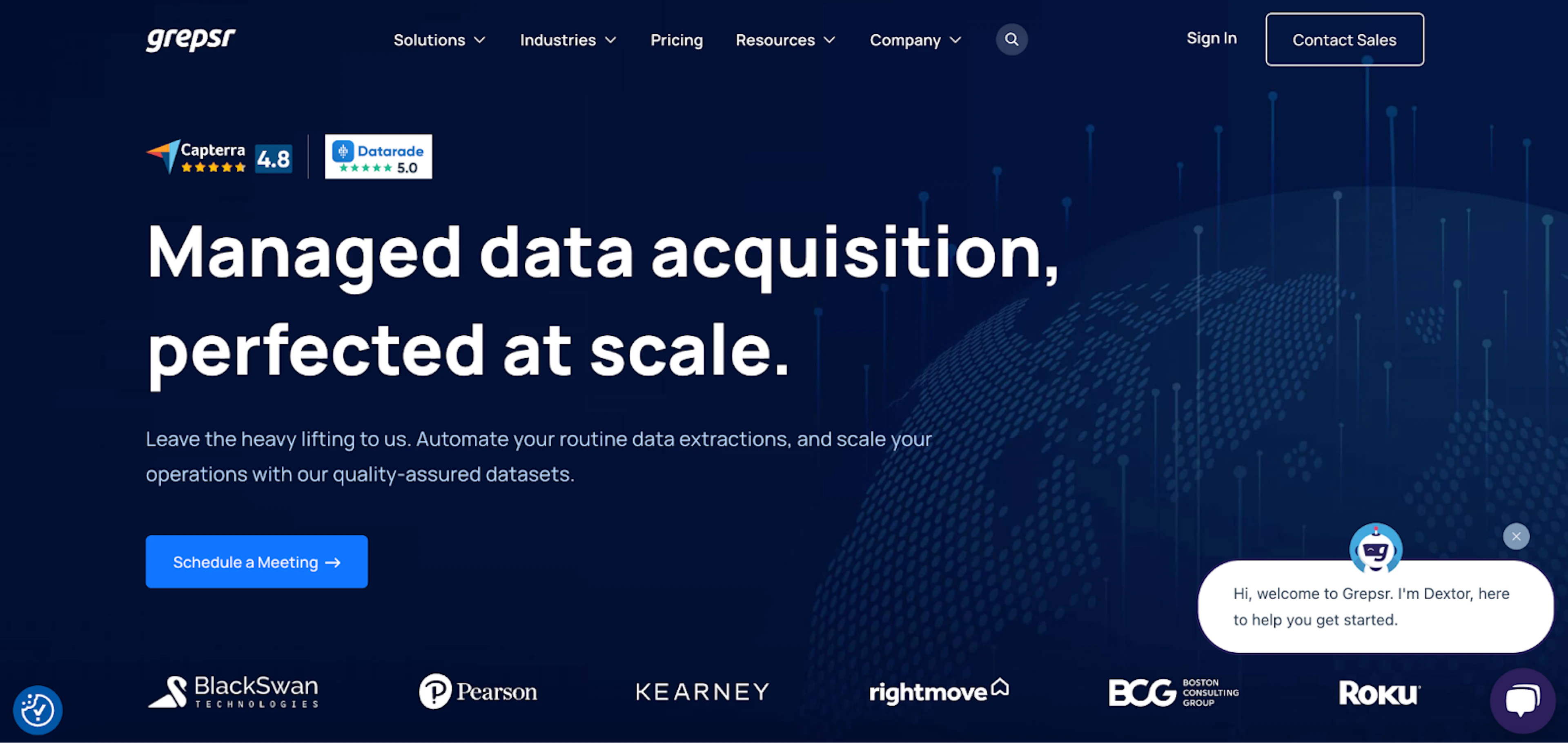
Grepsr Homepage
Grepsr is a web data collection company with over 12 years of experience, offering a range of services tailored to client needs. Operating on both Data-as-a-Service (DaaS) and Software-as-a-Service (SaaS) models, Grepsr provides solutions that are legally compliant, scalable, and capable of handling common blocks.
Products and technologies
| Data delivery | Multiple formats including CSV, JSON, Excel |
|---|---|
| Support | Email & phone support, chatbot |
| Self-service | Yes (for Pline users) |
Grepsr's web scraping solutions are designed to meet industry standards, ensuring efficient data extraction while maintaining compliance and scalability. They offer a variety of services depending on each client's needs, operating on both DaaS and SaaS models. Or, if you just need some expert advice, you can book a consultation with them. Their infrastructure supports dynamic content, JavaScript, auto-throttling, geo-targeting, and validated data extraction, enabling seamless data collection from complex websites.
A notable offering is Pline, an AI-powered browser extension that simplifies data extraction from various web pages without the need for coding. Users can specify desired elements through an intuitive interface to collect data efficiently. Pline is currently available for free, with plans to introduce advanced features such as AI recommendations, data validation, data masking, and reporting.
Pricing
One-Time Extractions: Starting at $350
Recurring Extractions: Pricing details available upon request
11. Datahut
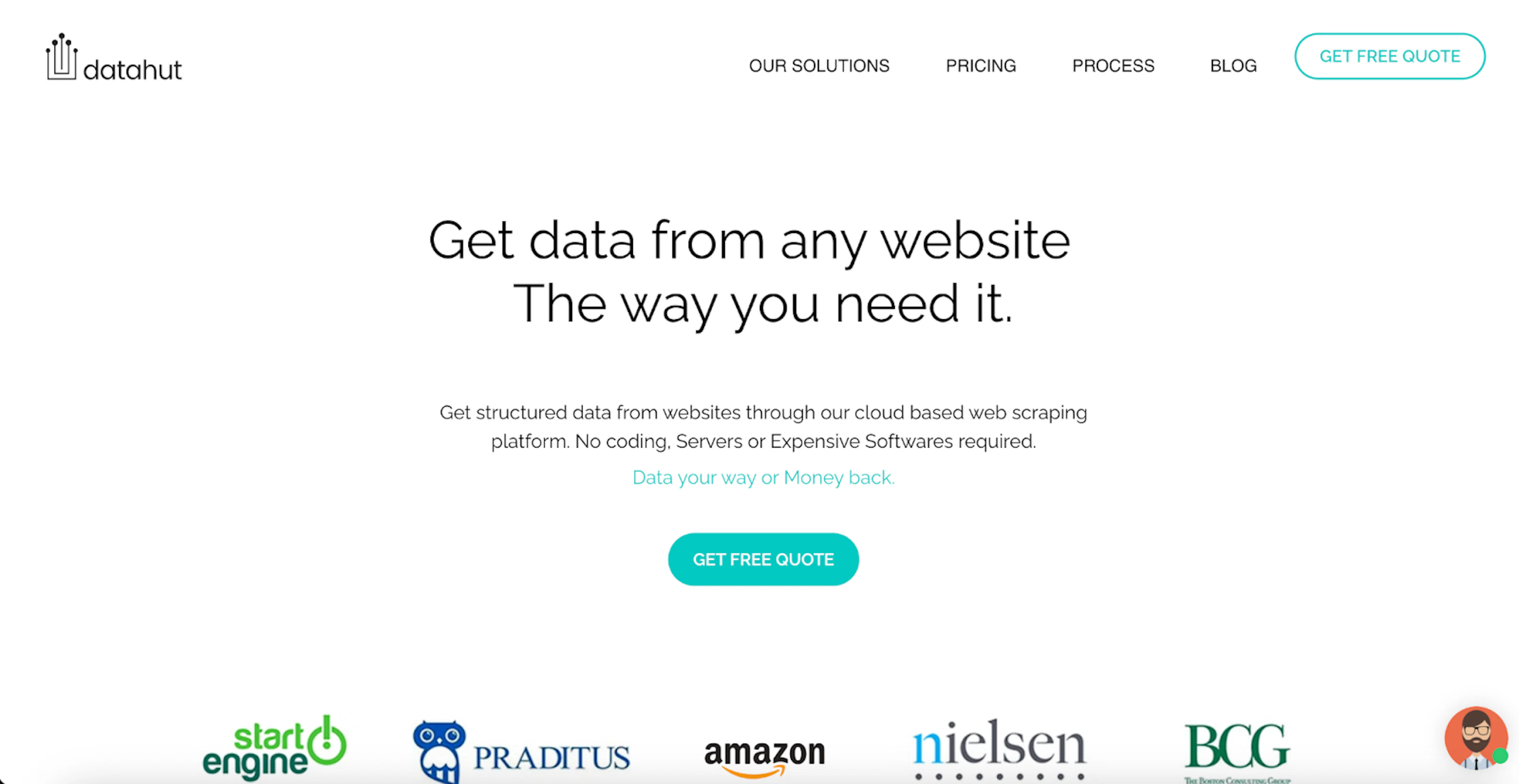
Datahut Homepage
Datahut is a web data extraction company founded with the mission to democratize web data access. They offer fully managed, cloud-based scraping services, eliminating the need for clients to write code, manage servers, or operate software. Their solutions cater to various industries, including e-commerce, search engine result page (SERP) tracking, news aggregation, and app development. Operating on a Data-as-a-Service (DaaS) model, Datahut provides tailor-made data extraction services, ensuring maximum data coverage with 100% integrity.
Products and technologies
| Data delivery | CSV, JSON, API-based data pulling |
|---|---|
| Support | Freshdesk support, chatbot, dedicated support for enterprise users |
| Self-service | No |
Datahut's web scraping solutions are designed to handle complex data extraction tasks from target websites without requiring client-side coding or infrastructure management. Their services include auto-throttling, geo-targeting, and support for dynamic content and JavaScript, ensuring comprehensive data retrieval from various websites.
Pricing
One-Time Extraction: Starting at $40 per website
Recurring Extractions: Pricing details available upon request
Top web scraping companies compared
Earlier, we discussed that ease of use, scalability, and technology are the most important factors to consider when choosing a web scraping company. Below is a comparison of how each of these companies measures up based on these key elements.
| Company | Technology | Ease of use | Scalability |
|---|---|---|---|
| Oxylabs | Proxies, Web Scraper API, datasets, and others | Great for large-scale operations | Highly scalable, ideal for complex, large-scale operations |
| Decodo (ex. Smartproxy) | Proxies, Scraper APIs | User-friendly with clear documentation | Scales well for businesses of all sizes |
| Octoparse | No-code scraping, API-based scraping | Extremely user-friendly, ideal for non-technical users | Good for medium to large projects |
| Bright Data | Proxies, Scraper API, datasets | Best for experienced users | Built for large-scale, enterprise projects |
| WebAutomation | No-code scraping, API-based scraping | Very easy to use with a point-and-click interface, no coding needed | Scalable for small to medium businesses |
| ScrapeHero | Custom crawlers, datasets, scraping API | Easy for non-technical users, one-click crawlers | Flexible, works well for small to large projects |
| Sequentum | Custom automation, datasets, API-based scraping | Can require technical knowledge but also offers point-and-click automation | Highly scalable, suitable for complex projects |
| Grepsr | Managed scraping, custom crawlers, datasets | User-friendly, great for non-technical users with customization options | Scalable for medium to large enterprises |
| Datahut | Managed scraping, datasets, custom crawlers | Very easy to use, no coding required | Scales well for businesses needing extensive data coverage |
Final thoughts
The rapid development of web scraping is great as you can get any service you can dream of. Whether it’s just web scraping proxies or a fully-managed service, there’s nothing you can’t find these days. So, there’s no excuse for not getting into web scraping and reaping the benefits of data.
If you’d like to learn more about the web scraping market, check out blogs on the best no-code web scrapers, best proxy providers, or best scraping tools.
Finally, if you'd like to learn how to web scrape, read our articles about the best web scraping courses, a quick look at the best websites to scrape data from, how to build a web scraper, and web scraping guides in C#, Python, or Java.
The information provided in the article relies on data available on March 3, 2025. Before depending on any information provided herein, users should confirm the present status of products or services.
About the author
Enrika Pavlovskytė
Former Copywriter
Enrika Pavlovskytė was a Copywriter at Oxylabs. With a background in digital heritage research, she became increasingly fascinated with innovative technologies and started transitioning into the tech world. On her days off, you might find her camping in the wilderness and, perhaps, trying to befriend a fox! Even so, she would never pass up a chance to binge-watch old horror movies on the couch.
All information on Oxylabs Blog is provided on an "as is" basis and for informational purposes only. We make no representation and disclaim all liability with respect to your use of any information contained on Oxylabs Blog or any third-party websites that may be linked therein. Before engaging in scraping activities of any kind you should consult your legal advisors and carefully read the particular website's terms of service or receive a scraping license.
People also ask
Are web data extraction services legal?
Web scraping itself is not inherently illegal, but legality depends on how the data is collected and used. Most providers focus on publicly available web data and emphasize compliance with applicable regulations and website terms.
Businesses should consider factors such as:
data privacy laws,
intellectual property rights,
rate limiting,
and access restrictions when building scraping workflows.
Because regulations vary by region and use case, companies handling large-scale extraction projects often consult legal counsel before deployment.
How much do web scraping services cost?
Related articles



Try Web API
Power AI agents with live web data through one API.

Get the latest news from data gathering world