
Mapping the Information Access Economy: What 34 Platforms Reveal About the Changing Web

Oxylabs Research
Last updated on
2026-07-01
8 min read
Oxylabs research tracks how rising subscription costs and shifting access models are redefining the way information flows online.
The spring of 2026 brought a familiar announcement: Netflix raised its prices for the second consecutive year, following Disney+’s hike the previous September.
The reaction to the rising costs was predictable. 40% of Americans, already under significant economic pressure, cut back on streaming services in the first three months of 2026. Nearly 75% said the platforms they rely on are inching beyond their financial reach.
Subscription fatigue has arrived, and it extends far beyond entertainment. The public web is undergoing a structural shift. Content that was once freely available is now moving behind registration prompts and hard paywalls – a response to collapsing ad revenues, shifting traffic patterns, and evolving business models.
Quality journalism, professional knowledge, and educational resources are increasingly being repriced as subscription products rather than supported by advertising alone.
The open web – the version of the internet where information circulates freely – is in retreat.
To understand what it now costs to stay informed – and what these shifts mean for the broader digital ecosystem, including AI – we analyzed seven years of pricing data across 34 major news, education, and streaming platforms.
Key Takeaways
Average annual subscription prices rose over 17% between 2020 and 2026.
A basic monthly bundle of news, education, and entertainment subscriptions costs about two hours of work at the median U.S. wage.
The average household is actually spending over eight hours of work a month on their total digital subscriptions.
74% of platforms now require registration even for nominally free content.
News subscription prices rose faster than any other category – with The New York Times nearly doubling from $18.47 to $32.59/month.
On average Americans pay $16.70/month for an individual plan – nearly four times the $4.21 introductory rate that’s often available.
Free resources on the open web are shrinking year by year. Publishers are adapting to real economic pressures, but the result is a widening gap between those who can afford quality information and those who can’t. At the same time, through Project 4β – our initiative supporting journalists and researchers – we’re seeing bad actors exploit these shifts. They are spreading disinformation to fill the gaps left by quality journalism.
Denas Grybauskas, Chief Governance and Strategy Officer (CGSO) at Oxylabs
Prices Have Increased for Everything, But Not at the Same Rate
The sharpest price increases were seen in the news category. For instance, The New York Times raised its monthly price from $18.47 in 2020 to $32.59 by 2026. The Financial Times moved from $49.97 to $75 by 2024 and stayed there. It is the most expensive title in our analysis, averaging $68.71 per month across all seven years.
In other words, business and financial news are now being priced as a professional service.
Education platforms like Coursera Plus, Skillshare, and Udemy were the most expensive and volatile category, with subscriptions averaging $25.89 per month across the period.
Entertainment sat at the opposite end: Netflix, Spotify, Apple Music, and YouTube Premium held an average of $9.39 per month, the lowest of the three categories and the most competitively stable.
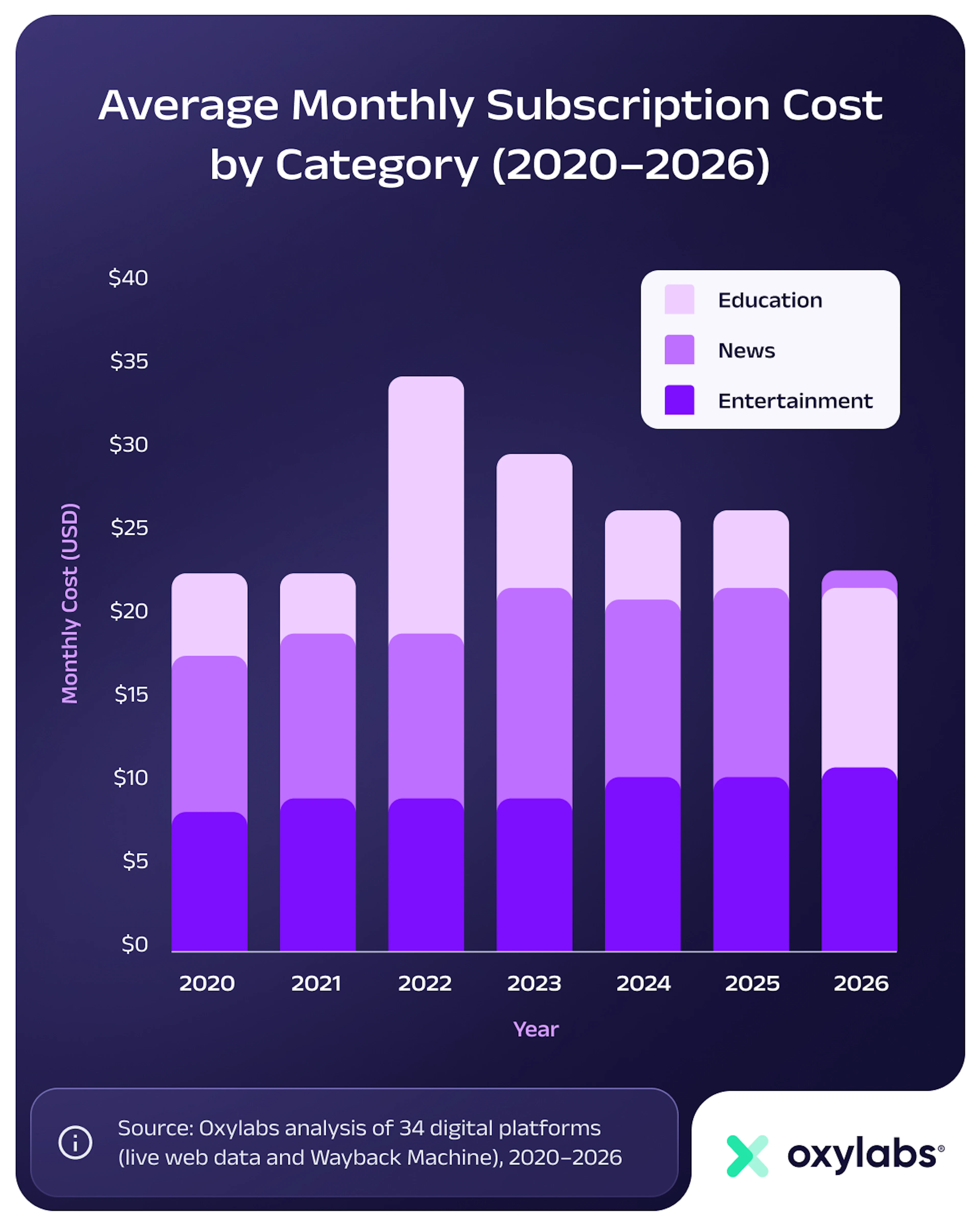
The arrival of Netflix’s ad-supported tier in 2022 introduced a downward price option that has no equivalent in news or education.
The exceptions to the general upward trend are Reuters, which reversed course sharply, dropping from $34.99 per month in 2023 to $4.00 by 2024, and TechCrunch+, which decided to remove its subscription cost entirely in the same year.
How Much Do Subscriptions Cost in 2026?
Looking at our snapshot for 2026, news stands out as the priciest category, costing an average of $21.85 a month. Education isn’t far behind at $20.74, while entertainment lags significantly at just $10.44.
But averages alone don’t say all that much on their own – for that, we need a more detailed breakdown of each category. News options vary widely, from free aggregators to the Financial Times, which charges a hefty $75 a month.
Education, on the other hand, is more consistent, with prices ranging from $14 to $33, and there’s no free tier to be found. Entertainment is the most straightforward of the bunch, with all paid platforms priced between $8 (for Netflix Basic with Ads) and $25 (for Netflix Premium).
Diving deeper into the news category, we find three distinct markets under one umbrella. Business and finance news averages around $21.50, but four out of five titles are locked behind a tough paywall, all of them running ads, and introductory offers can last a full year at $13.29.
General news averages $24.41, but with a median of $15.21, it’s clear that a few pricey titles (Financial News, The Wall Street Journal, and The New York Times) are skewing the numbers. Tech news is the most affordable, averaging $13.75, with half of its 2026 titles priced at $4 or less.
Entertainment operates differently: only 36% of paying users encounter ads, yet 82% of platforms now require a login for any access, and family plans help lower the per-person cost to a median of $4.61 – a perk that neither news nor education offers.
Education is the strictest of the three categories: all three platforms monitored have a hard paywall, none provide family plans, and only one (Coursera Plus) offers a significant introductory discount.
The Three Access Barriers
Around 60% of the platforms analyzed maintain a hard paywall, with no content of any kind available without payment. 74% require account registration even when content is nominally free, but this comes with its own price – your personal data.
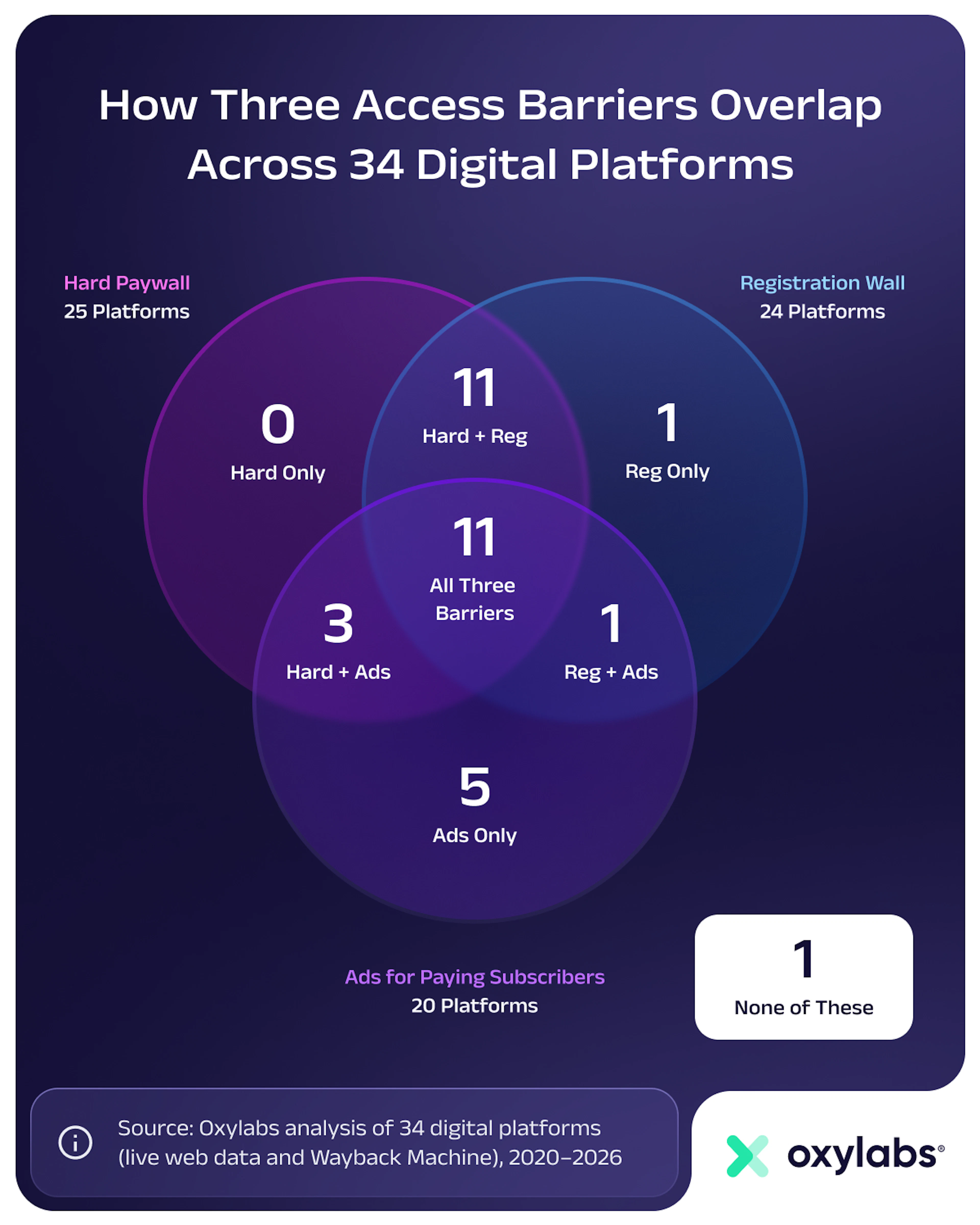
Out of the media companies analyzed, only The Guardian, funded by voluntary contributions, imposes neither condition.
Chartbeat’s analysis of traffic metrics from 2,756 news sites around the world, including 797 in the U.S., shows a steep drop in Google search traffic over the last year: 33% worldwide and 38% in the U.S.
Much of that drop, especially outside the U.S., occurred after Google began rolling out AI Overview. This feature provides a software-generated, multi-paragraph answer without the need to visit a specific site. In fact, users often have to click additional times to see links to the sources Google drew on for its AI-generated answer.
For publishers, the consequences of this fall directly on the traffic and advertising revenue that have funded open-web journalism for two decades. With referrals collapsing and ad-supported models under sustained pressure, paywalls and registration walls have become, for many outlets, one of the few remaining ways to keep paying journalists at all.
Paying for a subscription does not necessarily remove advertising either. 60% of platforms still show ads to paying subscribers. This is almost entirely a news phenomenon: ads appear on nearly every paid news platform analyzed, but are absent from education content and were largely non-existent in entertainment until Netflix introduced its ad-supported tier in 2022.
For many news subscribers, therefore, the cost of access includes both a monthly fee and continued exposure to advertising.
The Discount Ladder Most Subscribers Never Climb
A four-fold price difference separates the cheapest available entry point from the standard individual monthly plan. Introductory pricing averages $4.21 per month across the dataset.
News platforms use introductory pricing most aggressively, typically offering eight months of discounted access. This period is long enough for many subscribers to absorb the standard rate without noticing the transition. Entertainment platforms follow a similar approach, but typically offer only 1 to 3 months of free or discounted access.
For ongoing access, family plans bring the per-person cost down sharply. For instance, Apple Music works out to $2.83 per person per month across six users. Spotify Premium comes to $3.67, and across all platforms in the dataset the average is $4.30 per person.
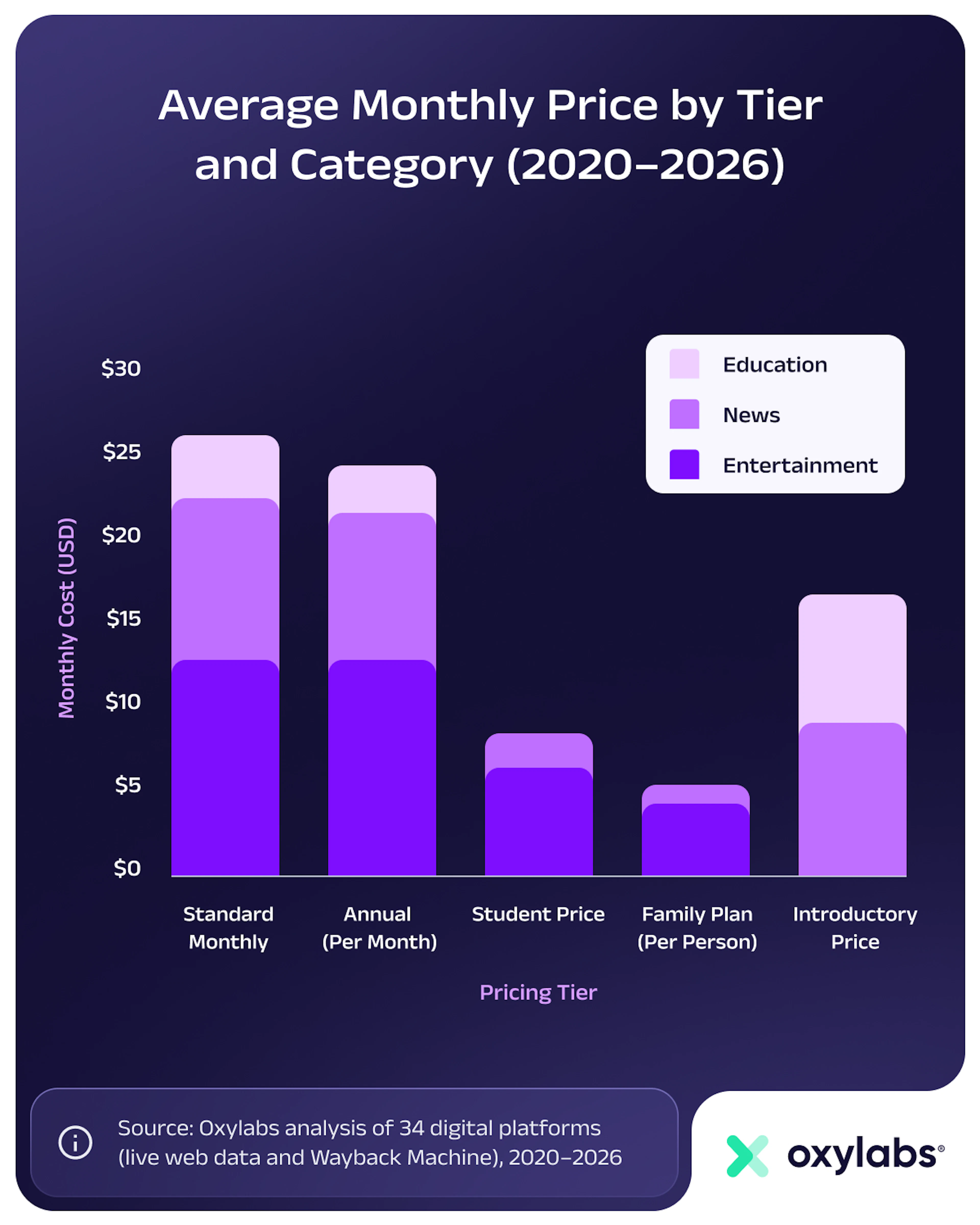
That pricing is broadly comparable to student pricing, which runs at a median of around $5 per month, although prices range from under $1 (The Times, Wired) to over $30 (Financial Times, MIT Technology Review). The notable difference is that family plans are available to anyone.
Education platforms offer neither family nor student pricing. Coursera, Udemy, and Skillshare are individual-only at the subscriber level.
Roughly a quarter of analyzed paid platforms, predominantly in news and education (e.g., MIT Technology Review, The Economist), discount their annual plan. The median discount is around 17% off the equivalent monthly rate. The majority of analyzed platforms, including Netflix Premium and Audible, charge exactly 12 times the monthly fee.
Gifts, Bundles and Workarounds
Some platforms offer their users alternatives to personal monthly subscriptions, which are a way to reduce expenses. For instance, gift subscriptions, which are available on only seven platforms, cost on average half the price of a standard annual subscription.
News platforms charging a substantial fee use alternative ways to reach readers. Take the Financial Times which, at $75 a month, is the most expensive publication in this analysis. It is bundled free into neobank Revolut’s Metal plan (which costs around £14.99/month in the UK).
The bank’s ultra-tier customers get the even pricier FT Premium Digital. Revolut has tens of millions of users, so this reach is very real. A $900-a-year subscription arrives as one perk in a plan that costs less than three months of an actual Financial Times subscription.
For high-price publishers, bundling represents a handy side door that allows them to grow their paying audience without touching their sticker price.
How Many Hours Do Americans Work to Pay the Monthly Subscription Bill?
Given the current U.S. median hourly wage ($25.67), one subscription per category at average prices – $19.86 for news, $9.39 for entertainment, $25.89 for education – comes to $54.86 per month. That is two hours and nine minutes of work.
The three categories in our analysis represent only the base, as the Americans’ actual subscription spending is considerably higher. In an average American household, streaming alone might account for $69 per month, as shown by Deloitte’s 2025 Digital Media Trends survey.
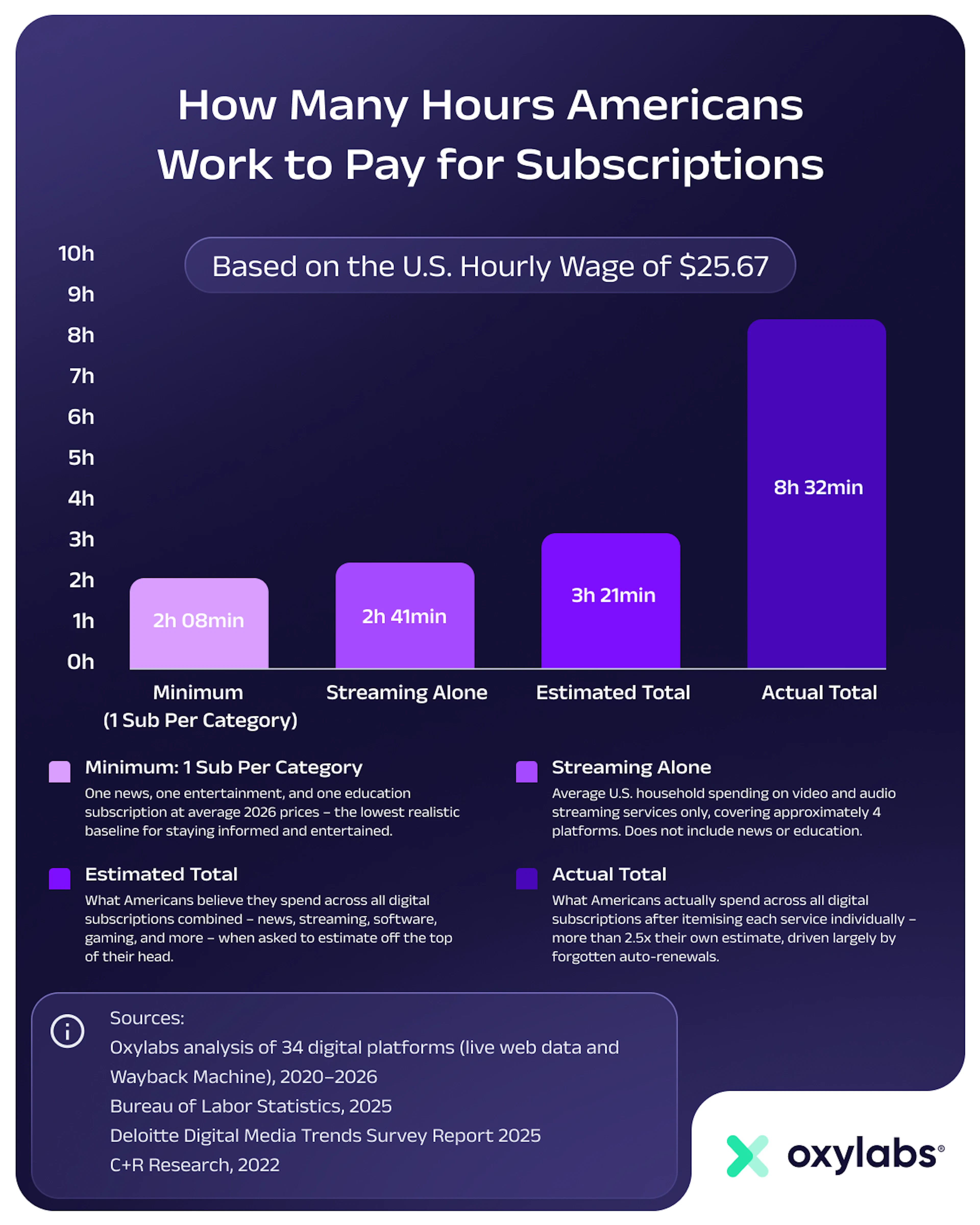
Total subscription spending across all categories including the ones we analyzed, as well as such categories as gaming and Amazon Prime averages $219 per month, according to C+R Research. This is equivalent to eight and a half hours of work each month at the median wage. The same analysis found that Americans estimate their monthly subscription spend at $86, less than half of what they actually pay.
Subscription Creep Is Among Reasons for Not Paying for News
The Pew Research finding that 83% of Americans have not paid for news in the past year belongs within the context of rising subscription costs. With news being the fastest-inflating category in this dataset, and most news content locked behind hard paywalls or registration requirements, consumers are continuously being sorted by their willingness and ability to pay.
The 17% who do subscribe are absorbing a growing cost. The 83% who encounter a paywall and look elsewhere are redirected to whatever remains free, and those options are shrinking.
What the subscribers and non-subscribers read is, increasingly, not the same thing. Essentially, they’re operating in different information ecosystems, with different emphases and blind spots. That’s the part of this trend we find most troubling. The open internet was meant to broaden access to reliable information, not stratify it by income. We believe the public web should remain something everyone can navigate, measure, and learn from – and that the data describing how it is changing should be available to anyone trying to understand it.
Denas Grybauskas, Chief Governance and Strategy Officer (CGSO) at Oxylabs
What’s at Stake
The data describes the news, education, and entertainment platform market moving consistently in one direction. A 17% increase in annual subscription prices, combined with a steady expansion of hard paywalls and registration requirements, represents a structural shift in how information is priced – not a temporary correction.
For consumers, the practical consequence is a widening gap between those who pay for quality information access and those who stop at the paywall.
The economics of digital subscriptions are replicating, in a new form, a distinction between better-informed and less-informed consumers that many assumed digital access had eradicated.
The pricing hierarchy in this research maps directly onto the kinds of knowledge that markets, civic life, and professional advancement depend on: financial information at the top, vocational education in the middle, passive entertainment at the bottom.
The people least likely to pay for news are younger, lower-income, and less educated, according to Pew. Notably, these are the same groups for whom the economic consequences of an information gap are largest.
What this data captures in pricing terms is just several verticals within a much broader structural shift happening across the public web. More of the web is moving behind walls, and the walls are getting higher. This isn’t a criticism of any individual business model – content creators have every right to set the terms for their work. But it does illustrate a worrying systemic trend with real consequences for how information circulates, how knowledge compounds, and who gets access to which parts of the digital commons.
Denas Grybauskas, Chief Governance and Strategy Officer (CGSO) at Oxylabs
A public web in which reliable information was free and accessible was never guaranteed, but was, for a period, the default. The data collected here represents only a few verticals but still suggests that default is eroding.
Whether similar shifts are occurring across other verticals, from academic research to social platforms, remains an open question worth quantifying. But for most people, the starting point is knowing what they are actually paying.
But the implications extend beyond household budgets. As freely accessible content shrinks, so does the pool of data available to train AI systems, conduct independent research, and build the next generation of digital tools. The question of who can access quality information, and at what cost, is shaping the future of technology itself.
About the Expert
Denas Grybauskas is a Chief Governance and Strategy Officer (CGSO) at Oxylabs, leading legal, risk management, ESG, and communication teams. He shares his knowledge with students and professors at numerous universities, such as the University of Michigan, and is a major voice of the Ethical Web Data Collection Initiative (EWDCI). Grybauskas is a thought leader in the public data acquisition industry, regularly providing comments to the media, including Forbes, Fast Company, Computer Weekly, and niche podcasts such as Temidy.
Methodology
Sample
This report is based on subscription pricing and access-model data for 34 digital platforms, collected across seven years from 2020 to 2026.
The platforms analyzed span three categories: news (19), entertainment (12), and education (3). They include print-to-digital news publications, video streaming services, music platforms, audiobook providers, and online course platforms available to global audiences. The selection represents a cross-section of platforms and pricing models, with a strong focus on prestige news outlets providing in-depth reporting.
Data Collection and Variables
Key Definitions
Subscription Calculations
Limitations
Frequently asked questions
How much have digital subscription prices increased since 2020?
Average annual subscription prices rose 17% between 2020 and 2026, from $174.53 to $203.79, according to Oxylabs Research data tracking 34 platforms.
How much does the average news subscription cost?
How many hours do Americans work to pay for their subscriptions?
Forget about complex web scraping processes
Choose Oxylabs' advanced web intelligence collection solutions to gather real-time public data hassle-free.
About the author
Oxylabs Research
Data-driven Storytellers
Oxylabs Research is the research and storytelling team at Oxylabs. We use ethical, compliant Oxylabs scraping tools to collect only publicly available web data – never private, paywalled, or personal data – and turn it into clear, timely insights that help everyone make sense of a fast‑changing technological, economic, and social reality. Our work is designed to support original reporting and analysis by journalists and to serve the broader public good. If you’re working on a story or investigation and need reliable web data to back it up, get in touch at press@oxylabs.io.
All information on Oxylabs Blog is provided on an "as is" basis and for informational purposes only. We make no representation and disclaim all liability with respect to your use of any information contained on Oxylabs Blog or any third-party websites that may be linked therein. Before engaging in scraping activities of any kind you should consult your legal advisors and carefully read the particular website's terms of service or receive a scraping license.