
What Nearly 1 Million U.S. Job Postings Reveal About Today’s Most In-Demand Programming Languages

Oxylabs Research
Last updated on
2026-05-28
8 min read
Oxylabs research suggests developers undervalue SQL in surveys, yet U.S. job postings reveal employers from industries beyond tech increasingly seek candidates who pair it with at least one other programming language, which shows the wide digitalization across the American economy.
The U.S. job market is going through a major, AI-driven innovation shift, and it brings both uncertainty and opportunities for many workers. Since late 2022, the information sector alone has had a strong decline in employment, with 13,000 jobs lost in April 2026.
Yet while many tech workers are being laid off, others are very much in demand as American companies continue to post new roles. Recent data show that new postings for technology roles have grown back to multi‑year highs.
For people trying to protect their careers, the question is no longer just which employers are most attractive, but which skills stay useful across different industries and can open more doors over time.
To find out what U.S. employers have actually been hiring for, and which skills offer a real career advantage in this environment, Oxylabs analyzed more than 800,000 U.S. job listings published between January 2025 and March 2026 that require at least one programming language.
Key Takeaways
Over 50% of U.S. job ads requiring programming languages come from industries beyond tech, showing how far digitization has spread across the economy.
SQL almost matches Python in demand: Python appears in 46% of postings, SQL in 45%.
SQL outpaces Python as the top requirement in 38 states, while 12 states favor Python.
1 in 5 tech jobs want both Python and SQL – the most co-mentioned duo in the dataset.
Just three states – California, Texas, and New York – account for roughly a quarter of all U.S. postings requiring coding skills.
Top 10 Most Mentioned Programming Languages in the U.S. Job Postings
Python is No. 1, but SQL shows up in nearly as many job postings, as it’s always co-mentioned with another programming language.
Python remains the single most frequently named programming language in our data: 46% of the analyzed U.S. job postings mention it as a requirement.
That finding isn’t surprising, since in many survey- and search-based rankings Python is usually crowned the most popular programming language.
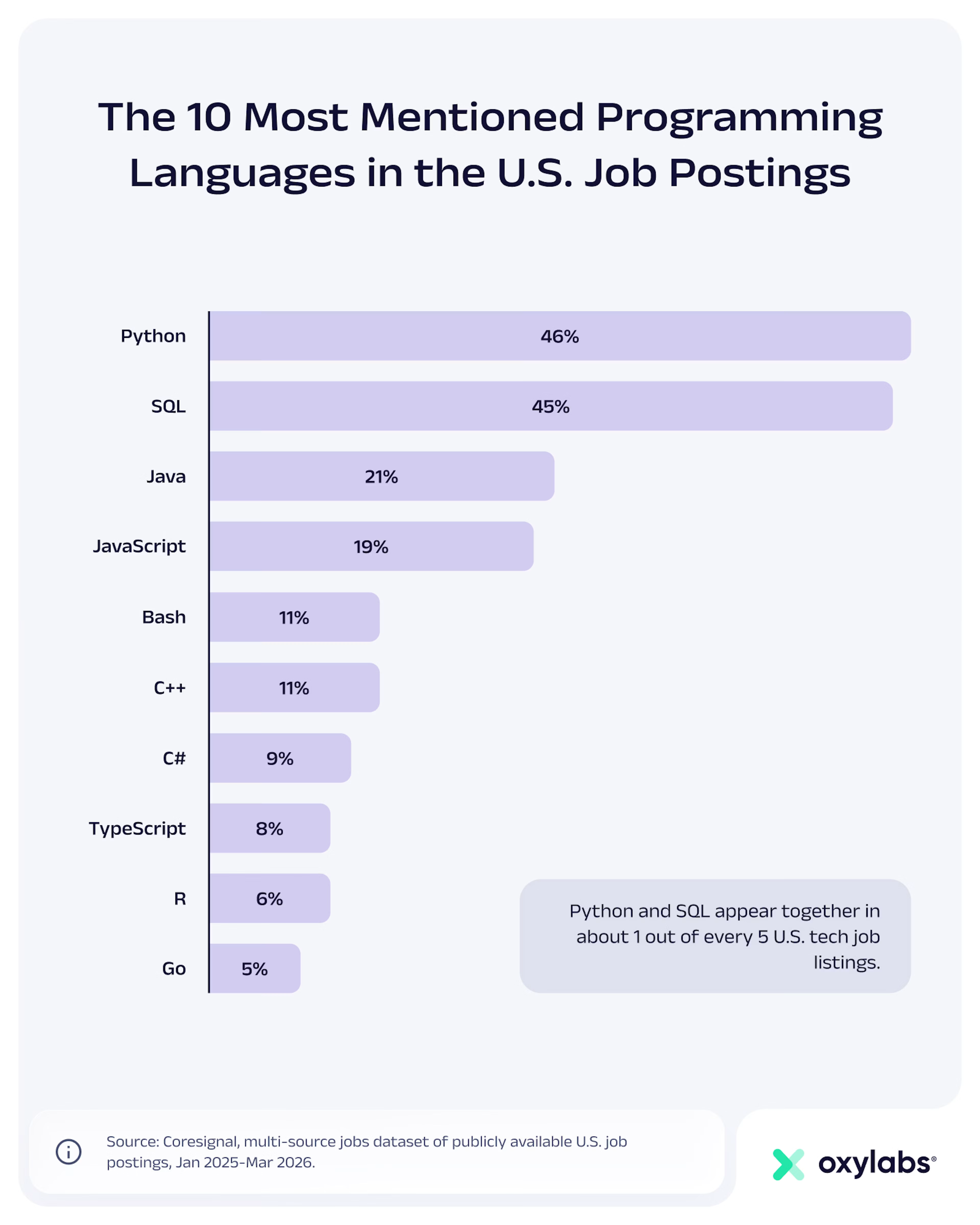
But it’s not the only top tech skill showing up in nearly half of today’s U.S. job postings. In our analysis, another programming language appears in roughly 45% of listings across roles, industries and regions – and it’s SQL.
Some surveys and search-based rankings tend to downplay SQL, and many developers don’t even think of it as a real programming language, so it can look less popular while Python gets all the attention. But when you look at real job postings at scale, you see what employers actually hire for. U.S. companies keep asking for SQL, mostly as the second must‑know programming language alongside another one, which shows its role as part of a broader stack.
Andrius Kūkšta, Tech Lead at Oxylabs
60% of job postings mention at least two programming languages.
Python and SQL appear together in about 21% of job postings, which is the strongest duo. SQL and Java are co-mentioned in 9% of job postings, and SQL and JavaScript have the same percentage.
Other SQL co-mentions with the rest of the programming languages range from 4% to 2%, but in our dataset, SQL never goes alone.
Individually, Python and SQL still form the most in-demand duo in U.S. tech job postings, and they are followed at about half the rate by Java, mentioned in 21% of postings, and JavaScript, at 19%.
The rest of the top 10 is rounded out by Bash and C++ (11% each), C# (9%), TypeScript (8%), R (6%) and Go (5%).
How Coding Requirements Are Distributed Across Tech Job Roles
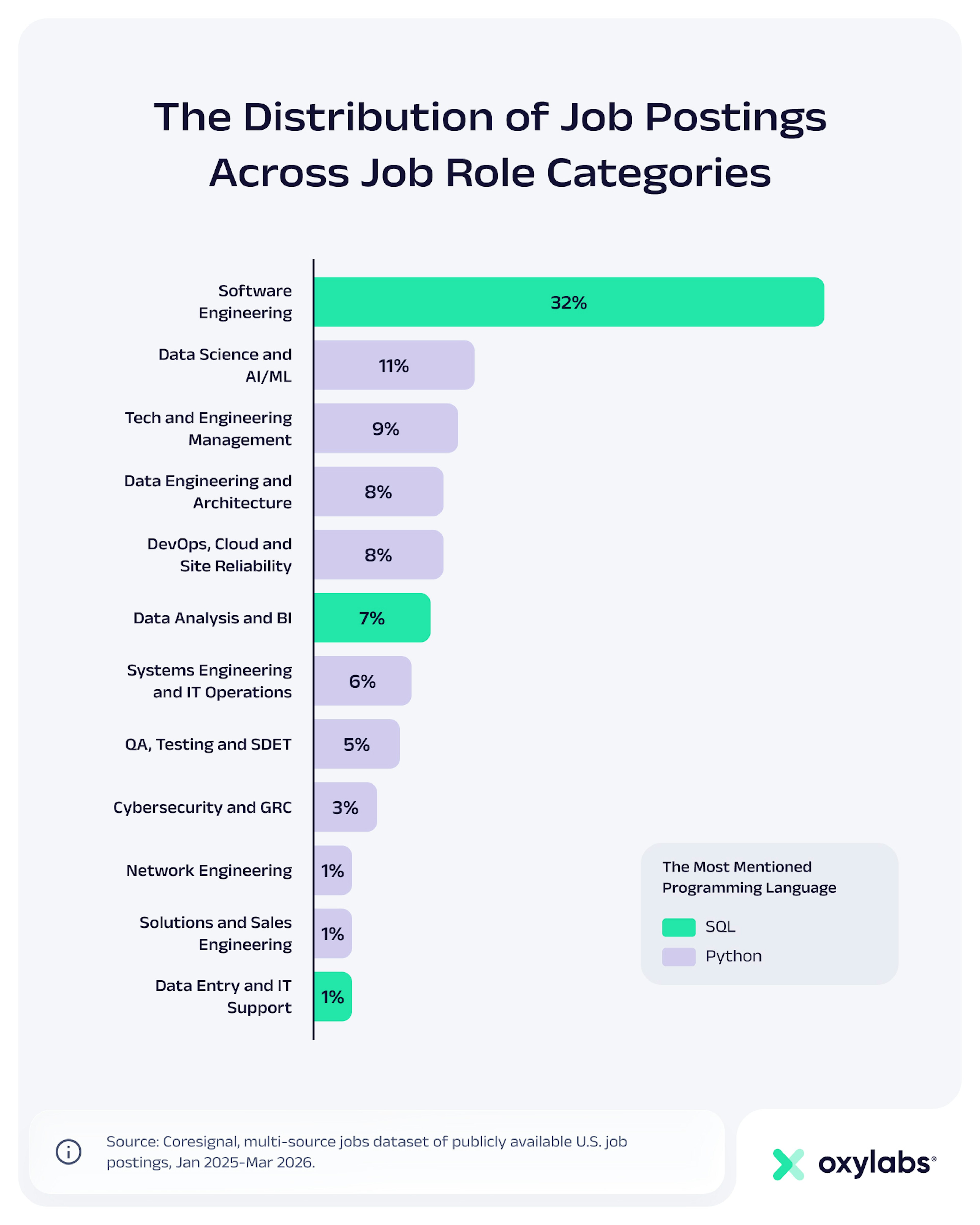
32% of job postings requiring at least one programming language are in software engineering, far outpacing data science and tech management (11%).
Not every job category mentions programming languages at the same frequency. Software engineering accounts for the largest share of postings that reference at least one programming language, at 32%.
The second and third spots go to data science and AI/ML roles (11%) and tech and engineering management (9%), which still mention programming much less often than core software roles.
The next tier of roles each makes up less than 10% of postings that require a programming language. These include DevOps, cloud and site reliability (8%), data engineering and architecture (8%), data analysis and BI (7%), systems engineering and IT operations (6%), QA, testing and SDET (5%), and cybersecurity and GRC (3%).
At the bottom of the list, data entry and IT support, solutions and sales engineering, and network engineering each account for just 1% of postings that ask for any of these programming languages.
Which Programming Languages Top the List in Each Major Tech Role Category?
Python is top one in eight tech role categories, while SQL and JavaScript dominate software engineering related jobs.
Looking at the top language within each role category, Python ranks first in eight of the analyzed roles, SQL in five, and JavaScript in two.
In software engineering – the role category with the highest share of postings mentioning at least one programming language – SQL appears in 42% of postings, which makes it the top language, followed by Python at 41% and Java at 38%.
Within software engineering sub-categories, the picture slightly changes. Backend development postings most often mention SQL (56%), frontend development is dominated by JavaScript (84%), and full stack roles also lean heavily on JavaScript (66%).
For job seekers, the message here is focus. General software engineering roles still expect you to work comfortably with data and databases, but once you pick a track the expectations narrow: backend roles reward strong database and server-side skills, while frontend and full stack jobs are built around JavaScript and the tools that sit on top of it.
Andrius Kūkšta, Tech Lead at Oxylabs
In addition to software engineering, SQL is also the most common language in postings for data engineering and architecture, data analysis and BI, and data entry and support roles.
Python leads in job postings for data science and AI/ML, DevOps, cloud and site reliability, cybersecurity and GRC, systems engineering and IT operations, network engineering, QA, testing and SDET, tech and engineering management, and solutions and sales engineering.
Python shows up across so many different job titles because it’s become the go-to language for automation and data work, not just classic software development. Whether you’re in data science, DevOps, security or even technical leadership, employers want people who can quickly script solutions, connect systems and make sense of data, and Python is the common toolkit for all of that.
Andrius Kūkšta, Tech Lead at Oxylabs
Which Industry Has the Biggest Share of Job Postings With Coding Requirements
43% of U.S. job ads requiring at least one programming language are in tech, data and telecom – the biggest share across the industries.
The largest share of job postings that require at least one programming language falls within the tech, data and telecom industry (43%). Professional, legal and business services rank second (17%), followed by manufacturing, industrial and defense (10%).
Finance, insurance and real estate rank fourth with 7%. No other industry exceeds 5%, including healthcare, pharma and wellness (3%), and education, government and non-profit with logistics, travel and construction having 2% each.
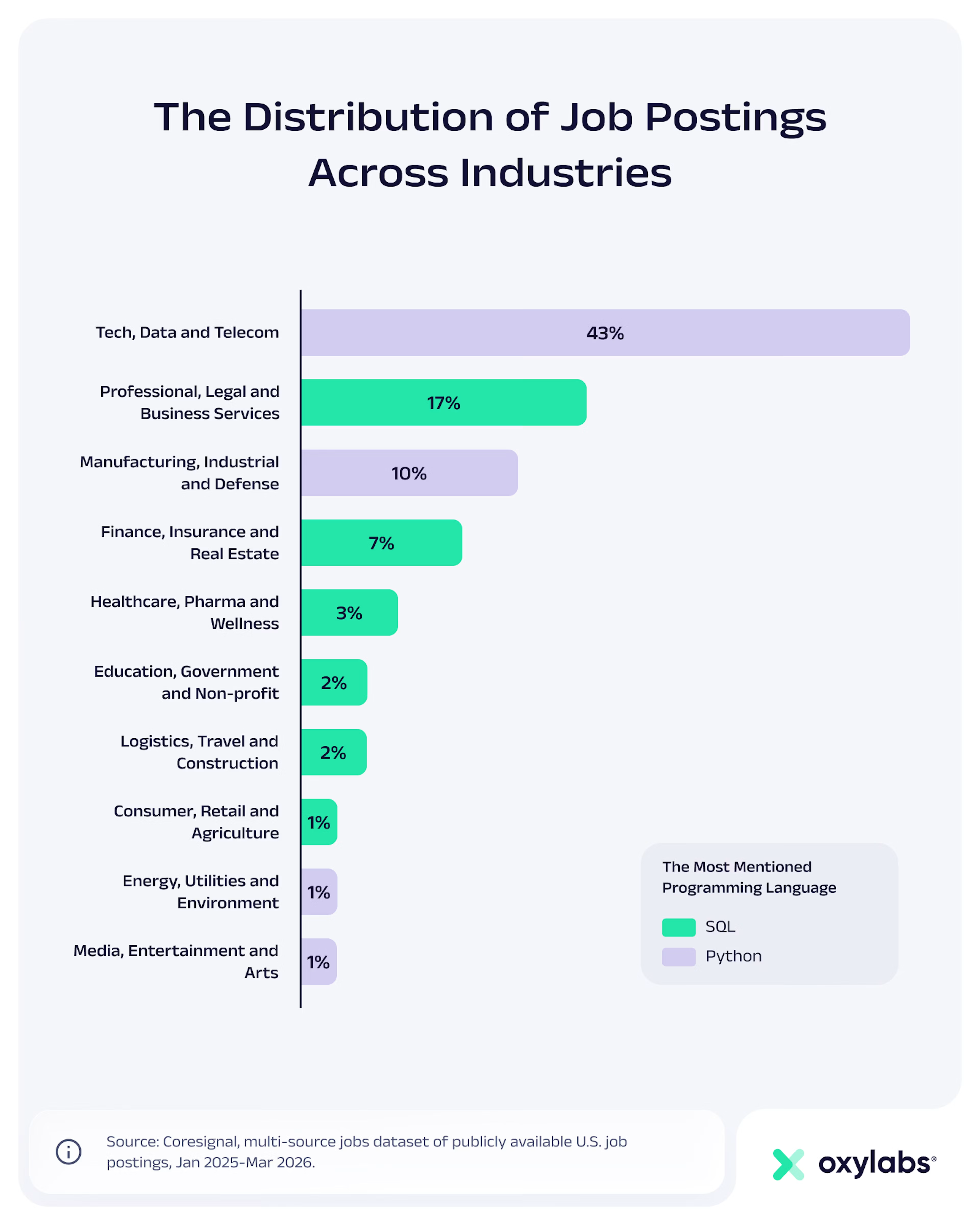
Almost half of all coding roles still sit inside tech and telecom, but the really interesting story is the other half. When professional services, manufacturing and finance together account for a huge slice of programming jobs, it means software skills aren’t chained to Silicon Valley. They’re becoming a passport you can use across the wider economy.
Andrius Kūkšta, Tech Lead at Oxylabs
What Are the Most Mentioned Programming Languages in Different Industries?
Python and SQL dominate as top programming languages across every major industry.
Looking at the top programming language within each industry category, Python ranks first in four of the analyzed industries and SQL in six.
Broadly, Python dominates in sectors focused on building new digital products and data capabilities, while SQL leads in fields driven by transactions, records, and reporting.
Python is the most mentioned programming language in tech, data and telecom (50% of job postings mention it), energy, utilities and environment (41%), manufacturing, industrial and defense (38%), and media, entertainment and arts (49%).
SQL is the top language in finance, insurance and real estate (62%), logistics, travel and construction (43%), professional, legal and business services (48%), education, government and non-profit (47%), consumer, retail and agriculture (62%), and healthcare, pharma and wellness (62%).
Across all industries, the second most mentioned programming language is either Python or SQL, depending on which one ranks first. In two industries, the gap between the top two is particularly salient.
In manufacturing, industrial and defense, Python appears in 38% of postings, compared with 22% for SQL – almost half as often. In healthcare, pharma and wellness, SQL is mentioned in 62% of postings, while Python appears in only 39%.
What our findings show is that industries don’t hire for programming in general – they rather have a native language. Product‑driven sectors speak Python, while transaction‑heavy sectors speak SQL. From a job seeker’s perspective, the primary language changes depending on whether you’re building new digital products or running the systems that keep the economy moving.
Andrius Kūkšta, Tech Lead at Oxylabs
The third most mentioned programming language varies in half of the analyzed industries, while the other five place JavaScript in third.
In every industry, the third‑ranked language is much less common than Python and SQL:
Tech, data and telecom – Java (25%)
Energy, utilities and environment – Matlab (8%)
Manufacturing, industrial and defense – C++ (19%)
Finance, insurance and real estate – Java (25%)
Logistics, travel and construction – JavaScript (11%)
Professional, legal and business services – Java (22%)
Education, government and non-profit – JavaScript (17%)
Consumer, retail and agriculture – JavaScript (16%)
Media, entertainment and arts – JavaScript (18%)
Healthcare, pharmaceuticals and wellness – JavaScript (14%)
Where in the U.S. Programming Skills Are Most in Demand
California tops all states for programming language job postings and favors Python, yet SQL is the most‑requested language in 38 states.
Not every U.S. state has the same demand for tech workers with coding skills. Within the top 15 states, the share of job postings in each state requiring at least one programming language varies widely, from 13% to 2%.
Unsurprisingly, California is the top state, with the largest share of job postings requiring at least one programming language (13%), followed by Texas (8%) and New York (5%).
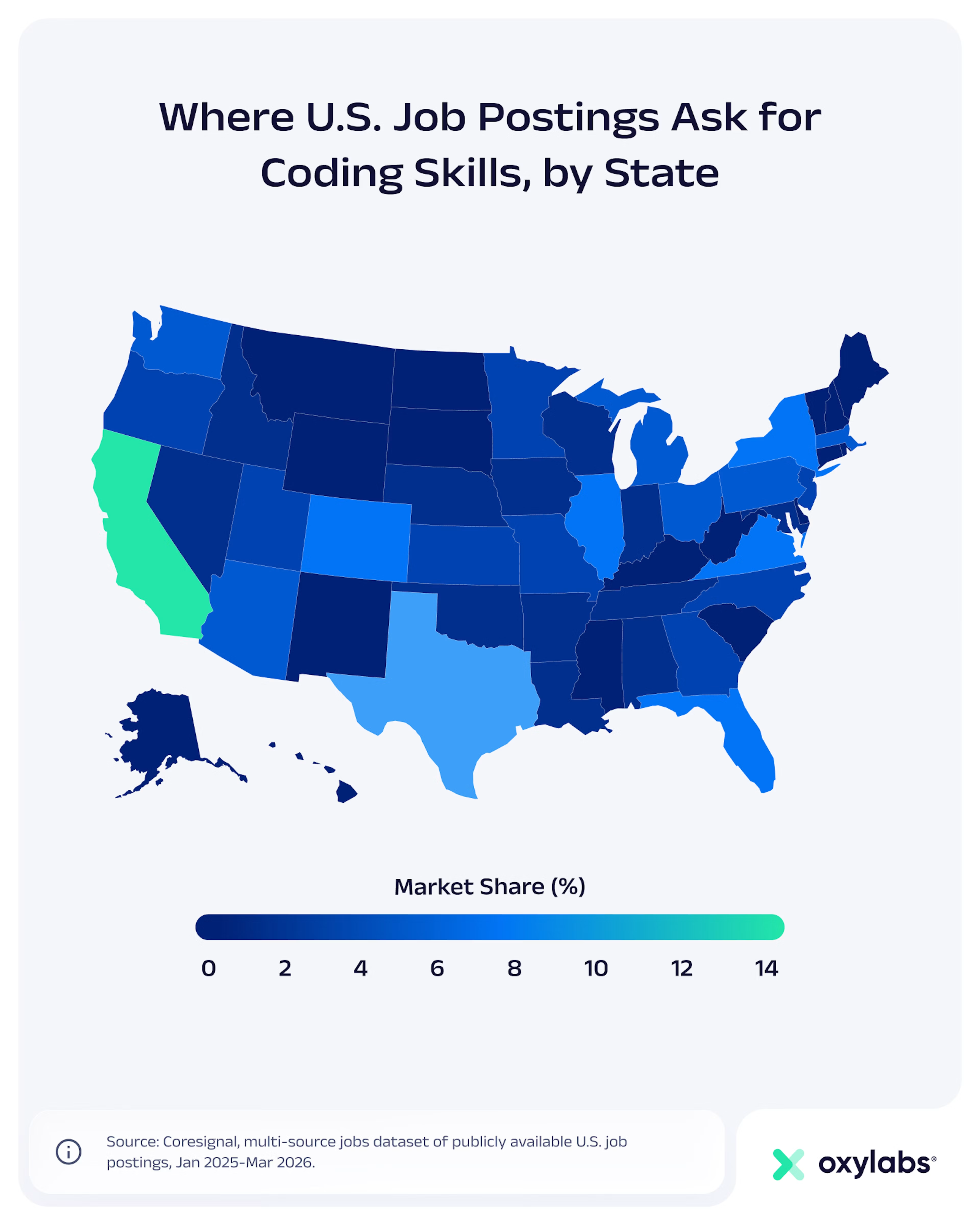
Virginia ranks fourth (4%), which goes against the pattern you would expect if you ranked states by population size. This can be attributed to the large number of data centers in Virginia: the state ranks second in the U.S. by data center count.
Six states – Florida, New Jersey, North Carolina, Illinois, Massachusetts, and Washington – each account for 3% of job postings requiring at least one programming language.
Five states – Georgia, Pennsylvania, Ohio, Colorado, and Michigan – each account for 2% of job postings requiring at least one programming language.
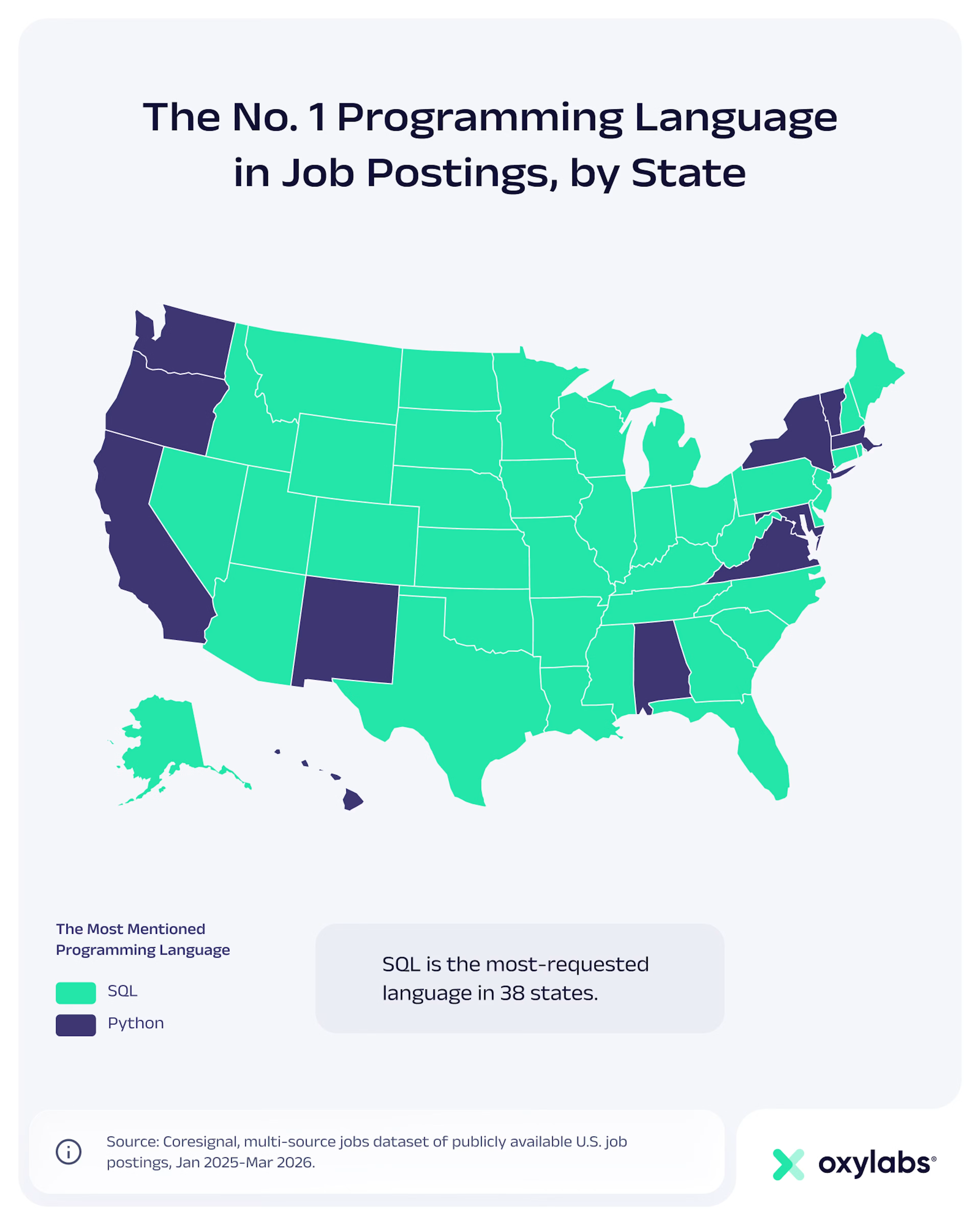
When it comes to the programming language most frequently mentioned in each state’s tech job postings, there is a clear winner. While Python is the most mentioned language in 12 states, including tech hubs such as California and New York, SQL is required more often than any other language in 38 states.
While Many Businesses Cut Jobs, Apple’s Hiring Peaks in 2026
Apple posted nine times more job ads in Q1 2026, than its 2025 average.
News outlets are reporting that many American companies are going through or planning major layoffs this year, but Apple is a notable exception. Our data show that Apple’s number of job postings remained fairly flat throughout 2025, then began to grow in December and jumped in the first quarter of 2026.
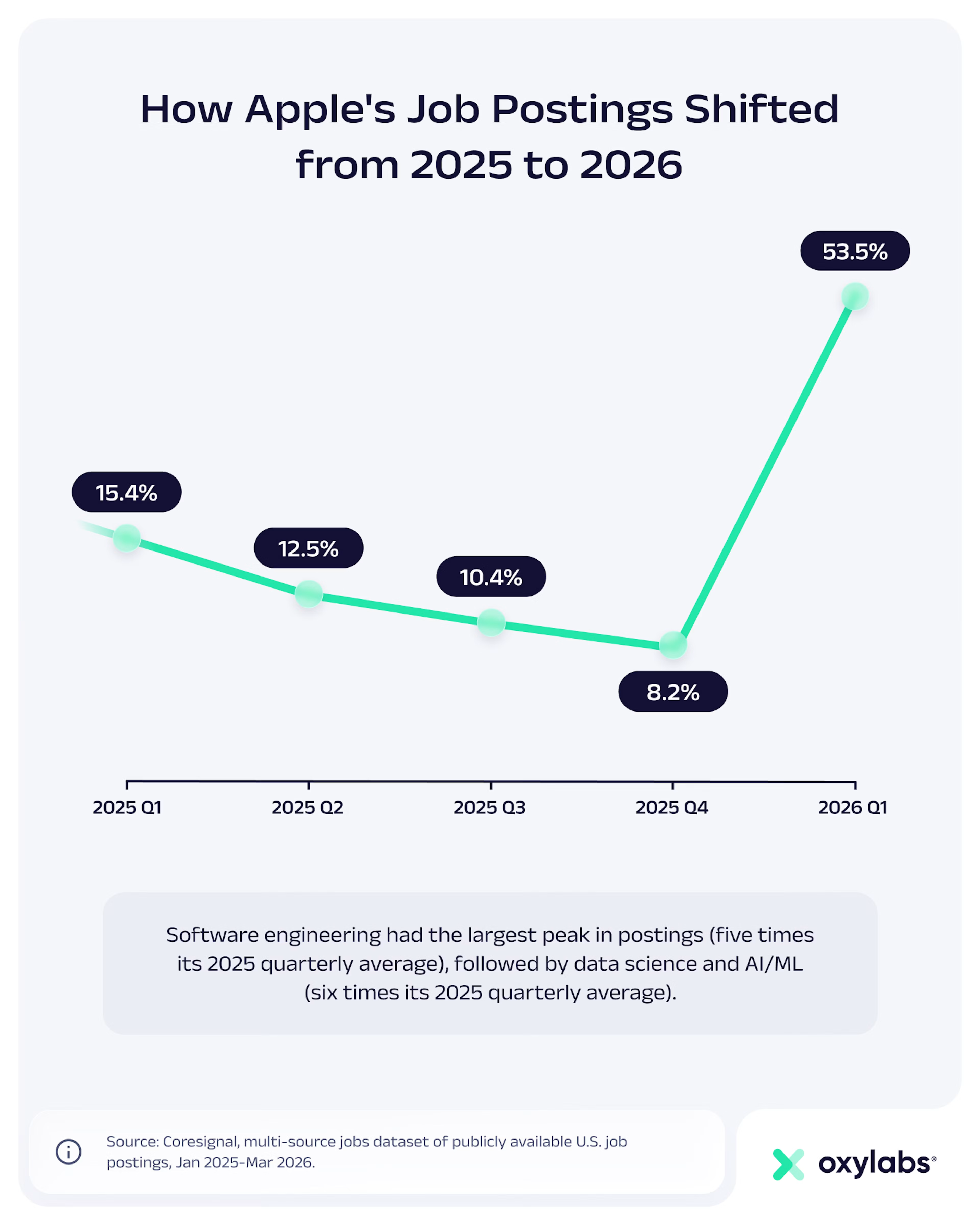
Of Apple’s job postings that require at least one programming language, 35.9% were posted in January 2026, followed by 9.8% in February and 7.8% in March 2026.
Throughout the analyzed period, Python was the most in‑demand language, and its mentions rose the fastest at the beginning of this year, reaching roughly twice the level of the company’s second most sought-after programming language, C++. During this peak, Java was the third most coveted language.
This shows that the tech job market isn’t frozen, but it’s becoming more selective. There are still good opportunities out there, but if you look for something new, you need to be sharper about what you learn and where you aim.
Andrius Kūkšta, Tech Lead at Oxylabs
By job role, the largest peak in job postings was in software engineering (five times its 2025 quarterly average), followed by data science and AI/ML (six times its 2025 quarterly average), which saw about half as many postings as software engineering.
The third‑highest peak was in DevOps, cloud, and site reliability (six times its 2025 quarterly average), closely followed by several other roles, including systems engineering and operations, data engineering and architecture, and cybersecurity and GRC.
Why U.S. Job Market Participants Should Care
Even U.S. employers from non-tech industries rely heavily on established coding skills, and the mix of skills they want varies by industry.
In today’s job market dominated by layoffs and uncertainty, this research offers a useful signal for workers and employers.
The report shows what employers are actually hiring for right now, not just what looks popular in surveys and online discussions. In the unstable job market, the skills that travel across industries are often the ones that create the most opportunities.
Employers are not just looking for one language or one narrow specialty – they want people who can pair Python, SQL, and other in-demand skills depending on the role.
The report also challenges a common idea that Python is the only programming language that matters. SQL appears at scale across many industries, including sectors that are often overlooked in tech coverage but employ large numbers of technical workers.
This means that coding skills are no longer just a tech-company issue. They are relevant across finance, manufacturing, healthcare and other parts of the economy, which has broader implications for where opportunities are growing and how workers can stay competitive.
The increasing mention of these programming languages in job ads across various industries is a clear sign that digitization has spread well beyond Silicon Valley.
Andrius Kūkšta, Tech Lead at Oxylabs
About the Expert
Andrius Kūkšta is a Tech Lead in the R&D team at Oxylabs. Over more than eight years there, he has progressed through roles including Analyst, Software Engineer, ML Engineer, Data Engineer, and R&D Engineer. He has contributed to several core products and is the author or co-author of five patents based on Oxylabs technologies. His work focuses on the latest AI and emerging technologies, translating trends into practical solutions. Outside of work, he is involved in sports analytics for the basketball club Žalgiris Kaunas.
Methodology
Data Source and Scope
The data comes from a multi-source jobs dataset provided by Coresignal, which aggregates online job postings. The analysis uses around 800,000 of U.S. job postings published between January 2025 and March 2026.
Each row in the dataset represents a job posting, not a hired person. One posting may correspond to several open positions.
Key Fields and How They Were Used
Each job posting contains 34–50 pieces of information (features). The most important for this report are:
Basic job information
title: the job’s title text (e.g., “Senior Data Engineer”).
company_name: the hiring company.
company_industry: the company’s industry as originally listed.
state: U.S. state or territory where the job is based.
created_at: the date and time when the job posting was collected.
Job categories (what kind of role it is) – the dataset includes binary flags indicating whether a job belongs to specific role groups, for example:
Software Engineering
Data Engineering and Architecture
Data Science & AI/ML
Data Analysis and BI
DevOps, Cloud & Site Reliability
Cybersecurity and GRC
Network Engineering
Systems Engineering and IT Operations
QA, Testing and SDET
Tech and Engineering Management
Solutions and Sales Engineering
Data Entry and IT Support
There are 18 categories in total. This report focuses mainly on the 12 that are clearly “tech” roles.
Programming language indicators.
For each of 22 programming languages, the dataset has a yes/no field (1 or 0) indicating whether that language is mentioned as a requirement in the job posting.
Clarification: HTML and CSS were deliberately excluded from the programming languages list. They are markup/style languages and do not contain logical control flow in the same way as full programming languages, so they were not counted in language rankings.
How Programming Languages Were Detected
Most languages were identified using straightforward keyword searches in job descriptions and related text.
However, some languages are also common English words or single letters (e.g., “Go”, “C”, “R”, “Assembly”).
To reduce false positives, for example “We go above and beyond” (not the Go language) or “Responsible for…” (not the “R” language), a large language model (LLM) (Ollama) was used to help decide whether such terms referred to the programming language or something else.
This step improves accuracy but is not perfect, which means some misclassifications inevitably remain.
Data Cleaning and Outlier Handling
Before counting anything, the dataset was cleaned to remove obvious errors and inconsistencies:
Removed or fixed clearly broken records (for example, missing essential fields or invalid dates).
Standardized state information and mapped it to cleaned state labels and two-letter state codes.
Grouped inconsistent or highly granular industry labels into broader, more readable “broad industry groups,” such as:
Tech, Data and Telecom
Finance, Insurance and Real Estate
Manufacturing, Industrial & Defense
Professional, Legal and Business Services
Healthcare, Pharma and Wellness
and others.
Reviewed unusually extreme values or anomalies (“outliers”).
How Jobs Were Categorized
Many job postings include vague or creative titles (“Rockstar Engineer”, “AI Ninja”) that do not map cleanly onto standard roles. To make analysis possible:
Job titles were mapped into 18 standardized categories (e.g., Software Engineering, Data Science and AI/ML, DevOps, etc.).
A single posting can belong to multiple categories if appropriate. For example, a role might be classified both as:
“Data Science and AI/ML” and
“Data Analysis and BI” if the description clearly covers both sets of responsibilities.
For software engineering roles, additional tags were created for:
Frontend development
Backend development
Full-stack development
This allowed separate analysis of language demand for, say, backend engineers versus frontend or full-stack engineers.
How Demand for Languages Was Measured
The central concept of “demand” in this report is: how often a language is mentioned as a requirement across job postings in a given dataset.
Concretely:
Overall share. For each language, the number of job postings with a “1” for that language flag was divided by the total number of analyzed postings. This gives a percentage, for example, “Python appears in 46% of job postings.”
By role (job category). To find out, for example, what percentage of data scientist roles require Python or SQL, within each role category, the same calculation was done:
Count of postings in that category that mention a given language
Divided by the total number of postings in that category
By industry. For each broad industry group, the share of postings that mention each language was computed. This reveals which languages dominate in sectors like finance versus healthcare or manufacturing.
By geography (state). For each state, the most frequently mentioned programming language was identified. The “most in-demand language by state” is simply the language that appears in the largest share of postings from that state.
Language co‑occurrence. To explore “tech stacks,” the analysis counted how often pairs of languages appear together in the same posting. Example: the percentage of all job postings that mention both Python and SQL.
All percentages are about postings, not people. They indicate how common a skill requirement is in job postings, not how many developers actually use a language.
Time Trends and Seasonality
To capture how demand changed over time:
Created_at dates were converted to calendar months.
The number of job postings per month was counted, and each month’s share of the total period (2025–2026 Q1) was calculated.
This allowed identification of hiring peaks (notably in early 2026) and comparison of language demand over time where appropriate.
How to Read the Results
When interpreting charts and percentages from this report, keep these points in mind:
Each percentage is “share of job postings,” not share of workers or companies.
A job can belong to more than one role category, and require more than one language. Therefore, category percentages do not add up to 100%.
Rankings show relative frequency in job ads, not judgments about which language is “better” or “more powerful.”
All insights are specific to the U.S. job postings from Q1 2025 to Q1 2026. They are not global figures.
Key Terms Used in this Research
Tech job – broadly defined as any role focused on building, maintaining, or supporting technology products and systems. While often associated with coding, the term encompasses a wide range of technical and non-technical roles across three main categories.
Job posting – one row in the dataset representing a single advertised role, regardless of how many people the company plans to hire into that role.
Programming language – a language used to write executable code with logical control flow, such as Python, SQL, Java, JavaScript, C++, C#, Go, R, Rust, etc. Markup and style languages like HTML and CSS are not counted as “programming languages” in this analysis and are excluded from language rankings.
Limitations: How Accurate Is this Analysis?
The analysis has several important limitations that readers should be aware of:
Incomplete coverage. The dataset does not include every job posting in the U.S. for the period. It is large and diverse, but still a sample of the total market.
Platform and company bias. Some companies and job boards are over‑represented (for example, “Jobs via Dice” alone accounts for a noticeable share of all postings). This can skew results toward certain types of roles or industries. Also, job board postings often can be duplicates of job postings published by employing companies. We removed duplicates when the same company posted the same job ad across different job boards around the same time. However, we did not remove recruiter postings.
Classification errors
Programming language detection, especially for ambiguous terms like “Go” or “R”, is improved using an LLM but still imperfect.
Job title categorization relies on algorithms and rules that can misclassify creative or unusual titles.
No salary or seniority weighting. Each posting counts equally, whether it is an entry‑level help desk job or a senior AI researcher role. The analysis does not adjust for pay levels, job seniority, or the number of positions behind each posting.
Close percentage. When language shares are very close (e.g., 45% vs 46%), small classification errors or sampling differences could change the ranking. The report emphasizes broad patterns rather than tiny numerical differences.
Timing and dating uncertainty. The database is updated monthly, and we use the update date as a proxy for when companies publish their job postings. As a result, there can be up to a one‑month discrepancy between the actual posting date and the date used in our analysis, which may introduce some noise in month‑to‑month comparisons.
Frequently asked questions
Which programming languages are most in demand in the U.S. job market right now?
Across recent approx. 800,000 U.S. tech job postings, the most in-demand programming languages are Python, SQL, Java, and JavaScript, and Bash.
Which programming languages are most in-demand for specific tech roles in the U.S.?
How does the demand for programming languages vary by U.S. state?
Forget about complex web scraping processes
Choose Oxylabs' advanced web intelligence collection solutions to gather real-time public data hassle-free.
About the author
Oxylabs Research
Data-driven Storytellers
Oxylabs Research is the research and storytelling team at Oxylabs. We use ethical, compliant Oxylabs scraping tools to collect only publicly available web data – never private, paywalled, or personal data – and turn it into clear, timely insights that help everyone make sense of a fast‑changing technological, economic, and social reality. Our work is designed to support original reporting and analysis by journalists and to serve the broader public good. If you’re working on a story or investigation and need reliable web data to back it up, get in touch at press@oxylabs.io.
All information on Oxylabs Blog is provided on an "as is" basis and for informational purposes only. We make no representation and disclaim all liability with respect to your use of any information contained on Oxylabs Blog or any third-party websites that may be linked therein. Before engaging in scraping activities of any kind you should consult your legal advisors and carefully read the particular website's terms of service or receive a scraping license.