
Project 4β Impact: How Debunk.org Revealed Scam Ads Impersonating Authorities Across Europe

Narmin Mammadova
Last updated on
2026-05-05
4 min read
Overview
In one of its latest investigations, Debunk.org examined a large-scale scam network operating across Europe. A long-standing partner of Oxylabs’ pro bono initiative Project 4β, Debunk.org is an independent research organization focused on disinformation, fraud, and online manipulation. The investigation uncovered campaigns impersonating Interpol, Europol, EU institutions, and national cyber police. The fraudulent ad campaign falsely promised compensation to victims of investment fraud while, in reality, directing them to deceptive websites designed to collect personal data and extract upfront fees.
These campaigns were not aimed at the general public. They specifically targeted people who had already lost money to fraudulent brokers, crypto schemes, or phone scams, those actively searching for ways to recover their funds, and individuals whose contact details may have been sold or shared by the original scammers. For people in this position, promises of “Interpol compensation” or “Europol-supervised confiscated funds” can feel less like a warning sign and more like a final chance to recover what they lost.
Using Oxylabs’ proxy infrastructure provided through Project 4β, Debunk.org analyzed the infrastructure behind the operation, traced recurring patterns across domains and landing pages, and documented how the scam adapted through multilingual targeting and rapid asset turnover. The investigation identified more than 50,000 ads, 459 domains, and over 1,100 related web pages, with an estimated reach of more than 52 million people across Europe.
The challenge
This was not a single scam page or isolated campaign. Debunk.org was tracking a coordinated online ecosystem built to scale, adapt quickly, and repeatedly target vulnerable individuals across multiple countries.
The operation impersonated trusted institutions while presenting itself as compensation funds, legal recovery services, and official victim databases. Its purpose was to exploit people who had already suffered losses from fraudulent investment schemes by luring them into a second wave of deception.
Investigating this kind of network is especially challenging because operators frequently rotate domains, redesign landing pages, relaunch ads in different languages, and replace assets quickly after takedowns. This makes manual monitoring difficult and limits the ability to connect scattered signals into a broader operational picture.
The web intelligence behind the investigation
Debunk.org combined Meta Ad Library data, OSINT techniques, and Oxylabs data collection solutions to systematically investigate the scam network at scale.
Using Oxylabs-supported data collection workflows, Debunk.org was able to gather and structure public web data across a wide set of campaign assets, including:
landing pages tied to scam ads;
domains used in refund-fraud funnels;
repeated design patterns and content templates;
multilingual variants of the same narratives;
signals of infrastructure reuse across apparently different “brands.”
Our assessment is that these scam operations are a massive systemic risk related to the Digital Services Act. It doesn’t matter how many times we report this illegal content and META takes it down - the next day, new scam pages and ads with Interpol and Europol scams will again appear on META platforms. From our analysis, it looks like META is not even trying to take steps to prevent this risk. If they did, we would not see new scams the next day with the same topic and principle mechanism.
Viktoras Daukšas, Head of Debunk.org
This approach helped Debunk.org move beyond isolated examples and investigate the campaigns as a coordinated cross-border ecosystem. It was particularly valuable in a case involving multiple languages, short-lived web assets, and rapidly changing scam infrastructure.
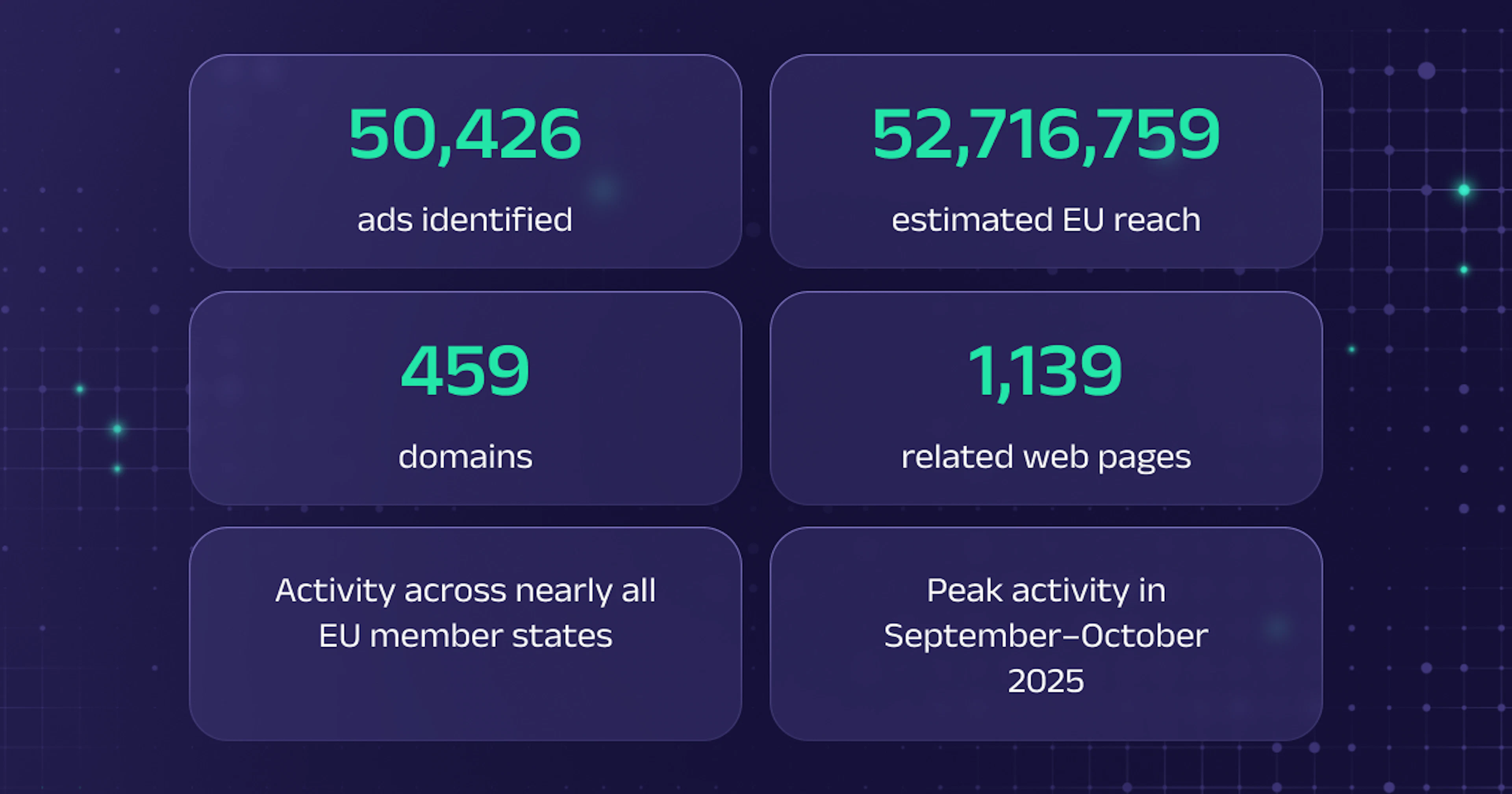
Debunk.org’s investigation revealed the scale and persistence of the operation
50,426 ads linked to the scam ecosystem
52,716,759 estimated EU reach
459 domains identified
1,139 related web pages tracked
campaigns operated across nearly all EU member states
activity peaked during September and October 2025
The most used languages are Russian, English and Polish
By ad count, the most used languages are Russian (~26.9k ads), English (~9.0k), Polish (~3.9k), Spanish (~1.2k), German (~1.2k), followed by Czech (944), Slovak (895), Italian (799), French (500), and others.
How the campaign evolved over time
Debunk.org’s analysis showed that the operation scaled in waves throughout the year. Activity gradually increased in the early months of 2025, surged in May, softened during the summer, and then reached its highest intensity in September and October before rebounding again in December.
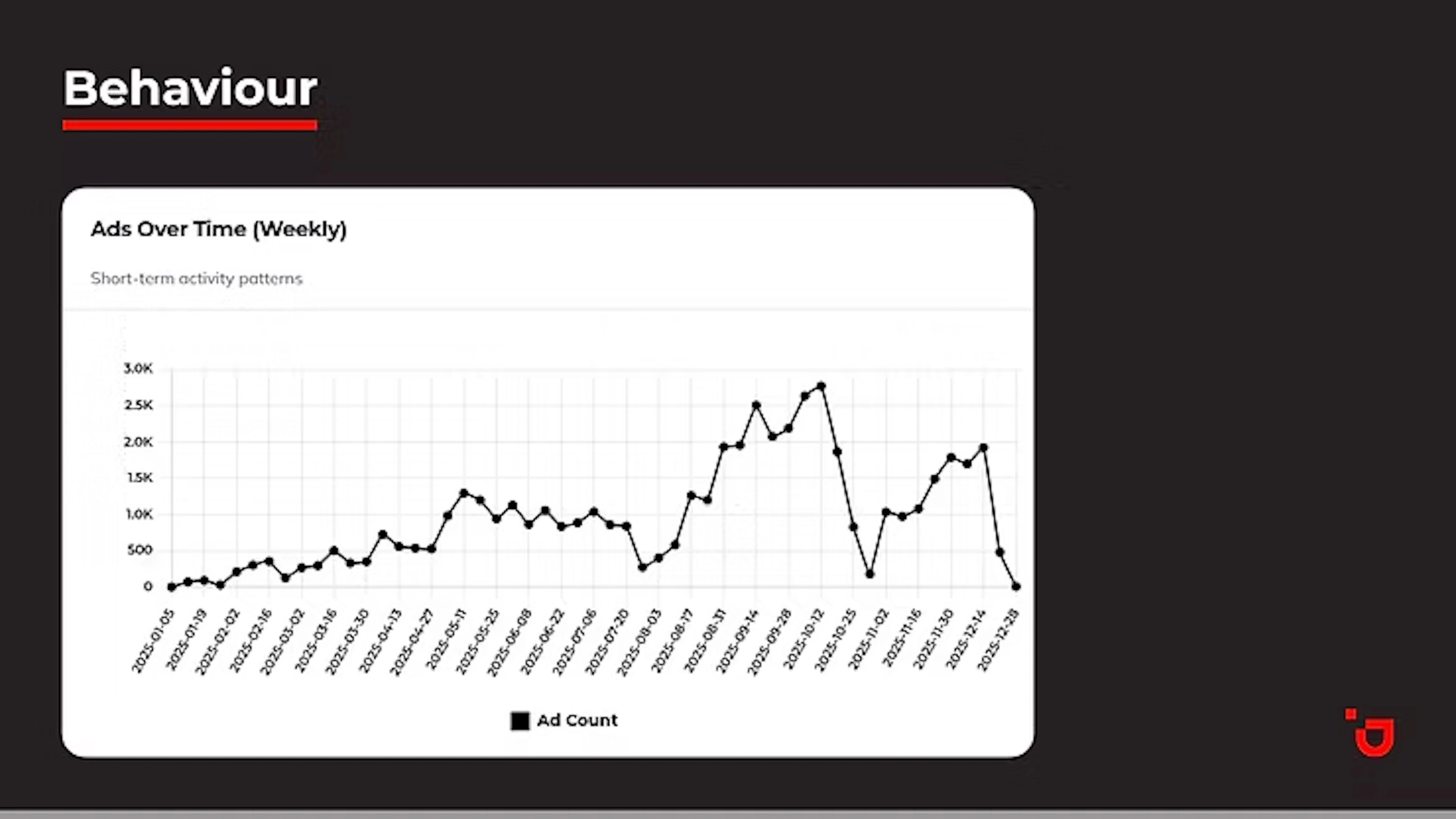
Ad activity grew over time, with the largest surge recorded in September and October 2025.
This pattern suggests a persistent and adaptive operation capable of rapidly relaunching pages, domains, and creatives in response to disruptions.
Multilingual targeting across Europe
The campaign was explicitly pan-European. Russian- and English-language ads accounted for the largest labeled volume and reach, while Polish, Spanish, German, Italian, French, Czech, Slovak, and other languages were also used to target victims across multiple jurisdictions.
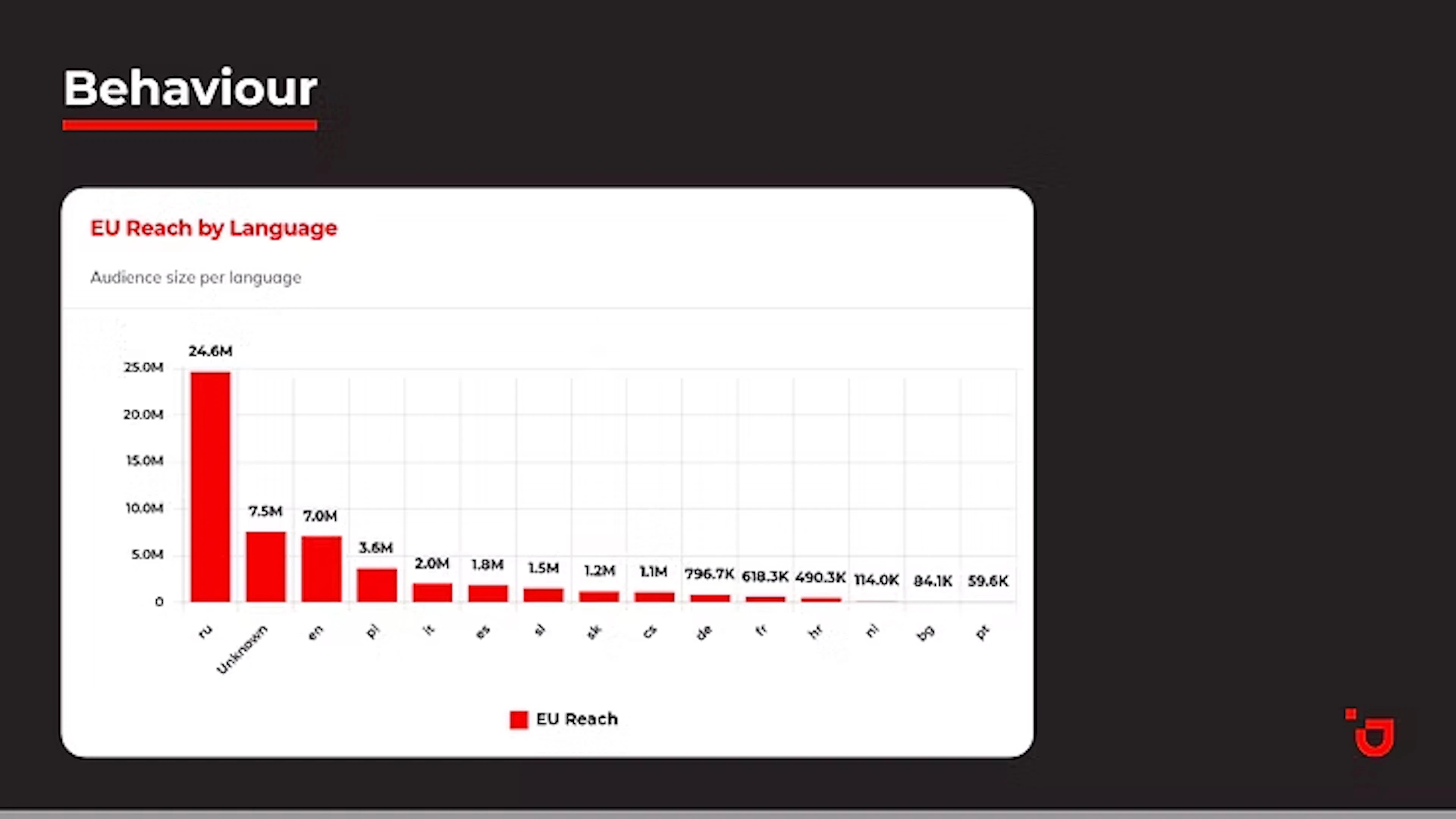
Russian- and English-language ads drove the largest labeled reach, alongside broad multilingual targeting across Europe.
This multilingual structure helped the operators reach vulnerable audiences across nearly all EU member states and maintain visibility among people actively searching for compensation or recovery options.
Visual evidence of impersonation
Debunk.org found that the scam ecosystem repeatedly reused official-looking layouts, institutional seals, police imagery, and law-enforcement language to create a false sense of legitimacy. Fake landing pages posed as Interpol, Europol, cyber police, legal recovery services, and victim compensation databases.
These deceptive design choices were central to the scam’s success, helping convince previous fraud victims to submit personal information and engage with fraudulent “recovery” processes.
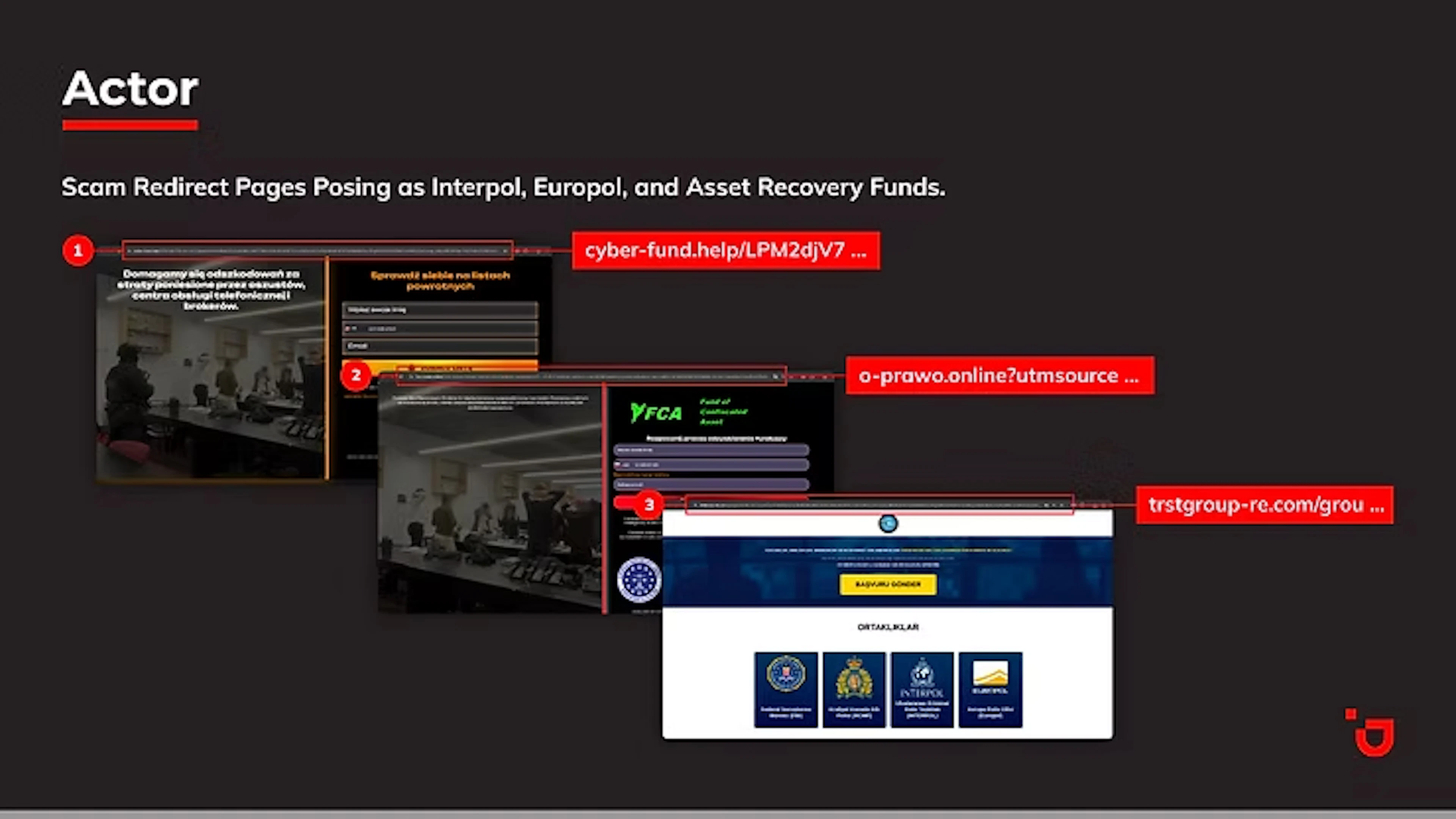
Examples of fraudulent landing pages impersonating law enforcement, public institutions, and compensation programs.
Why this matters
The findings show how online fraud actors use institutional impersonation, short-lived websites, and coordinated advertising tactics to exploit people who have already suffered financial losses. Rather than operating as isolated scams, these campaigns formed a persistent second-wave fraud ecosystem targeting victims of prior investment scams.
Beyond direct financial harm, this activity also erodes trust in legitimate institutions. When public authorities, regulators, and law enforcement are impersonated at scale, genuine recovery processes become harder to distinguish from fraud.
The case also underscores the limits of reactive enforcement. Although many tracked assets were eventually removed, the broader infrastructure was designed for rapid replacement, allowing the scam model to continue regenerating with minimal friction. You can read Debunk.org’s full investigation here.
This case shows why access to reliable web intelligence tools matters for public-interest investigations. Through Project 4β, Oxylabs supports organizations working to uncover digital threats and expose wrongdoing. To learn more, contact the team via the form or at 4beta@oxylabs.io.
Forget about complex web scraping processes
Choose Oxylabs' advanced web intelligence collection solutions to gather real-time public data hassle-free.
About the author
Narmin Mammadova
PR Content Manager
Narmin is the PR Content Manager for Project 4β at Oxylabs. She enjoys the challenge of getting people to care, and pro bono work gives her good stories to tell. In her spare time, she travels whenever possible or indulges her love of poetry and reciting.
All information on Oxylabs Blog is provided on an "as is" basis and for informational purposes only. We make no representation and disclaim all liability with respect to your use of any information contained on Oxylabs Blog or any third-party websites that may be linked therein. Before engaging in scraping activities of any kind you should consult your legal advisors and carefully read the particular website's terms of service or receive a scraping license.
Related articles


Oxylabs Launches IP Transparency Tool for Next-Level Visibility into Ethically-Sourced Residential Proxies

Vytautas Kirjazovas
2026-09-10


Get the latest news from data gathering world
Scale up your business with Oxylabs®
Forget about complex web scraping processes
Choose Oxylabs' advanced web intelligence collection solutions to gather real-time public data hassle-free.