
Reflections from the 2026 International Journalism Festival in Perugia

Narmin Mammadova
Last updated on
2026-05-07
4 min read
When Oxylabs’ Project 4β joined the International Journalism Festival in Perugia this year, one question seemed to sit behind many of the conversations: what does credible journalism need in order to work in today’s information environment?
Across discussions on investigations, fact-checking, AI, digital evidence, platform accountability, and disinformation, the same idea kept resurfacing. Public-interest journalism increasingly depends on the systems that help journalists gather, preserve, verify, and work with public digital information at scale.
Data - an essential part of the reporting process
Many important investigations no longer begin with a single document, source, or example. They often start with scattered public digital traces that need to be collected, filtered, compared, and turned into credible evidence.
This was especially clear in conversations about platform accountability and citizen-powered investigations. Journalists are increasingly trying to understand how wider systems work — from recommendation algorithms to coordinated influence campaigns. That requires the ability to identify patterns across large volumes of public information.
The Washington Post’s TikTok investigation was one example of this shift, relying on user-donated data at scale to explore how recommendation systems may shape behavior. Similar challenges are evident in investigative and cross-border journalism, where the task is often not finding a single piece of evidence but building a reliable body of evidence from many fragments.
That is increasingly true for the kind of work done by organizations such as ICIJ, Follow the Money, and the Pulitzer Center, and it is one of the clearest reasons why support structures like Project 4β are becoming more relevant.
Verification now depends on preservation
Another major theme in Perugia was verification. Many discussions touched on how synthetic media, manipulated content, and fast-moving online narratives are making evidence harder to assess. But the key takeaway was not that truth has become impossible to establish—the standard for proving it has become higher.
Tools can help, but method matters more. Journalists need to know where the material came from, whether it was preserved, what context surrounds it, and how clearly the reporting process can be explained.
That is why archiving came up so often. If online content can be edited, deleted, or stripped of context, preserving it early becomes part of the reporting process itself.
Bellingcat’s Auto Archiver is a strong example. Through the Project 4β partnership with Bellingcat, Oxylabs' infrastructure supports the archiving of user-generated online content relevant to open-source investigations, accountability work, and researcher safety. In practical terms, this helps ensure that important digital evidence does not disappear before it can be investigated.
Open-source methods are now mainstream
Perugia also showed how far open-source methods have moved into everyday journalistic work. Geolocation, chronolocation, archive checks, timeline reconstruction, and source verification are no longer niche skills used only by specialist teams. They are becoming normal parts of how many investigations are built.
Editorial judgment remains essential. But many investigations now also require technical capacity: the ability to collect digital evidence systematically, preserve it, compare it, and make the process transparent.
The information environment is getting harder to monitor
Another strong takeaway from Perugia was that journalism is now operating in a more crowded, manipulated, and difficult information environment.
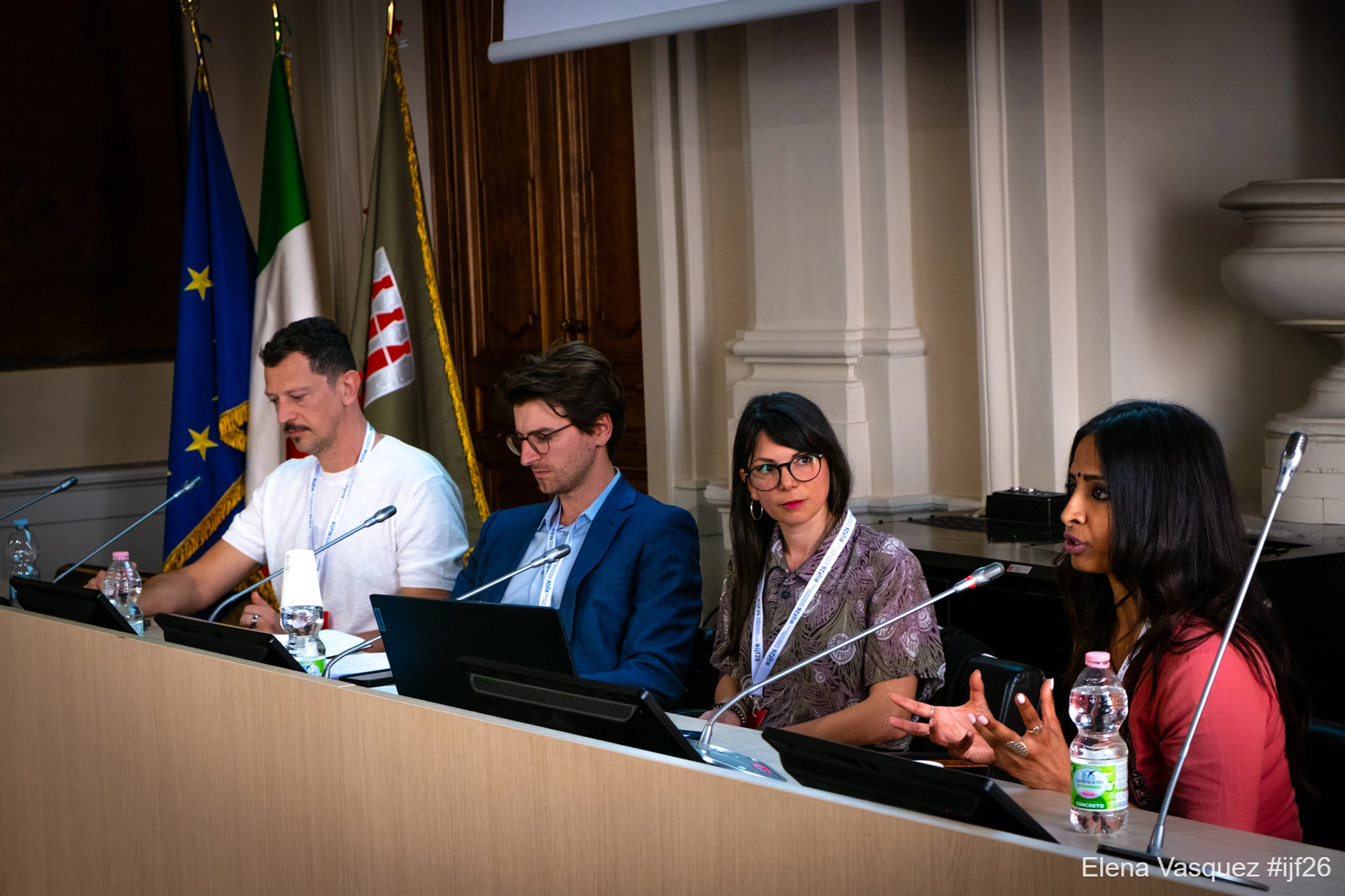
Cecilia Anesi, Peter Matjasic, Preethi Nallu, and Ryan Powell speak at Perugia International Journalism Festival 2026. Credit: Elena Vasquez
This concern ran through discussions about disinformation, online pressure, and the erosion of trust. The issue is not simply that false information exists, but that it spreads through systems that often reward speed, volume, outrage, and repetition more than credibility. In this environment, journalism is not only competing with falsehood - it is also working against the design of the systems through which information now travels.
That is why monitoring and analysis are becoming increasingly important. Organizations working on disinformation and information threats need to analyze large volumes of public content across social platforms, websites, and news sources to identify patterns. They often need to do this quickly and across many contexts at once.
This need is reflected across several Project 4β partnerships. Organizations including Debunk.org, Doublethink Lab, and CeMAS use publicly available web data to investigate disinformation, hate speech, coordinated influence campaigns, and broader information threats.
These examples show that public web data is not only relevant to investigative journalism. It is also essential to understand how information is shaped, distorted, and weaponized.
AI makes the method even more important
AI was present across the festival program, but the strongest discussions did not treat it only as a newsroom tool. The more important question was how AI is changing the wider environment around journalism.
Generative systems can produce convincing text, images, audio, and video quickly. They can repackage information without context, flood online spaces with synthetic material, and make evidence harder to assess.
In that setting, what matters most is not adopting new tools for their own sake, but maintaining strong methods. That is why so many conversations in Perugia kept returning to the same ideas: evidence, transparency, verification, and traceability. When the environment becomes noisier, the value of disciplined reporting methods becomes even greater.
Wrapping up
The wider lesson from Perugia is that journalism now depends much more on the infrastructure around it than it once did. Reporting remains central, but it increasingly relies on systems that enable journalists and public-interest organizations to gather public information, preserve it, verify it, and work with data at scale. Access to data is becoming just as important because, without it, many significant stories are not only harder to report but harder to investigate properly in the first place.
Through Project 4β, Oxylabs works with journalists, researchers, NGOs, public initiatives, and mission-driven organizations that rely on public web data for public-interest work. In some cases, that means strengthening investigative journalism directly. In others, it means helping organizations detect harmful content, map disinformation, monitor manipulation, or build tools that strengthen accountability.
What I took away from Perugia is that credible journalism today needs the infrastructure, tools, and partnerships that make evidence easier to gather, preserve, and verify. Through Project 4β, we want to support exactly that kind of work — giving public-interest organizations better access to public web data so they can investigate, collaborate, and build work that strengthens the public information space.
Gabija Birgile, Project 4β Manager at Oxylabs
Perugia made clear that these are no longer secondary concerns. They are becoming part of the essential conditions on which credible journalism now rests. The strength of reporting increasingly depends on the strength of the systems that support it.
Forget about complex web scraping processes
Choose Oxylabs' advanced web intelligence collection solutions to gather real-time public data hassle-free.
About the author
Narmin Mammadova
PR Content Manager
Narmin is the PR Content Manager for Project 4β at Oxylabs. She enjoys the challenge of getting people to care, and pro bono work gives her good stories to tell. In her spare time, she travels whenever possible or indulges her love of poetry and reciting.
All information on Oxylabs Blog is provided on an "as is" basis and for informational purposes only. We make no representation and disclaim all liability with respect to your use of any information contained on Oxylabs Blog or any third-party websites that may be linked therein. Before engaging in scraping activities of any kind you should consult your legal advisors and carefully read the particular website's terms of service or receive a scraping license.
Related articles

One API to Get Fresh Web Data: Introducing Oxylabs Web API

Shinthiya Nowsain Promi
2026-10-14


Oxylabs Launches IP Transparency Tool for Next-Level Visibility into Ethically-Sourced Residential Proxies

Vytautas Kirjazovas
2026-09-10

Get the latest news from data gathering world
Scale up your business with Oxylabs®
Forget about complex web scraping processes
Choose Oxylabs' advanced web intelligence collection solutions to gather real-time public data hassle-free.